Why the Meta-Age T-shirt is less about age than identity, participation and the quiet tribal signals we wear without thinking.
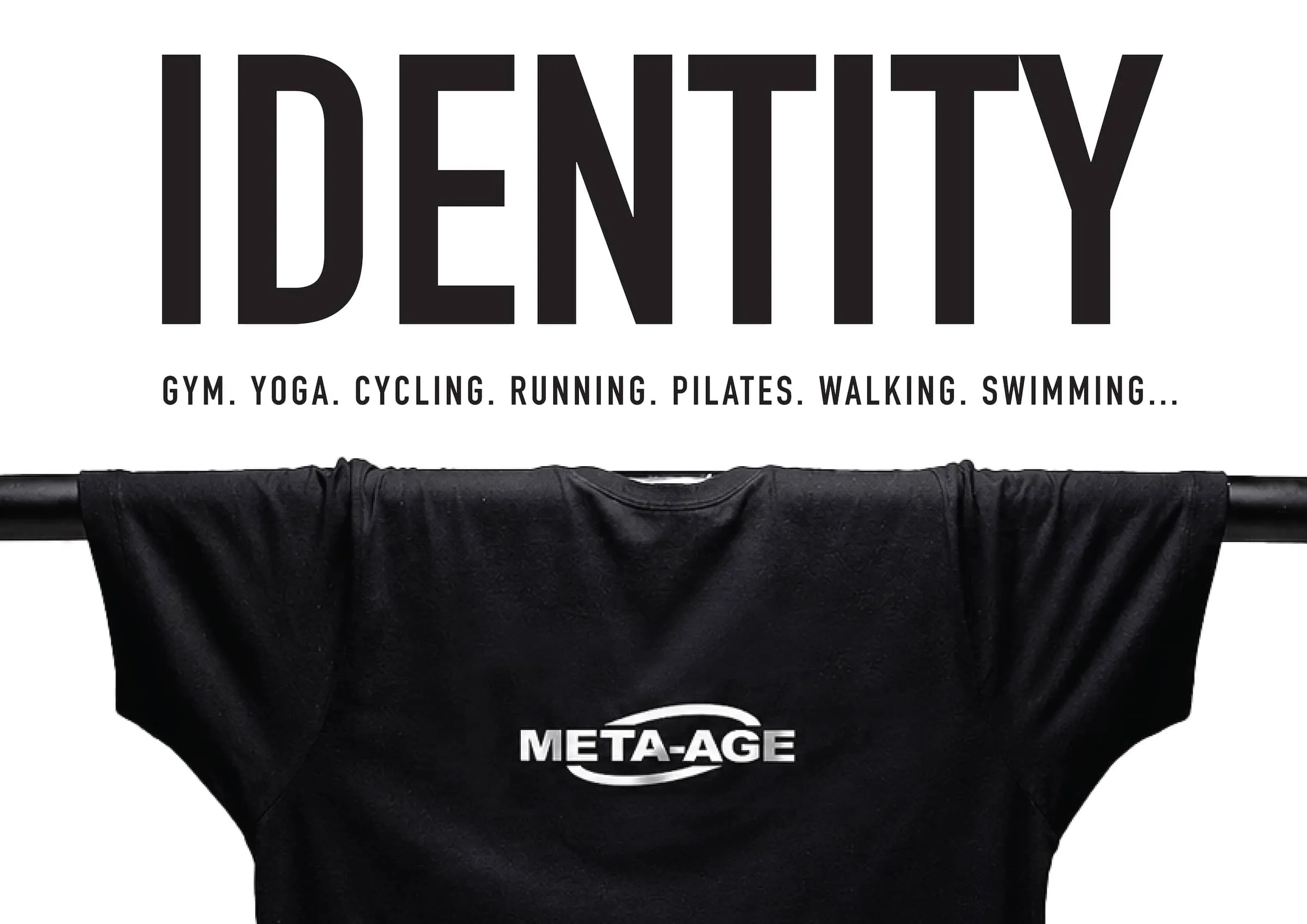
The poster, nothing elaborate. No bold graphics, no ironic slogan, no fleeting reference to the meme of the moment. Just a simple design, clean and deliberate.
Above the tee, a single word: IDENTITY. Beneath it, a list: GYM. YOGA. CYCLING. RUNNING. PILATES. WALKING. SWIMMING… And suspended below them, hanging from a bar as if waiting to be claimed, a black Meta-Age T-shirt.
Look at the image for a moment and something begins to emerge. Those words are not really about exercise. They are about tribes.
Ask someone what they do and they will often tell you, “I’m a runner.” Not, “I occasionally run.” I’m a runner. Another person is a cyclist. A swimmer. A yogi. A gym person. The activity has ceased to be merely something they do; it has become part of who they are.
Psychologists have been mapping this terrain for decades. Social identity theory proposes that a significant portion of our self-concept derives from the groups to which we believe we belong. Group membership is not merely external; it becomes woven into the fabric of the self.
Which brings us, unexpectedly, to rock bands. Consider the band T-shirt. Millions of people wear shirts bearing the names of musicians they have never met. Many were not even born when the music was recorded. A teenager can walk past you wearing a Led Zeppelin T-shirt, despite the surviving members being generations older. And yet it does not seem strange.
Why? Because the teenager is not claiming to have been at Madison Square Garden in 1973. The shirt is saying something else: This is part of who I am. The music has escaped its generation. The T-shirt has become a symbol.
Fashion has long understood this dynamic. Music merchandise operates not merely as a souvenir of an event attended, but as a declaration of taste, affiliation and identity. Research into sports fandom reveals something similar: the stronger our identification with a team, the greater our intention to buy and wear its colours.
And that is where this apparently simple Meta-Age T-shirt becomes interesting. Because ageing has, for decades, been marketed in almost exactly the opposite way.
We divide people. Products for the young. Products for the middle-aged. Products for seniors. Over-50s. Over-60s. “Active ageing.” “Healthy ageing.” Every label reminds you which demographic box somebody has decided you occupy.
But look at that poster again. There is no age on it.
Imagine a 28-year-old runner, a 47-year-old Pilates devotee and a 72-year-old cyclist wearing the same Meta-Age T-shirt. Nobody needs to explain their age. Nobody needs to pretend to be younger. Nobody is congratulated for being “amazing for their age.” They recognise something in each other that has nothing to do with the number on their birth certificate.
They participate. That is the tribe.
And human beings possess a powerful appetite for belonging. Our social relationships and group identities contribute profoundly to how we understand ourselves. Shared experiences strengthen the connection between individual and group identity.
Perhaps that is why clothes can carry so much meaning. A football shirt. A university sweatshirt. A band tee. They can turn a stranger into someone you recognise. You see the shirt across an airport lounge, in a café, on a train or cycling past you. A glance. A nod. You’re one of us.
And this is where the Meta-Age T-shirt does something rather clever. It doesn’t ask us to be the same age. It doesn’t even ask us to do the same thing. Run. Swim. Walk. Lift weights. Practise yoga. Ride a bicycle. Learn something. Make something. Go somewhere.
The activity is not the point. Participation is.
Perhaps that is also why Meta-Age is occasionally mistaken for the name of a rock band. Maybe that’s not such a bad comparison. Not because it makes music, but because a great band can give people something larger than themselves to belong to — and somehow, decades later, a kid can pull on the T-shirt and say: This means something to me too.
And perhaps that is the real idea hanging from the bar in the Meta-Age poster. Not an ageing uniform. Not a badge announcing how old you are. A quiet signal that says: I’m participating.
And when someone else wearing one walks past? A glance. A nod. No explanation required.
We’re in.