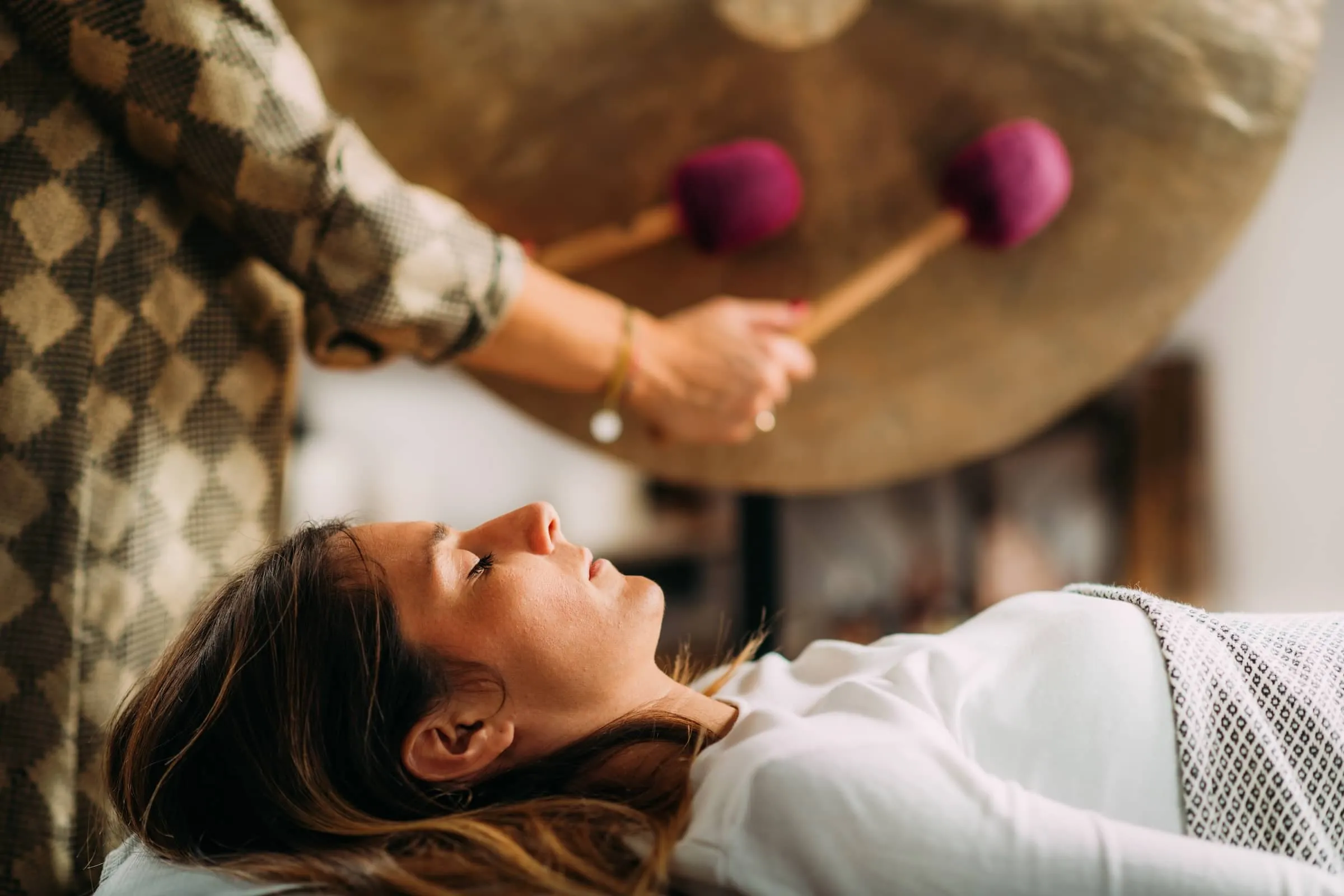
What is a sound bath? Discover how gong and singing bowl sessions work, their potential benefits, what the science says and what to expect.
If you have wondered what a sound bath is, the first useful thing to know is that no water is involved.
Instead, participants usually lie down while gongs, singing bowls, chimes and other instruments create overlapping waves of sound. It sits somewhere between meditation, deep listening and structured rest — which may explain why it is finding an audience among people thoroughly exhausted by wellness telling them to work harder at relaxing.
Modern wellbeing has acquired an impressive quantity of administration.
Sleep is scored. Steps are counted. Heart-rate variability is monitored. Exercise recovery can be plotted, compared and fretted over before breakfast. Technology has made useful information available to almost anyone, but it has also produced the peculiar possibility of failing at rest.
Against that background, the sound bath has an obvious attraction: there is remarkably little to do.
What actually happens during a sound bath?
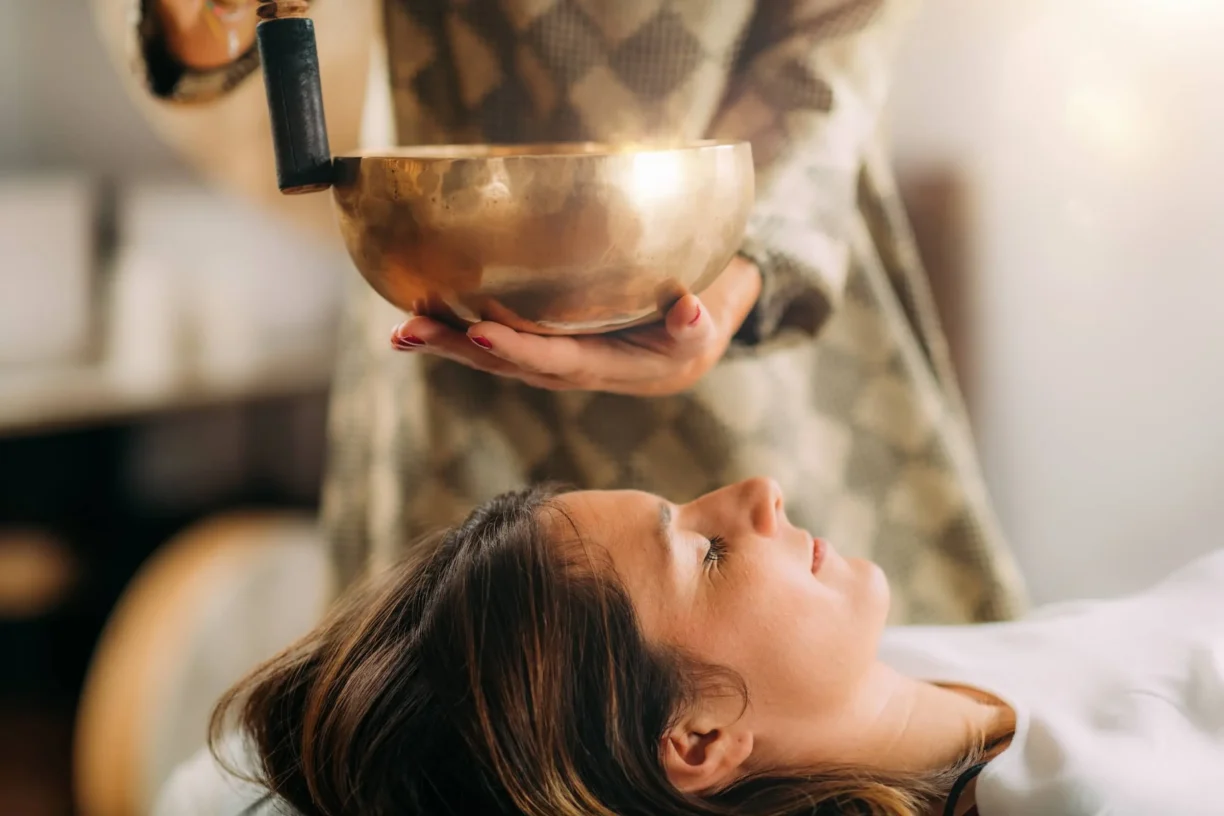
Most sound bath sessions take place with participants lying down, often in savasana or another comfortable supported position. Eyes are generally closed, although there is no prize for doing so particularly convincingly.
A practitioner then uses instruments such as gongs, crystal singing bowls, chimes and percussion to produce sustained sounds that build, overlap and fade.
Unlike conventional music, there may be no melody to follow and no obvious rhythm demanding attention. Instead, the listener hears layers of vibration and resonance changing around the room.
That distinction is important.
The intention is not simply to provide pleasant background music. A sustained gong or singing bowl produces complex tones and overtones that evolve as the sound decays. One vibration may still be lingering as another begins, so the acoustic environment never remains entirely static.
For somebody attempting meditation, that can give the mind a useful point of focus without requiring much effort.
Why sound baths can feel physical as well as relaxing
Sound is not experienced solely through the ears.
Low frequencies and powerful sustained tones can create vibrations that some participants perceive physically, particularly when large gongs are used in enclosed spaces. That does not require any exotic explanation; sound is vibration, and sufficiently strong low-frequency energy can be felt as well as heard.
The room itself also affects the experience.
Hard surfaces, room size and the position of the instruments can change how tones resonate and overlap. Silence is often used deliberately too, rather than every second being filled with noise.
Those quiet gaps can be surprisingly noticeable.
We spend much of the day surrounded by alerts, conversation, traffic, music, screens and assorted electronic objects determined to attract our attention. A period in which sound appears slowly and then disappears can therefore feel unusually stark.
Apparently, silence now needs scheduling.
What are the claimed benefits of a sound bath?
Sound baths are frequently associated with relaxation, reduced stress, better mood and improved sleep.
Those claims require some care.
Research into music, meditation and sound-based relaxation is broader than research into the specific modern practice commonly described as a sound bath. There is scientific interest in how auditory stimulation, meditation and relaxation practices may affect stress and wellbeing, but evidence for specific health outcomes from sound baths remains developing.
A sound bath should therefore not be presented as treatment for insomnia, anxiety, depression, chronic pain or any other medical condition.
That does not make the experience pointless.
There is a much simpler proposition available. Spending a defined period lying comfortably, reducing external distractions and concentrating on sound may help some people feel calmer. Not every useful wellbeing practice requires a heroic clinical claim attached to it.
The sensible distinction is between feeling relaxed after an experience and claiming that experience can diagnose, prevent or treat illness.
Those are very different things.
How is a sound bath different from meditation?
There is considerable overlap.
Traditional meditation practices may ask participants to concentrate on breathing, bodily sensations, a mantra or simply the movement of attention itself. A sound bath provides an external object of concentration.
For some people, that may be easier.
Trying to sit quietly while watching one’s own thoughts can initially feel less like serene contemplation and more like accidentally opening 38 browser tabs at once. Sound provides something concrete to return attention to whenever the mind wanders.
It is also generally passive.
There is no complicated technique to learn, no required level of fitness and usually no performance measure. That makes sound baths accessible to people who find more structured forms of meditation intimidating or simply tedious.
Whether they subsequently find a large gong more agreeable is another question, and highly personal.
Why are sound baths becoming more mainstream?
Their growing visibility fits neatly into a wider change in wellness culture.
For much of the past decade, wellbeing has increasingly been framed around optimisation: better sleep, better training, better nutrition, better recovery and, preferably, a device capable of assigning all of it a percentage.
There are obvious benefits to measurement. Athletes in particular can make valuable decisions using training and recovery data.
But recreational wellbeing does not always require the methods of an Olympic performance laboratory.
The appeal of sound baths may partly lie in their refusal to provide another number.
There is no personal best. No distance covered. No leaderboard. Nobody hands you a graph afterwards explaining that your gong performance deteriorated badly in the final quarter.
For people already surrounded by data, that absence can be refreshing.
Where can you try a sound bath?
Sound baths, gong baths and similar sound-meditation sessions are now offered in yoga studios, wellness centres, spas, retreats and increasingly in mainstream hospitality venues.
One example is Rockwater Branksome, which is holding a 90-minute Gong Bath on Monday 24 August at 7 pm as part of its coastal wellness programme. The company also operates a venue in Hove.
The Branksome session illustrates how far the format has travelled from its association with specialist retreats. Sound-based meditation is increasingly appearing alongside more familiar yoga, fitness and recovery offerings.
Anyone considering a session should check practical details beforehand. Length, instruments, group size and setting can differ considerably between practitioners.
People who are particularly sensitive to loud sound, have hearing concerns or have a medical condition that might make participation uncomfortable should seek appropriate advice rather than assuming every wellness activity is automatically suitable.
Are sound baths worth trying?
That depends largely on what you expect from one.
Go in expecting a medical cure and the evidence does not support the proposition.
Go in expecting 60 or 90 minutes in which you can lie still, listen closely and briefly stop managing your wellbeing like a quarterly performance review, and the idea becomes considerably easier to understand.
Sound baths are interesting partly because they run against the prevailing direction of fitness culture. Exercise asks the body to perform. Training asks it to adapt. Tracking asks it to produce data.
A sound bath asks almost nothing.
For an increasingly over-measured population, that may be precisely the point.