A million Brits now play padel. The science on what it does for your heart, your brain and how long you live is more compelling than you'd think.
What Britain’s Fastest-Growing Sport Does for Your Body & Brain
You’ve probably noticed it by now. Who could miss it?
The glass-walled courts going up at your local leisure centre, the colleague who won’t stop talking about their Tuesday night game, the sudden appearance of the word “padel” in every conversation about staying fit.
It’s not a fad. At least, the numbers don’t suggest one.
Britain passed one million padel players in 2026, up from just 15,000 in 2019. That’s not growth, that’s an explosion. And while plenty of trends burn bright and fade, padel has something most of them don’t: a genuine, evidence-backed case that it’s doing your body and brain a real favour.
Here’s what’s actually going on when you step on court.
Why everyone’s suddenly playing
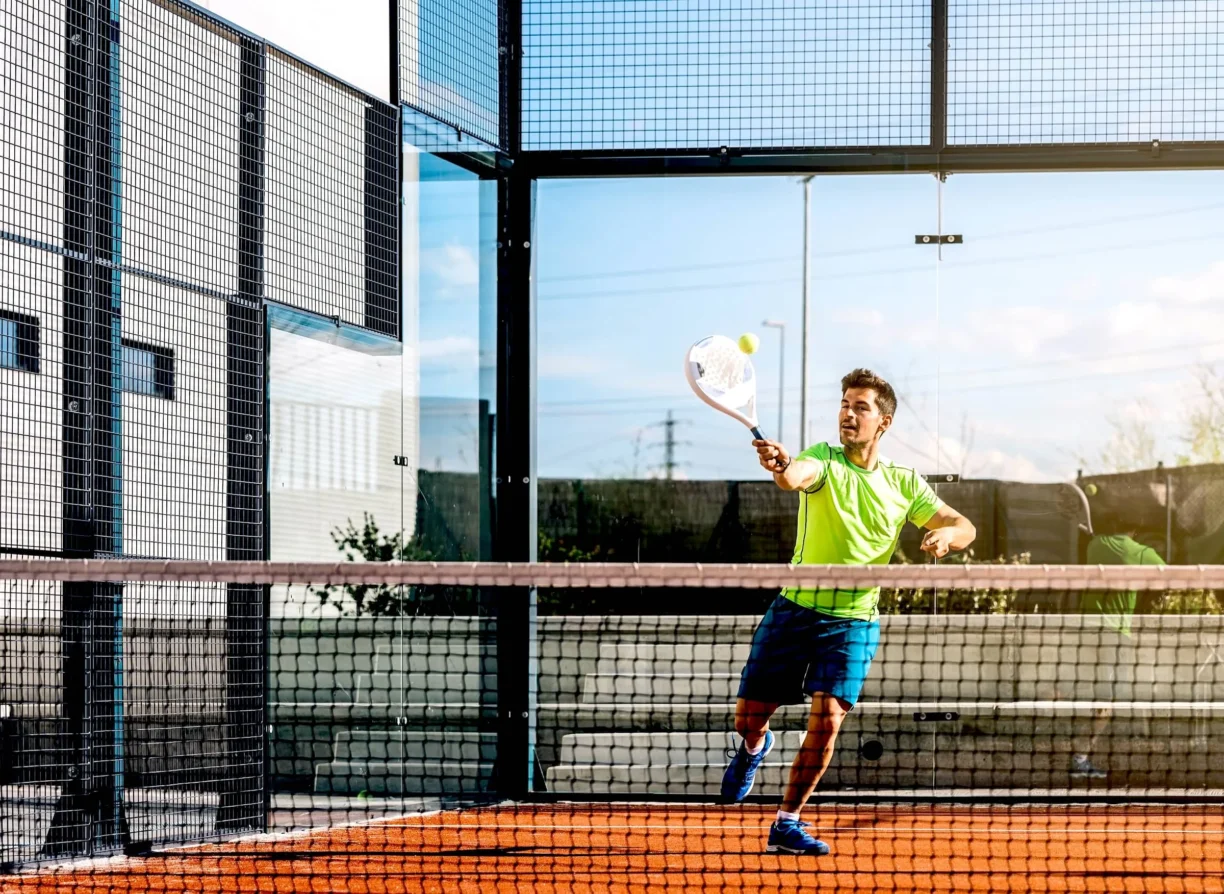
Padel is a racquet sport, played in doubles on an enclosed court about a third the size of a tennis court. The walls are the clever bit. The ball stays in play when it rebounds off them, so rallies last longer and beginners aren’t constantly stopping to fetch the ball.
That single design choice is most of the reason it’s taken off. You can have a genuinely fun, competitive game on your very first visit, which is not something you can say about tennis or squash. There’s no long apprenticeship of mishit balls and bruised pride before the sport becomes enjoyable. It’s fun more or less immediately, and that turns out to matter enormously when it comes to whether people stick with it.
The pace of the boom has taken even the people inside the industry by surprise. “We’re seeing clubs add courts faster than we can keep up with, and the people picking it up aren’t just the usual racquet-sport crowd,” says Padel Cover, a specialist that designs and installs padel court covers for clubs across the country. “It’s complete beginners, people in their fifties and sixties, folk who haven’t played a sport in years. It’s gone properly mainstream in about three years flat.”
Globally the picture is the same. Industry figures suggest nine new padel clubs are opening somewhere in the world every single day. It’s one of the fastest-growing sports on the planet, and Britain is catching up fast.
But popularity is one thing. The more interesting question is what it’s doing to the people playing it.
What it does for your body
Here’s the headline, and it’s a big one.
A University of Oxford study tracked more than 80,000 adults and looked at which sports actually moved the needle on living longer. Racquet sports came out on top. People who played them had a 56% lower risk of dying from heart disease or stroke, and a 47% lower risk of dying from any cause at all, compared with people who didn’t. Running, cycling and football didn’t show the same protective effect in that analysis.
That’s a striking result, and it points to something specific about the way racquet sports load the body.
Padel works you in intervals. Short, sharp bursts of movement, lunges, sprints and quick changes of direction, broken up by brief recoveries. That stop-start pattern is brilliant for your heart, keeping it working hard without the relentless grind of a long run. Expect to burn somewhere in the region of 400 to 600 calories an hour, depending on how hard you go at it.
It’s also a full-body affair. Your legs and core do the moving, your arms and shoulders do the hitting, and because you’re constantly adjusting your balance and footwork, it quietly builds the kind of agility and coordination that tends to fade as we age.
And crucially, it’s kinder on the joints than you’d expect. Because it’s doubles, there’s less ground to cover than tennis, and the controlled, reactive movements mean less of the brutal lateral pounding. That’s a large part of why it suits people coming back to exercise after years away, or anyone whose knees have started voicing opinions.
What it does for your brain
This is the part that gets overlooked, and it might be the most interesting bit of all.
Padel isn’t just a physical workout. It’s a cognitive one. Every rally has you tracking the ball, reading your opponents, anticipating angles off the walls and making split-second decisions about where to move and what to hit. Your brain is working as hard as your legs.
Sports scientists are starting to take this seriously. Research has found that playing padel triggers a rise in BDNF, brain-derived neurotrophic factor, a protein that supports the growth and protection of brain cells. In plain terms, the very act of playing appears to help keep your brain healthy.
Francisco Pradas, a sports science researcher at the University of Zaragoza who studies the sport, has gone as far as calling padel one of the best tools we have this century to fight the global epidemic of sitting still. The combination of constant motion and constant decision-making is what makes it tick.
Then there’s the social side, which matters more than it sounds. You can’t play padel alone. You need three other people, which builds the kind of regular, face-to-face connection that’s quietly become one of the most reliable predictors of good mental health. People come off the court having had a laugh, not just a workout.
A sport you’ll actually keep doing
Plenty of exercise is good for you. The problem is sticking with it.
Gym memberships lapse, running shoes gather dust, the rowing machine becomes a clothes rail. What makes padel different is that most people don’t experience it as exercise at all. It’s a game. It’s sociable, it’s competitive, it’s genuinely good fun, and the fitness arrives almost as a side effect.
One of the few real downsides is the repetitive arm movement, which can nag at the elbow if your technique’s off, so a couple of beginner lessons and a proper warm-up are worth the effort early on. Get that right and the barrier to entry is about as low as sport gets.
So, if you’ve been eyeing those glass courts and wondering whether to give it a go, the science is fairly firmly on the side of yes.
Your heart, your brain and your social life will all quietly thank you for it.