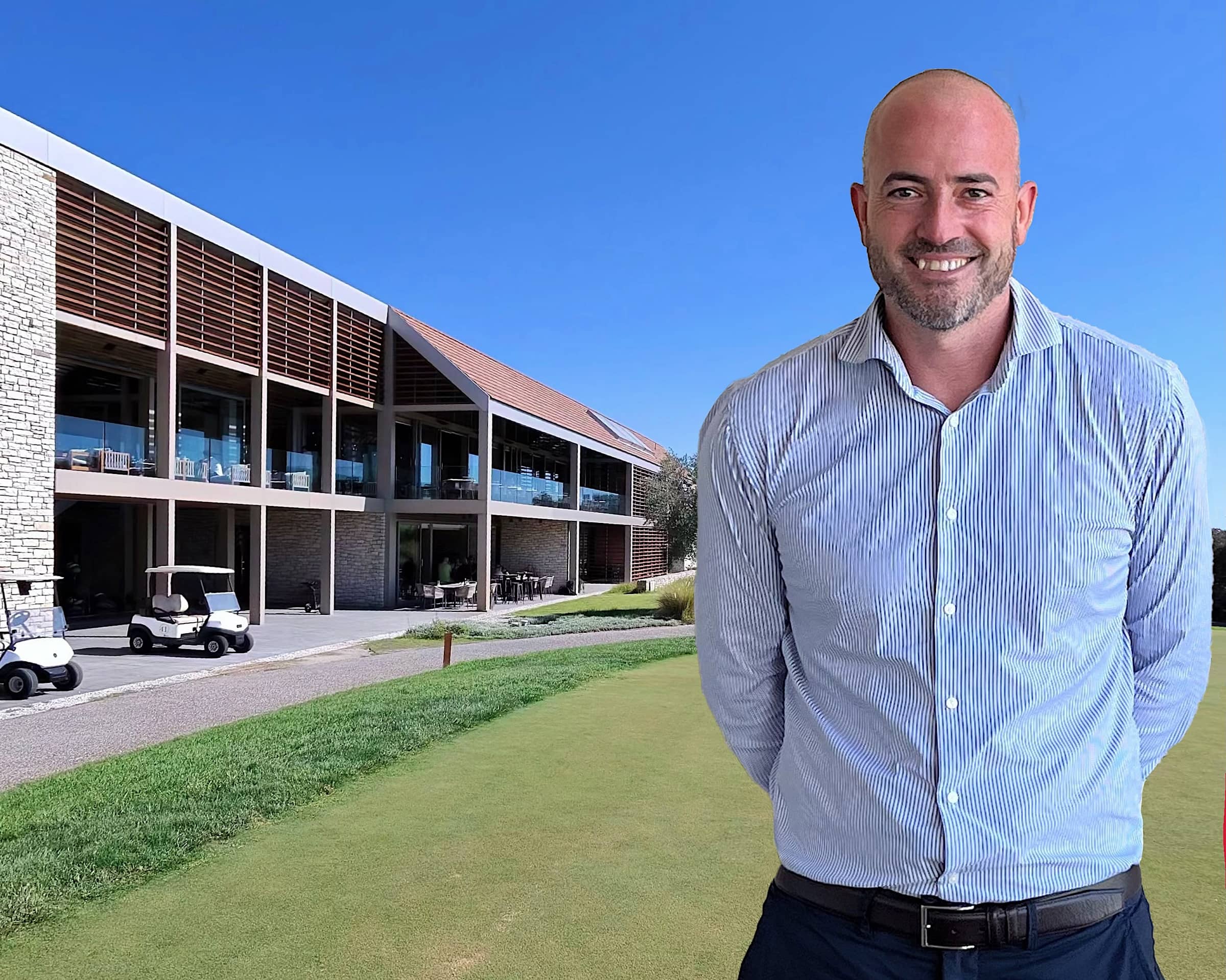
The former Yorkshire county golfer and now Director of Golf at Minthis in Cyprus has spent a lifetime studying the swing. But an early discovery about his own body raises a question that deserves more attention: are golfers preparing to play better, or to keep playing for longer?
At 19 or 20, Adam Davison was hitting thousands of golf balls every week and representing Yorkshire at amateur county level. A physical assessment revealed something rather more interesting than anything a launch monitor could have told him.
The right side of his back had developed noticeably more than the left.
He was a right-handed golfer. The explanation was hardly a mystery requiring the attention of the R&A.
Davison was even encouraged to hit the occasional ball left-handed to help address the imbalance. Years later, he can still see the difference. All those repetitions had apparently left their mark.
It was an early lesson in golf and mobility, and in how the movement we spend years trying to perfect can also shape the body performing it.
A muscular imbalance is not, in itself, evidence of injury or lasting damage. Davison’s experience does, however, illustrate something golfers rarely consider when examining their swing. While they are busy teaching the body to move a golf club, the body is adapting to the demands placed upon it.
For a man who subsequently built his career around the game, that distinction has become increasingly important.
The Longer Game That Doesn’t Appear on the Scorecard
Davison is now Director of Golf at Minthis in Cyprus, where he sees a side of the sport that receives rather less attention than driving distance or the latest equipment.
He has members in their seventies who walk the course three or four times a week.
There is something rather wonderful about that. At an age when many people have stopped participating regularly in sport, these golfers are still getting themselves around 18 holes, presumably with the occasional disagreement over a putt that should have been conceded.
Their continued participation is not proof that golf guarantees good health or longevity. It does, however, demonstrate one of the game’s most attractive qualities: the possibility of remaining involved well beyond the years normally associated with competitive sport.
That raises an uncomfortable question for an industry understandably fascinated by performance.
How much attention goes into helping somebody play better today, compared with helping them remain physically capable of playing years from now?
At the elite level, Davison has seen physical screening become a much more established part of golf. Players and their support teams increasingly recognise that physical capability matters alongside technique.
Among ordinary amateurs, he sees a different picture.
A golfer might happily invest in a new driver, another lesson or a detailed swing assessment while paying considerably less attention to the physical limitations influencing the movement itself.
There is nothing wrong with wanting an extra ten yards. It is simply worth remembering that the golfer has to be able to turn up and enjoy them.
When the Swing Fault Isn’t Entirely a Swing Fault
Davison encountered this problem repeatedly during his coaching career.
A player would arrive with a movement that needed attention. The temptation was to identify the technical issue and prescribe the correction. Change the position. Improve the rotation. Find a more efficient sequence.
Perfectly reasonable advice, assuming the golfer could physically do what was being requested.
That assumption is where things become complicated.
A restricted movement might reflect more than poor technique. Previous injuries, accumulated stiffness and years of physical compensation can influence how a golfer swings.
The resulting movement may be the body’s available solution rather than a deliberate technical choice.
It is an important distinction for anyone who has spent a small fortune being told to rotate more freely without establishing what is restricting that rotation.
Davison also encountered older golfers who had largely accepted that their physical limitations were permanent. Some responded to concerns about potentially troublesome movement patterns by wanting to make changes. Others regarded the restrictions as part of the deal.
Age can influence physical capability, of course. But accepting every limitation without examining it leaves little room to discover what might still be improved.
Physical assessment does not replace good swing coaching. The point is that one should inform the other. A technically desirable movement is of limited use if the person receiving the instruction cannot comfortably perform it.
Strong Enough to Swing, Too Restricted to Move
One golfer particularly stayed with Davison.
The player possessed considerable physical strength but moved with the freedom of a plank of wood.
It is possible to be powerful without being particularly mobile. Golf provides plenty of opportunities to demonstrate the difference, usually at considerable expense to the quality of the strike.
Davison summarised the problem neatly:
“Tension kills speed.”
The observation matters because golfers frequently confuse effort with effective movement.
Davison draws an interesting comparison between children learning to swing and adults who already possess considerable upper-body strength.
A young child cannot necessarily overpower a golf club. The weight and momentum of the club encourage the child to discover a sequence that allows the movement to happen.
An adult, meanwhile, may possess enough strength to force the club through the ball without developing the same sense of flow.
That approach can produce a perfectly serviceable shot. It may also conceal restrictions elsewhere in the movement.
Strength remains useful. So does technique. But neither automatically guarantees that a golfer moves freely or efficiently.
There is also a difference between developing a more effective golf swing and maintaining the broader physical capacity to continue playing.
The two objectives can overlap without being identical.
Eighteen More Movements, This Time Without a Golf Club
One approach to that broader question comes from KunAqua’s The Other 18.
The concept consists of 18 movements performed in water. Its connection with golf is deliberate, although it takes golfers away from almost everything they normally associate with playing.
There is no golf ball to strike, no club to control and no target demanding their attention.
Instead, water creates a different environment in which to experience movement.
Balance feels different. The resistance to movement changes. Familiar methods of producing force or controlling the body may no longer behave in quite the same way.
For golfers accustomed to repeating a highly practised movement, that change of environment presents an interesting opportunity to pay attention to how their bodies move outside the swing.
The underlying idea is to develop awareness of movement rather than provide another collection of technical corrections.
There is an important distinction to preserve here. The concept should not be confused with proof that these particular aquatic movements prevent injuries, improve golf performance or extend a golfer’s playing career. Those benefits would require appropriate evidence.
Its immediate interest lies in asking golfers to consider physical movement beyond the narrow requirements of striking a ball.
After years spent finding increasingly reliable ways to repeat the same action, experiencing movement differently is at least a worthwhile proposition to examine.
Why Minthis Is Interested in More Than the Golf
The connection with Minthis is understandable when considering how Davison describes the resort.
Golf remains central, but it sits alongside the landscape, spa, wider environment and wellness facilities. Davison places considerable emphasis on the overall experience rather than treating the quality of a visit as something determined entirely by the scorecard.
A round of golf can be thoroughly enjoyable without producing a personal best. Most golfers should find that reassuring, given the statistical improbability of playing brilliantly every time they venture out.
Davison’s interest in the connection between golf and The Other 18 reflects that broader outlook.
The programme introduces another way of engaging with the golfer as a person rather than concentrating exclusively on the swing. Whether individual participants experience measurable physical benefits is a separate matter, but the thinking fits a resort interested in wellbeing as well as golf.
It also represents an interesting shift in perspective for the industry.
Golf has become extremely sophisticated at measuring performance. Club speed, launch conditions, ball flight and technical positions can all be examined in extraordinary detail.
Yet the physical experience of the ordinary golfer, particularly somebody who has been playing for decades, can be more complicated than those measurements suggest.
Davison’s own story provides a useful reminder.
He learned patience, respect and an appreciation of rules through golf, qualities he carried beyond the course. The game also left him with a visible physical adaptation that he can still recognise years later.
Neither fact cancels out the other.
Perhaps that is the most sensible way to approach the relationship between golf and the body: appreciate everything the sport offers while remaining curious about the demands it places upon the people who play it.
The scorecard will tell you how well you played today.
It has absolutely nothing to say about whether you’ll still be enjoying the game in twenty years.