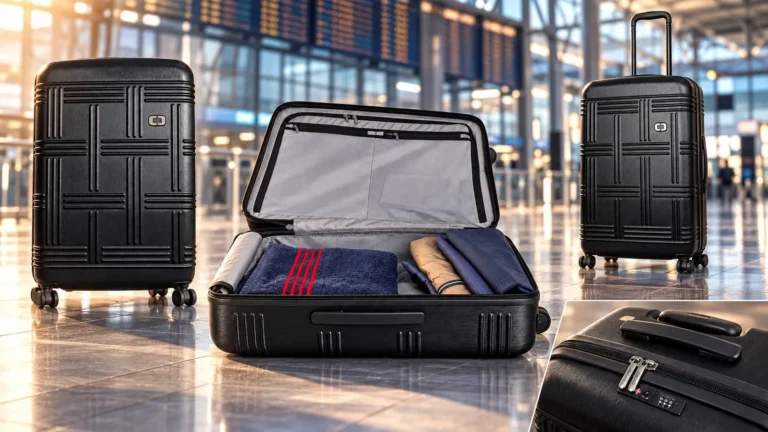
Simple stress-free travel tips for airports and stations, from smarter packing and route planning to luggage storage and phone back-ups.
Crowds, queues and last-minute platform changes may be unavoidable. The frantic scramble around them often is not. A few sensible habits can make the journey feel considerably less exhausting.
There are few less convincing ways to begin a holiday than sprinting through a terminal with a suitcase bouncing behind you, a boarding pass hiding somewhere on your phone and the vague suspicion that Gate 34 may be in another county.
Busy airports and railway stations are designed to move enormous numbers of people, not necessarily to make each of them feel serene. The useful stress-free travel tips, therefore, are not about pretending the crowds will disappear. They are about removing as many unnecessary decisions, delays and bits of luggage-related wrestling as possible before the pressure builds.
Done properly, the first part of a trip becomes pleasantly uneventful. In travel, uneventful is underrated.
Make fewer decisions on travel day
Much of the aggravation of a busy journey comes from having to solve small problems while surrounded by several thousand other people doing exactly the same thing.
Booking train or flight tickets well in advance removes one obvious uncertainty. Before leaving home, check the latest information for delays, cancellations, platform changes or altered departure details. Advice around reducing stress during busy travel often comes back to the same practical principle: knowing about disruption early gives you more room to deal with it calmly.
The same applies to documents. Tickets, identification and anything you will repeatedly need should be somewhere immediately accessible rather than buried beneath clothing, chargers and the book you optimistically packed.
For longer trips, a thorough solo travel checklist can also help catch bigger practical details such as passports, visas, insurance and budgeting before departure day arrives.
Then give yourself time.
A generous buffer is less thrilling than a heroic dash through departures, but it also involves considerably less sweating. Arriving early enough to walk to the correct gate, find a seat or buy a coffee removes one of the largest self-inflicted pressures from the journey.
Make the connection boring on purpose

The journey begins before the airport or station. Getting there — and getting away again at the other end — deserves more thought than it usually receives.
Trying to understand an unfamiliar transport network while carrying luggage is an excellent way to make a simple journey feel like an entrance examination. Good stress-free commuting begins with removing as much uncertainty as possible before setting off.
Look up the route beforehand. Note the train, bus or metro line, the direction of travel and any changes required. If you are heading somewhere unfamiliar, guidance on navigating public transit can help make sense of the basics before you arrive.
Online journey planners can take much of the guesswork out of connections, while transport apps may allow tickets or passes to be bought in advance rather than at a machine surrounded by an increasingly impatient queue.
It also pays to know what Plan B looks like. If the preferred train is badly delayed, is there another line or a workable bus route? If public transport becomes impractical, having a ride-hailing app already installed gives you another option without requiring a frantic search.
The aim is not obsessive planning. It is simply to avoid making basic logistical decisions at the moment when you are least inclined to make them well.
Treat your suitcase as a logistics problem
Luggage becomes particularly irritating during the dead periods of travel: several hours between hotel checkout and departure, perhaps, or an early arrival before accommodation is ready.
Dragging bags through a city during that gap limits where you can go and makes every staircase, café table and crowded pavement more complicated than it needs to be.
Where appropriate, a luggage storage service can turn those awkward hours back into usable time. Travellers passing through the capital, for example, may consider London Euston luggage storage rather than carrying cases around until their next booking begins.
The practical benefit is straightforward. Without bags in tow, it becomes easier to have lunch, visit somewhere nearby or simply walk around without constantly negotiating space for a suitcase.
Packing light remains the simplest answer when the trip allows it. When it does not, knowing when to put the luggage down is nearly as useful.
Let your phone do the dull work
Used properly, a smartphone can remove a surprising amount of travel-day friction.
Airline and rail operator apps can provide departure information, boarding details and alerts about changes. Digital tickets keep another piece of paper out of circulation. Mapping and transport apps can help identify the correct platform, stop or connection in an unfamiliar place.
Live tracking and arrival information can also make public transport feel more predictable. Better information about where a service is and when it is expected can help ease bus anxiety, particularly when an unfamiliar journey already involves a fair amount of guesswork.
This works beautifully until the battery reaches 1 per cent.
A portable power bank is therefore one of the less glamorous but more useful things to carry. Modern travel has made the phone part ticket wallet, part map and part information desk; allowing it to expire halfway through the journey is needlessly ambitious.
Keep essential information available offline as well. Screenshots of tickets, booking confirmations and important directions provide a useful fallback where Wi-Fi is unreliable or mobile reception disappears.
Technology should reduce the number of things you need to remember, not create a new crisis when the signal vanishes.
Give yourself somewhere to come down a gear
Planning can remove many sources of stress, but it cannot make a crowded terminal quiet.
If the noise and constant movement begin to feel overwhelming, look for somewhere calmer. Depending on the location, that might be a quieter café, a designated quiet area, a prayer room or a pay-per-use lounge. Even a short spell away from the busiest part of a terminal can make the next stage easier to manage.
Basic comfort matters too. Hunger and thirst can make an already tiresome delay feel worse, so carrying water and a simple snack is sensible.
And when progress slows to the speed of a security queue, resist mentally travelling the entire journey at once. Slow breathing may help ease feelings of impatience and anxiety, while breaking the trip into its next immediate task keeps the process manageable.
Get through security. Find the gate. Find somewhere to sit.
There will be time later to think about the rest.
The object is not to make an airport peaceful or a major railway station empty. That would require talents beyond the scope of most travel advice. It is to stop the terminal deciding how you feel before the trip has properly begun.