Repeated swelling after knee replacement may be recurrent haemarthrosis. Learn the warning signs, causes, treatment options and when to seek help.
You had the knee replaced so you could get back to walking, cycling and lifting without pain. For a while it worked. Then, months or even years after the operation, the knee swells up over a few hours for no obvious reason. It feels tight, hot and heavy. It settles over a week or two, and then it happens again.
If that pattern sounds familiar, it may not be arthritis in a neighbouring joint or a technique problem in the gym. It may be bleeding into the joint itself.
What recurrent haemarthrosis actually is
Haemarthrosis simply means bleeding into a joint cavity. After a knee replacement, some swelling and bruising in the first weeks is expected and normal. Recurrent haemarthrosis is a different thing: repeated episodes of bleeding into the joint that occur without any injury, often long after recovery should have finished.
It is genuinely uncommon. Reported rates after knee arthroplasty sit below 1%, with published estimates of prevalence in the region of 0.3% to 0.65%. That rarity is precisely the problem. Because most physiotherapists and many GPs will see it only a handful of times in a career, it is often treated as ordinary post-operative swelling for far longer than it should be.
How it differs from ordinary swelling
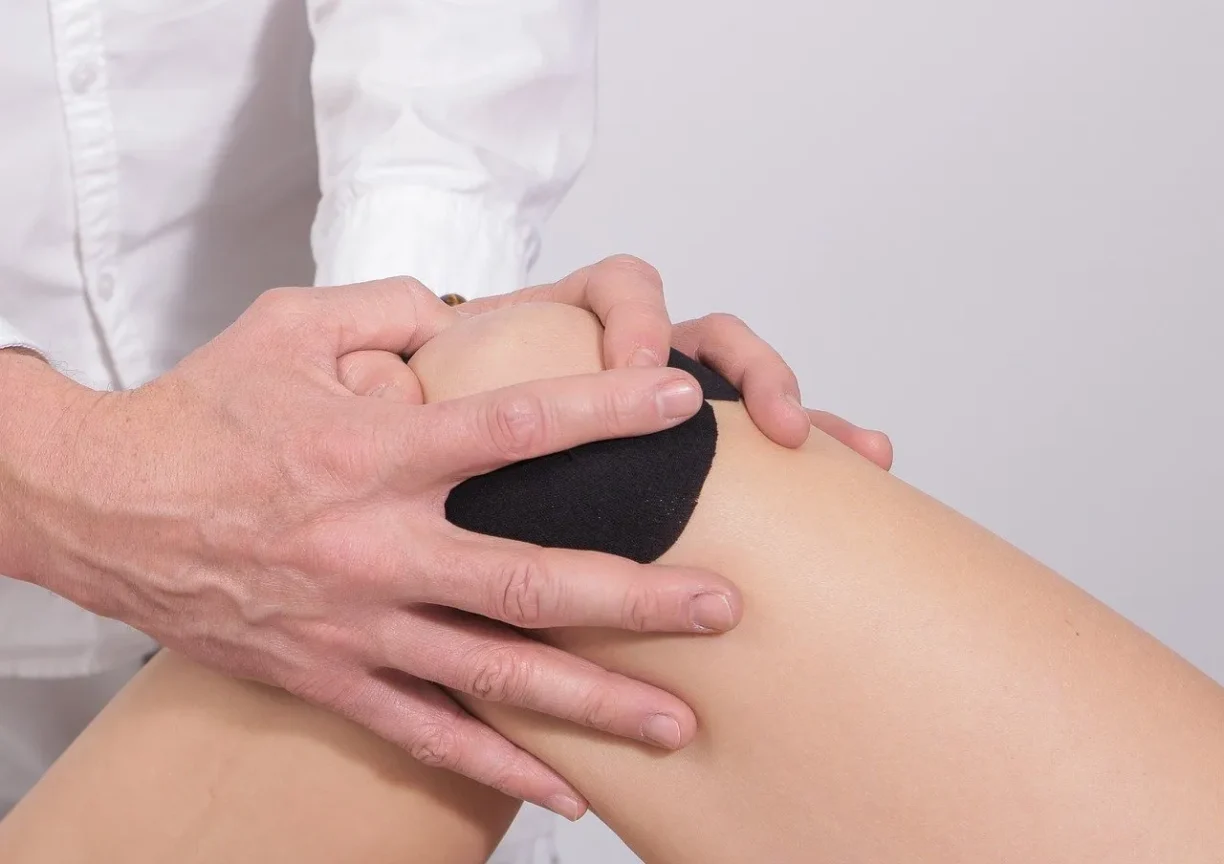
The pattern usually gives it away.
- It comes on quickly, often over hours rather than days, and without a fall, twist or unusual session.
- The knee feels tight and full rather than simply achy, and bending it becomes difficult.
- Bruising may appear around the joint or track down the calf a few days later.
- It resolves, sometimes with aspiration, and then returns.
That last feature is the important one. A single episode can have many explanations. A repeating cycle of swelling, partial recovery and swelling again is a pattern that deserves proper investigation rather than another course of anti-inflammatories.
One thing that must be ruled out first
A hot, swollen, painful knee after a joint replacement is not always bleeding. It can also be infection around the implant, known as periprosthetic joint infection. That is a serious complication requiring urgent assessment, not a wait-and-see approach.
Contact your surgical team or seek same-day medical care if swelling comes with fever, feeling generally unwell, spreading redness, wound discharge, or pain that is escalating rather than settling. Sorting out which of the two you are dealing with is the first job, and it is done with examination, blood tests and usually aspiration of the joint. Everything that follows in this article assumes infection has been excluded.
Why the bleeding happens
There are several recognised causes, and they are not mutually exclusive.
- Synovial hypervascularity. The lining of the joint develops an abnormally rich, fragile blood supply. These vessels can be pinched by the implant during movement and bleed repeatedly. This is the most common mechanism seen at angiography.
- Anticoagulant medication. Blood thinners taken for atrial fibrillation, clots or other reasons substantially raise the risk, and sometimes the dose itself turns out to be the driver.
- Vascular injury. A small pseudoaneurysm or damaged branch artery near the joint can bleed intermittently.
- Other joint conditions. Pigmented villonodular synovitis and inherited bleeding disorders such as haemophilia can produce the same picture.
The conventional treatment ladder
Management usually starts conservatively and escalates only if the problem persists.
- Rest, ice, compression and aspiration of the joint to relieve pressure and confirm that the fluid is blood.
- A review of anticoagulation. If you are on a blood thinner, the dose and the drug may need reconsidering in discussion with the doctor who prescribed it. This alone resolves some cases, and it is never something to adjust on your own.
- Arthroscopic synovectomy, in which the inflamed joint lining is removed through keyhole surgery. It works for many people, but it means another operation and another recovery, and the bleeding can return.
- Revision surgery, reserved for cases where the implant itself is implicated.
Where embolisation fits
When bleeding keeps returning despite the steps above, there is a non-surgical option that many patients are never told about. Genicular artery embolisation is an image-guided procedure performed by an interventional radiologist rather than an orthopaedic surgeon.
A thin catheter is passed from an artery in the groin or wrist and steered into the small genicular arteries that supply the knee. Contrast dye reveals the abnormal, overgrown vessels feeding the bleeding, and tiny particles are then injected to shut those specific branches down.
It is done under local anaesthetic with light sedation, usually as a day case, and there is no incision and no general anaesthetic. Most people walk out the same day.
This is not a new or experimental idea. Embolisation of the genicular arteries was originally developed for exactly this problem, and it is only more recently that the same technique has been adapted for knee osteoarthritis, which is what most people have heard about. For recurrent bleeding after joint replacement, it is the older and better established of the two uses.
What the evidence shows, and what it does not
A retrospective study of 31 patients who underwent 39 embolisation procedures for recurrent haemarthrosis after knee arthroplasty concluded that the treatment was safe and effective, with clinical improvement in most patients. Review articles in the interventional radiology literature reach a similar conclusion and describe it as well established for this indication.
Two honest caveats belong alongside that.
- The evidence base is made up of case series and retrospective studies rather than large randomised trials. That reflects how rare the condition is, and it is a real limitation.
- It does not work for everyone, and bleeding can recur. A published case report describes recurrence in a patient on full-dose anticoagulation whose symptoms only resolved once the anticoagulant dose was reduced, which is a useful reminder that embolisation works best as part of a joined-up plan rather than in isolation.
Risks are generally low but are not zero. They include bruising or bleeding at the access site, temporary knee pain after the procedure, patches of skin discolouration if particles reach small skin vessels, and the radiation dose involved in any X-ray guided procedure. Because the genicular arteries are small and vary considerably between individuals, the procedure is technically demanding and outcomes depend heavily on the experience of the operator.
What this means if you want to get back to training
The practical cost of recurrent haemarthrosis is not just the swelling. It is the stop-start pattern. Every episode interrupts loading, and repeated interruptions cause quadriceps wasting, stiffness and a steady loss of confidence in the joint. People stop trusting the knee, then stop using it, and the deconditioning becomes its own problem.
Getting the bleeding under control is what makes consistent rehabilitation possible again. Whichever route you take, that is the goal, and it is worth pushing for a definitive answer rather than accepting repeated aspirations as a way of life.
Questions worth asking
- Has infection been formally excluded?
- Has an angiogram or contrast imaging been done to look for abnormal vessels?
- If I am on an anticoagulant, has the prescribing doctor reviewed whether it is contributing?
- Am I a candidate for embolisation before considering further surgery?
- How many of these procedures has the person treating me performed?
The bottom line
A knee that repeatedly fills with blood after a replacement is uncommon, under-recognised and treatable. It is not something to train through and not something to accept.
If your knee keeps swelling without a clear reason, ask your surgical team directly whether bleeding into the joint has been considered, and whether a referral to an interventional radiologist is appropriate. The condition is rare enough that the question is often worth asking yourself.
This article is for general information and education only. It is not medical advice and is not a substitute for assessment by a qualified doctor. Never stop or adjust anticoagulant medication without speaking to the doctor who prescribed it. Treatment suitability depends on individual circumstances and should be discussed with your surgical team or another qualified healthcare professional.
References
1. Geniculate Artery Embolisation in Patients With Recurrent Hemarthrosis After Knee Arthroplasty: A Retrospective Study. The Journal of Arthroplasty, 2019. PMID: 31601456.
2. Geniculate Artery Embolisation: Role in Knee Hemarthrosis and Osteoarthritis. RadioGraphics, Radiological Society of North America. doi:10.1148/rg.210159. PMID: 34890274.
3. Genicular Artery Embolisation: A Review of Hemarthrosis and Osteoarthritis. Vascular Disease Management.
4. Selective Genicular Artery Embolisation for Recurrent Hemarthrosis Following Total Knee Arthroplasty: A Case Report. PubMed Central, PMC12753183.