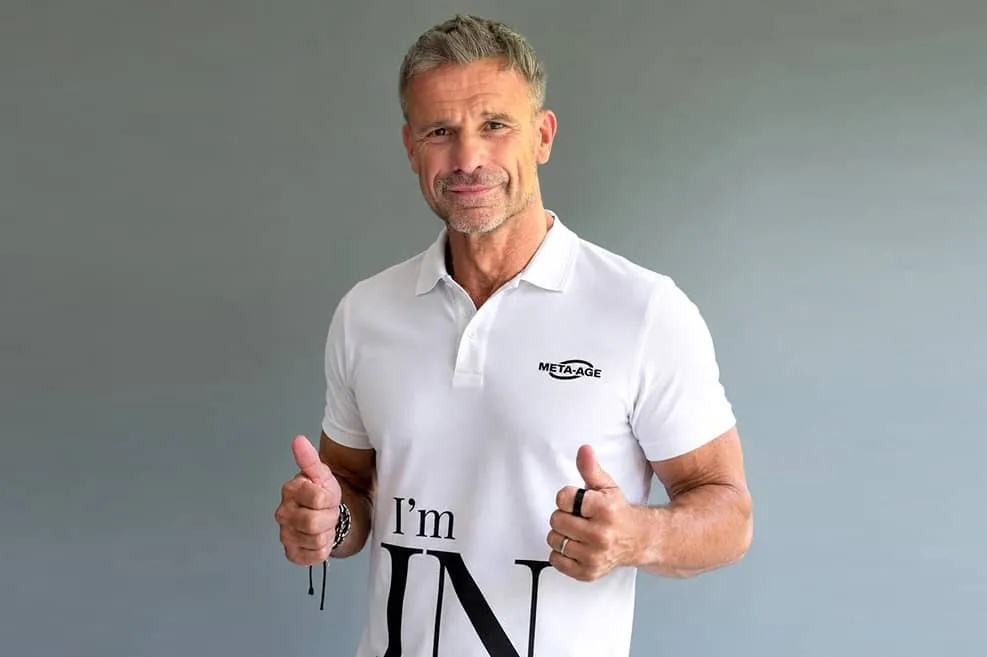
Jason Smith went from burnout and poor health to marathon running, personal training and inspiring a new midlife fitness conversation.
A few months ago, I wrote about Jason Smith. At the time, his story resonated because it felt familiar. Here was a man approaching fifty who was overweight, struggling with his health, taking medication for hypertension and high cholesterol, battling depression, and finding it increasingly difficult to keep up with his young son.
Like many people, he had started to accept a narrative that quietly settles over midlife: this is what happens when you get older.
Then something changed. A social media post featuring Bilbo Baggins running through the Shire with the words “I’m going on an adventure” struck a chord. Jason pulled on his trainers, headed into the Surrey Hills, and took the first step on a journey that would transform his life.
The story that followed is well known. The weight came off. His health improved. He became a marathon runner, a qualified personal trainer, and the founder of Fit in Midlife. What began as a personal challenge evolved into a mission to help other people realise that their future health was still largely in their own hands.
But recently, it wasn’t another race medal or fitness achievement that caught my attention. It was the way Jason described himself. A Meta-Ager.
The term stayed with me, not because it described a programme or a product—it didn’t. Jason was using it to describe something else entirely. A way of approaching the years ahead.
The more I thought about it, the more familiar it felt. Over the years, I have interviewed athletes, entrepreneurs, coaches, health professionals, and ordinary people who have achieved remarkable things later in life. Their stories have all been different, yet many have shared a common thread. They remained engaged with life. They kept learning. They adapted when circumstances changed. They refused to believe that another birthday automatically meant a smaller future.

Jason’s story fits that pattern. His transformation was never really about losing weight. Weight loss was simply the visible outcome. The deeper shift was that he stopped drifting and started participating again. He made a decision that the years ahead still mattered.
That idea sits at the heart of Meta-Age: not anti-ageing, not age-defying, not pretending to be younger, but simply refusing to withdraw from life before life has finished with you. It is a distinction that becomes increasingly relevant as people live longer. The challenge facing many of us is no longer lifespan. It is maintaining purpose, capability, curiosity, and engagement throughout those extra years.
That is one reason Jason has announced his support for the upcoming Meta-Age NHS campaign. What appeals to him is not another fitness challenge or wellness trend. It is the principle behind it. The belief that meaningful change rarely begins with dramatic transformation. More often it begins with a small decision repeated consistently over time. A walk. A commitment. A willingness to begin. The same ingredients that changed the direction of his own life.
The original Sustain Health article introduced readers to Jason Smith’s transformation. This chapter feels different, not because Jason has changed course, but because the conversation has evolved. The question is no longer whether Jason transformed his health—that much is obvious. The more interesting question is why.
And the answer seems to be found in the idea that first caught my attention. A Meta-Ager. Someone who chooses participation over withdrawal.
Jason Smith is one of them.