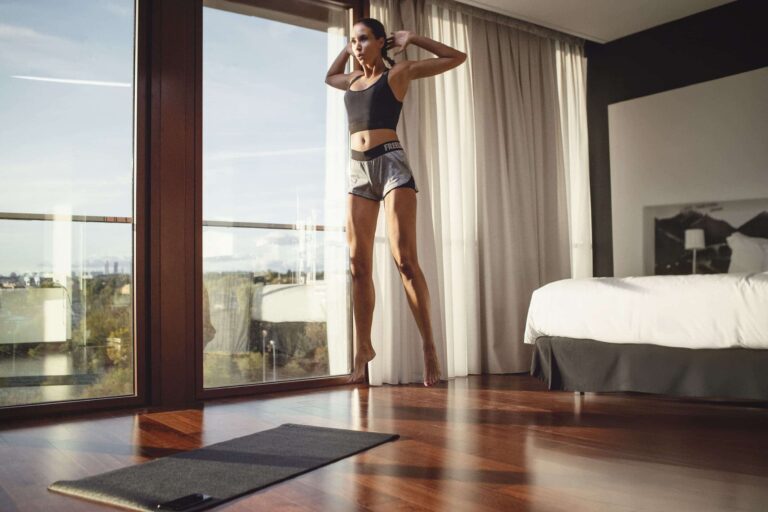
Make small-space workouts work with simple setup tips, quiet exercises, and compact kit for strength and cardio at home.
Trying to pull off a proper home workout in a tiny flat can feel like attempting a long drive in a broom cupboard: you know what you want to do, but the walls have other plans. Lifting, jumping, sprinting and stretching suddenly become “luxury movements” when your living room is also your dining room, office, hallway and—if you’re really living the dream—your laundry drying suite. But here’s the good news: the size of your home shouldn’t stop you from keeping fit and seeing results. No excuses needed.
What follows is a small-space game plan for turning even a postage-stamp floorplan into a workable training zone—without annoying your flatmates, wrecking your knees, or rearranging the furniture like you’re auditioning for a daytime TV makeover show.
1) Pick your “training turf” and stick to it
The biggest mistake with small-space fitness is treating your home like a roaming workout safari—one set by the sofa, one set by the kettle, then a lunge that ends in the houseplant. Instead, carve out a designated spot and make it your regular base.
The living room usually offers the most space, even if you have to shift the furniture around first. And if you share with flatmates or family, set a regular workout time and run it past the household so your burpee ambitions don’t crash into someone else’s Zoom meeting.
2) Clear more space than you think you need
Bringing workouts indoors is the most convincing reason for a declutter since your mum came to visit. Sort through boxes, papers, and any random clutter that has quietly taken over a corner of your home.
You don’t need much space for a good workout—just enough for a mat, with stepping room either side for lunges and star jumps, plus enough space behind you to drop into a plank. Rearranging bigger pieces (sofas, tables), closing doors, and moving “trip hazards” into cupboards can make a surprising difference.
3) Train like you’ve got neighbours (because you do)
If you live above someone, treat jumping like it’s a luxury item. You can still get a serious sweat on without sounding like you’re testing the structural integrity of the building.
Squats, no-jump burpees and plank reaches are high-intensity moves that keep noise down, protect your joints, and keep the peace with whoever lives below. If you’re following a YouTube or Instagram session, fast-forward through the workout first so you’re not surprised by a sudden “30 tuck jumps” moment in a room the size of a wardrobe.
4) Go big with a suspension trainer (without taking up big space)
If there’s one bit of kit that punches above its weight in a small home, it’s a suspension trainer. They’re one of the best methods out there for total-body conditioning in tiny spaces because they use gravity and your own body weight to dial up the difficulty—no machines, no bulky weights, no dedicated gym room required.
TRX-style straps can be anchored to a closed door and open up an endless menu of moves: rows, chest presses, bicep curls and plenty more. When you’re done, they disappear behind the sofa or into a drawer like a well-behaved piece of equipment.
5) Add a pull-up bar and turn your doorway into a gym
Whether your goal is to lose a few kilos or build a stronger upper body, a pull-up bar is a portable classic—small footprint, big return. Most models wrap around a door frame, go up in seconds, and don’t need screws, which means no damage to a rented home and no awkward conversations with a landlord.
And it’s not just for pull-ups: place the bar on the floor for push-ups and tricep dips and suddenly your home workout setup looks a lot more like a mini gym than a compromised compromise.
6) Use resistance bands for strength without the bulk
Resistance bands are the unsung heroes of small-space training: cheap, effective, easy to store, and deceptively brutal. Add one looped around your thighs and you’ll quickly learn that “stretchy elastic” can be a menace.
Try hip abductions, glute bridges and lateral walks for lower-body strength, and use longer bands for rows, presses and assisted stretches. They’re also excellent for recovery work—helping you sink deeper into hamstring and glute stretches after a hard session.
7) Turn your furniture into training equipment
If the sofa is in the way, congratulations: it’s now a piece of gym kit. Use it for tricep dips, elevated mountain climbers, and seated leg raises. A kitchen worktop can stand in as a ballet barre (wipe it down afterwards), and a footstool becomes a handy bench for step-ups or hops.
With a bit of creativity, you’ll find props everywhere. A kitchen towel can work as a slider, tins of soup can substitute for light weights, and stairs can become the ultimate cardio finisher. That’s the charm of a home workout—you’re not short on options, just short on floor space.
The bottom line: small space doesn’t mean small results
A tiny home doesn’t disqualify you from getting fitter, stronger, or leaner—it just asks you to be smarter. Pick a spot, clear it, keep things neighbour-friendly, and lean on compact kit like suspension trainers, pull-up bars and resistance bands. Then use your furniture like it’s been waiting all along for its moment.
No gym? No problem. Just you, a bit of space, and a plan that actually fits.