Self-isolation and social distancing can mean it’s easy to stop working out entirely, but your body and mind will hugely benefit from exercise.
Home exercise has finally grown up. It is no longer the poor relation of “real” training, wheeled out only when the weather turns foul or life gets too busy to behave. Done properly, a home workout can build strength, sharpen endurance and lift the mood, all without queues for machines, booming playlists or somebody else’s sweat on the mat.
That is the beauty of it. You do not need a garage full of kit, a wall of mirrors or the kind of motivation usually reserved for polar expeditions. What you do need is a challenge, a bit of consistency and the willingness to be mildly uncomfortable on purpose.
The good news is that some of the best home fitness tests are brutally simple. They ask very little in terms of equipment and quite a lot in terms of honesty. Which, in exercise as in life, is often where the real work begins.
Why home exercise still matters
There is a reason bodyweight training and living-room workouts have stuck around. They are convenient, flexible and free of the nonsense that sometimes clings to modern fitness. No commute. No waiting. No excuses dressed up as logistics.
More importantly, home exercise can slot into real life. It suits busy parents, remote workers, lapsed runners, time-starved professionals and anyone who wants to move more without turning their week into a military campaign. A short session at home may not look glamorous, but it often gets done, and that is half the battle.
There is also a mental edge to it. A focused workout breaks up the day, resets the brain and gives you a small, measurable win. In a world full of vague intentions, that is no small thing.
The indoor endurance test

Let us start with the wildest option on the list. Running a marathon indoors is not for everyone, or indeed for most sane people, but it proves an important point: limited space does not automatically mean limited ambition.
The most famous example came from Pan Shancu in Hangzhou, who set up two tables in his apartment and ran laps around them for hours. It sounds faintly absurd, which is usually a sign that somebody is either a genius or in need of a lie down. Shancu later said: “I felt a little dizzy at first, but you get used to it after you circle many times.”
Most readers need not start by trying to recreate an ultra-endurance epic between the sofa and the radiator. A more sensible version of the same idea is an indoor distance challenge: 30, 45 or 60 minutes of steady movement using shuttle runs in the garden, stair climbs, step-ups, jogging on the spot or a mix of cardio drills.
That is where home exercise becomes practical rather than theatrical. You are training the engine, building stamina and proving you can work hard even when conditions are less than ideal.
The 100 push-up challenge
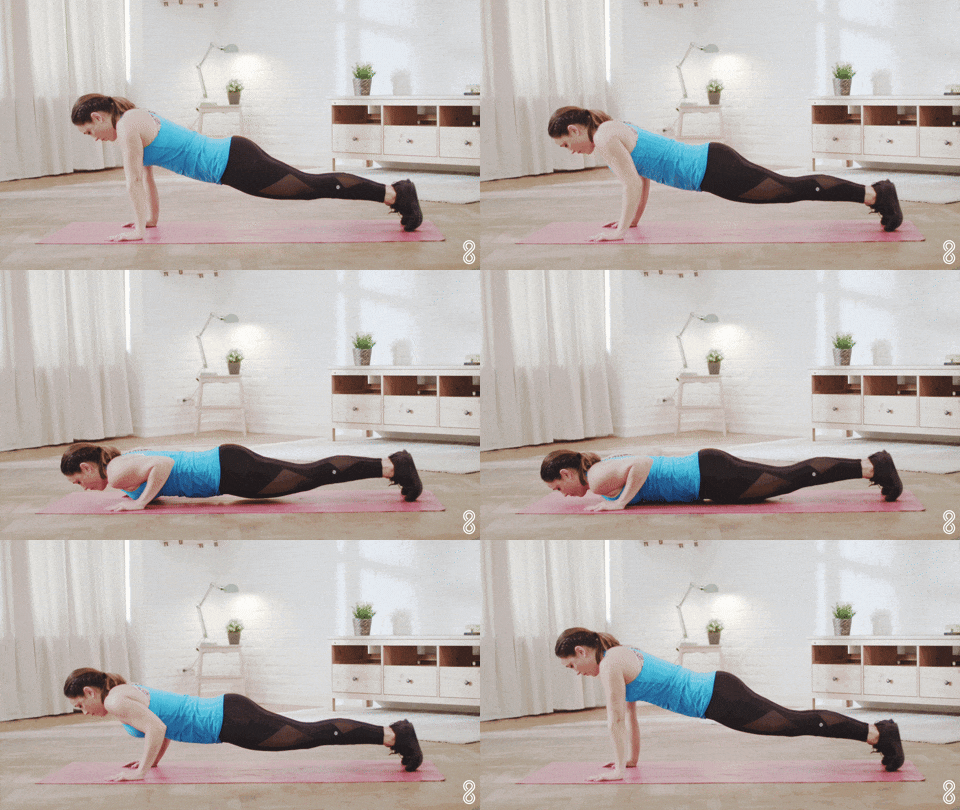
Push-ups are wonderfully democratic. They do not care about your gym membership, your postcode or your excuses. They simply ask whether you can move your own body with control.
Aiming for 100 push-ups a day is one of the cleanest home exercise challenges around because it is scalable. Beginners can break it into sets of five or ten. Stronger exercisers can attack bigger sets, vary hand positions or slow the tempo to make the movement more demanding.
The benefits are obvious enough: stronger chest, shoulders, triceps and core, along with better muscular endurance. The hidden benefit is rhythm. You can scatter sets through the day and turn dead time into training time.
The trick is not to chase ugly reps for the sake of a round number. Quality matters. A straight line through the body, full range of motion and sensible pacing will do more for your strength than flinging yourself at the carpet like a man trying to swat a wasp.
Burpees: dreadful, effective, unavoidable
Burpees have all the charm of unpaid taxes, but they work. They are one of the most efficient full-body drills in any home exercise routine because they blend strength, coordination and cardio into one deeply unpleasant package.
A smart challenge is to measure how many burpees you can complete in two minutes, then try to improve that score over time. It is simple, brutally honest and impossible to fake. After about 40 seconds, the body tends to begin negotiating. After a minute, it starts writing strongly worded letters of complaint.
Still, the burpee earns its place. It drives the heart rate up, trains multiple muscle groups and builds the sort of conditioning that transfers well to everyday sport and general fitness. The key, again, is form. Keep the movement tidy, land softly and do not sacrifice mechanics for speed.
For those who hate running and get bored by standard circuits, this sort of benchmark gives home exercise some proper bite.
The wall sit challenge for leg strength and focus
Then there is the wall sit, a movement so simple it almost seems insulting until your thighs begin to tremble like a shopping trolley on cobbles.
Sit with your back against the wall, knees bent, thighs roughly parallel to the floor, and hold. That is it. No drama, no equipment, no soundtrack required. Just time, gravity and your own tolerance for discomfort.
This is one of the best home exercise challenges for people who sit for long stretches and need a sharp reset during the day. It targets the quads, tests mental resolve and provides a clean metric you can track. Hold for 30 seconds today, 45 next week and a minute after that, and you have proof of progress.
It is not flashy, but that is rather the point. Effective training is often terribly unfashionable.
How to make home exercise sustainable
The biggest mistake people make with home exercise is assuming it must be heroic to count. It does not. It has to be repeatable.
Pick one or two challenges. Log your scores. Build gradually. If you are new to training, start modestly and focus on consistency over punishment. If you are experienced, use these tests as benchmarks around your wider strength or cardio programme.
You can also rotate them through the week: push-ups on Monday, burpees on Wednesday, wall sits on Friday, endurance work at the weekend. That gives your training structure without draining the joy from it.
And that, really, is the sweet spot. Home exercise works best when it becomes part of the furniture of life rather than a grand act of self-improvement.
A smarter way to train at home
The old assumption was that home training was second best. That feels outdated now. For many people, it is the most realistic way to stay active, build resilience and keep fitness from slipping off the table entirely.
These challenges will not suit everyone in equal measure. The indoor endurance test is for those who like to suffer creatively. The push-up challenge rewards discipline. Burpees are for the stout-hearted. The wall sit is a quiet assassin.
But each one proves the same thing: useful training does not need much space, fancy gear or a monthly direct debit. It just needs intent.
And that may be the great strength of home exercise. It strips fitness back to the essentials, which is often where the truth lives.