Oxford University won a dramatic FT Nikkei UK Ekiden as Britain’s Japanese-style relay gathered serious pace on the Thames.
Oxford University won the third FT Nikkei UK Ekiden after a 112km scrap along the Thames that had just about everything: pace, panic, a Japanese sash, a late charge from Exeter and the sort of finish that leaves respectable runners looking as if they have briefly mislaid their skeletons.
This was not a gentle jog with scenery. Sixteen of the UK’s strongest university endurance running teams lined up for what has quickly become one of the country’s most compelling relay races, joined by Japan’s Ritsumeikan University, 18 corporate and community teams, and enough competitive tension to make Windsor feel rather less royal and rather more feral.
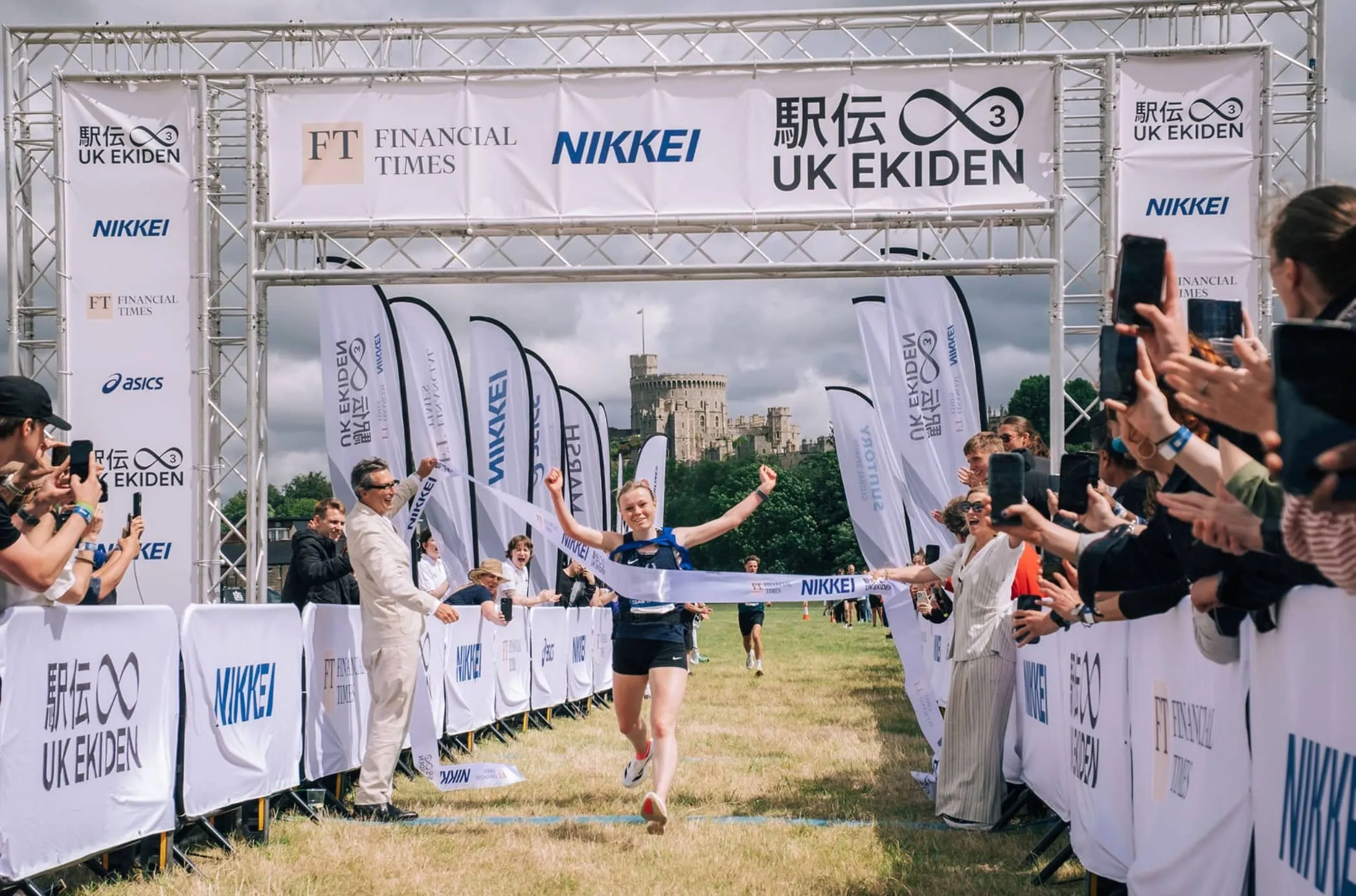
Oxford crossed the line in 06:49:01, taking control shortly before the fifth of ten legs and clinging on until the finish. Exeter appeared to have chased them all the way home by mere seconds, only for an official review of course data by the results team to relegate them to third. That elevated last year’s winners, Ritsumeikan University from Japan, into second, with Cardiff University fourth.
Oxford’s Final Leg Had No Room For Polite Breathing

The last leg belonged to Oxford University’s Ella Davey, a first-year Chemistry student who had the small matter of a university victory and a closing Exeter runner to think about while her legs were already deep into negotiation.
Oxford had been runners-up last year. This time, they made the thing stick.
Oxford University’s Ella Davey, who ran the thrilling last leg and clinched victory for last year’s runners up, said: “That was the best running experience I’ve ever had. Seeing the crowd at the end pumped me full of adrenaline and I just had to dig in. I could see Exeter closing when I turned the bend for home but thankfully I got us home. I have never felt emotion or a finish like it. My team was incredible.”
Ella, a first year Chemistry student, said: “The UK Ekiden is an amazing race. There is nothing like it in the UK. I’m looking forward to next year already.”
That is the beauty of the Ekiden format. It is individual suffering in team clothing. Every runner gets their own little chapter of discomfort, but the story only works if all ten chapters hold together.
Ritsumeikan Showed Why Japan Still Owns The Ekiden Soul
Ritsumeikan University did not merely take part; they reminded everyone that Ekiden is stitched deeply into Japanese sporting culture. They surged from sixth to first after the fourth leg, a move with all the subtlety of a grand piano arriving through a greenhouse roof.
Oxford eventually reeled them in, but Ritsumeikan’s presence gave the race extra weight. This was not only a British university contest borrowing a Japanese idea. It was a proper cultural meeting point: UK endurance running testing itself against a format that Japan has refined into something approaching theatre.
The FT Nikkei UK Ekiden uses mixed teams of 10 male and female runners, who pass a traditional “tasuki” sash rather than a baton. It is a small detail with a large emotional charge. The sash carries more than timing data and sweat. It represents trust, shared effort and the understanding that your bad patch may become someone else’s crisis if you do not get on with it.
A Thames Route With Bite
The 112km course began and ended in Brocas Field, Windsor, following the Thames Path to King’s Meadow in Reading and back. Picturesque, yes. Easy, absolutely not. The Thames can look charming from a pub garden. It is rather less charming when you are being asked to race along it at university endurance pace while knowing nine other people are depending on you.
The race was also the most competitive staging yet. Every elite university team had to qualify to reach the start line, and for the first time the event was licensed by England Athletics.
The top eight university teams — Oxford, Ritsumeikan, Exeter, Cardiff, Birmingham, Bath, Newcastle and Leeds — now qualify for next year’s event.
Anna Dingley, Founder and CEO of FT Nikkei UK Ekiden, said: “ We couldn’t have dreamed of a more thrilling race. The finish was remarkable and shows how the UK Ekiden is the pinnacle of team relay races.”
A Race Building Its Own Place In British Running
There are plenty of running events in Britain with fine scenery, enthusiastic volunteers and participants who swear they enjoyed it once their central nervous system has rebooted. The FT Nikkei UK Ekiden is different because it is not simply about who runs fastest. It is about sequence, strategy, nerve and the peculiar pressure of handing responsibility to another human being while trying not to collapse into the nearest hedge.
Matt Seddon, Athletics Director for the FT Nikkei UK Ekiden, said: “The race just shows how the Ekiden will become a massive part of UK running culture. The Ekiden is not a typical race but is an experience. Nothing can beat the drama in team running terms.”
That drama was everywhere. The university race had Oxford, Ritsumeikan, Exeter and Cardiff in the thick of it. The wider field brought together corporate and community teams, including 2012 Paralympic hero Richard Whitehead, Oxford University Pro-vice-chancellor Alexander Betts and Team GB Olympian Steph Twell, who has competed for Britain across the 1500m, 5000m, 10,000m and marathon.
Richard Whitehead MBE, a two-time Paralympic Gold medallist, said: “It’s an iconic venue and an iconic course. It was fantastic to be part of the growing energy of Ekiden. The real core value of the event are togetherness, teamwork and supporting other members of your team.”
The Royal Air Force were the first to cross the line from the community and corporate teams.
The Kanakuri Cup And A Nod To Ekiden History
The winner of the community and corporate race received the Kanakuri Cup, a specially made trophy crafted by British craftsmen at Linley. It is named after Shiso Kanakuri, the first Japanese Olympian more than a century ago, whose vision and leadership helped establish Ekiden as one of Japan’s most cherished sporting traditions.
That historical thread matters. Ekiden was inspired by the old Japanese communication system, where messages were relayed across distance by multiple runners. Modern sport being modern sport, the messages are now less likely to concern national administration and more likely to involve split times, lactic acid and someone shouting “dig in” at an athlete who is already digging so deep they may shortly discover archaeology.
The tasuki remains the emotional centrepiece. Each runner does not merely pass an object. They pass duty, momentum and a little parcel of collective jeopardy.
Mini Ekiden Could Be The Smartest Long-Term Move
For the first time this year, a Mini Ekiden was rolled out for up to 50 primary schools across the UK, giving pupils the chance to experience the sash handover and the team-first character of the race.
That may prove more significant than it first appears. Elite sport often talks about legacy as if repeating the word enough times will make it happen. This is more practical. Give children a version of the event they can understand, run and feel, and the pathway becomes visible.
In a few years, some of those pupils may be chasing university colours, a place on the start line, or perhaps even a future Olympic dream. For now, Oxford have the win, Ritsumeikan have the reminder that they remain a formidable Ekiden force, and the FT Nikkei UK Ekiden has something every young event craves: a finish people will talk about.
A sash, ten runners, 112km and one bend for home. Not a bad way to turn a stretch of the Thames into a proper sporting argument.