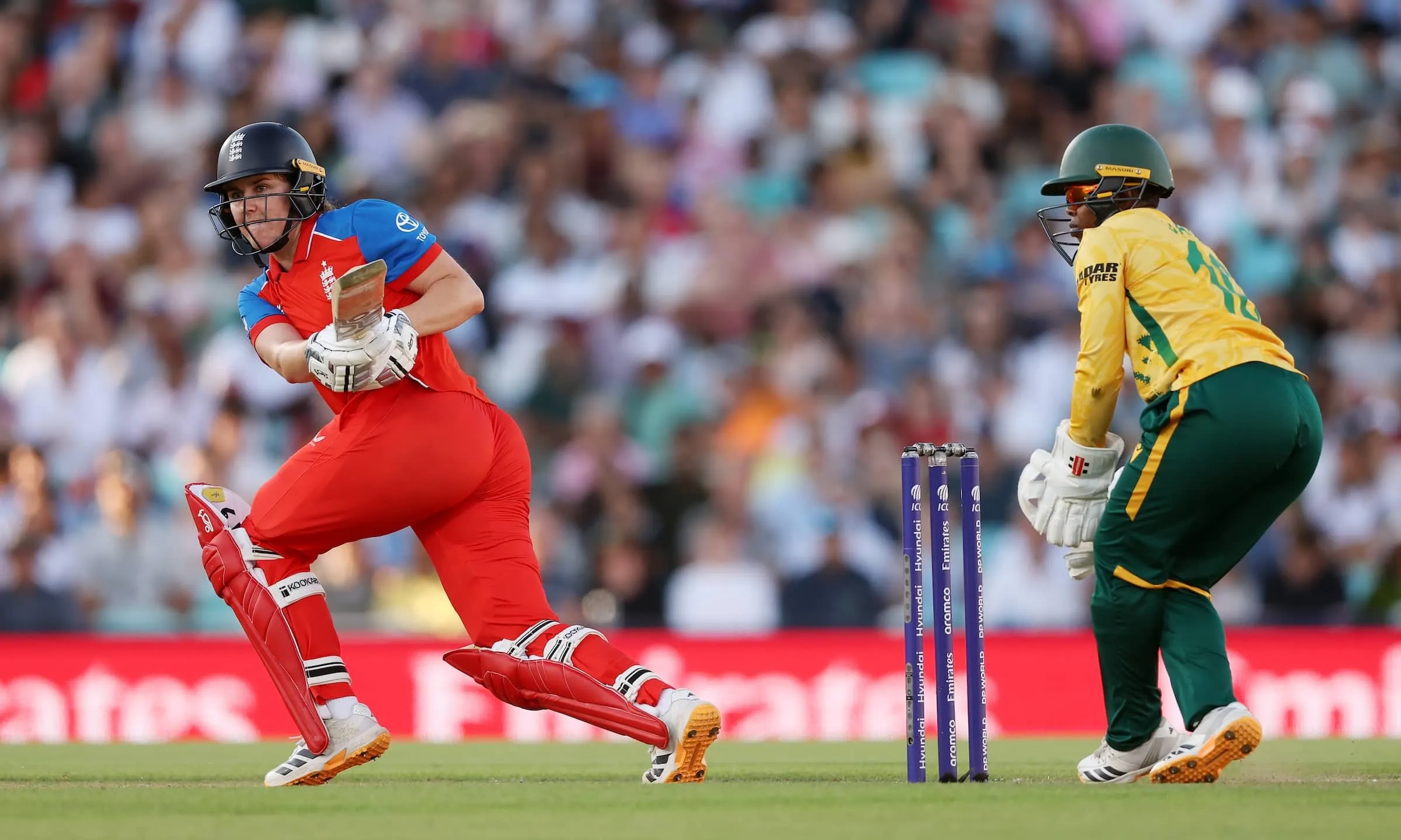
Nat Sciver-Brunt returns from injury to steer England past South Africa and into a T20 World Cup final against Australia.
The England Women World Cup final place is booked, and Nat Sciver-Brunt’s fingerprints are all over it: back from a calf injury, in at 23-3 against South Africa Women at The Oval, and out for 75 only after England had been dragged from bother into Sunday’s final against Australia at Lord’s.
England Women beat South Africa Women by 40 runs, posting 169-5 before restricting South Africa to 129-8. In scorebook terms, it looks tidy. In reality, it began with the faint smell of smoke and the sound of South Africa rummaging for a match.
England wobble, then find the grown-ups
Sciver-Brunt had missed England’s previous three matches with a calf injury, which is never ideal preparation for a World Cup semi-final. Nor is walking in during the powerplay with the scoreboard reading 23-3 and South Africa looking as though they had just discovered a loose thread in England’s jumper.
Marizanne Kapp had been terrific, bowling her full four overs from the start and finishing with 1-16. It was hostile, intelligent, awkward cricket. The sort of spell that asks batters personal questions and then waits, politely, for them to panic.
England did not panic. Not quite. They did something far more useful: they trusted experience.
Sciver-Brunt and Knight give England a spine
With Heather Knight at the other end, Sciver-Brunt put together the innings England needed rather than the one neutrals might have fancied. There was authority without vanity, urgency without daftness, and enough controlled aggression to shift the mood of the match one over at a time.
The pair added 133 from 90 balls, which was less a partnership than a rescue mission conducted in full view of a packed Oval. Sciver-Brunt made 75, Knight 58, and together they turned a semi-final lurch into something that began to look suspiciously like a plan.
Knight’s contribution should not be mislaid in the captaincy confetti. England’s record appearance holder across all formats has had a strong tournament, and here she brought exactly the sort of clear-headed nous that semi-finals tend to expose if you do not possess it.
By the time Sciver-Brunt fell, England had moved from danger to definition. A total of 169-5 was not outrageous, but it was competitive. More importantly, it gave England’s bowlers something to defend and South Africa something to chase with the clock ticking loudly.
Ecclestone sets the tone in the field
South Africa’s chase did not collapse immediately, which made England work for their comfort. The opening breakthrough took a little longer than they would have liked, but it came just before the end of the powerplay when Linsey Smith removed Laura Wolvaardt.
The wicket owed plenty to Sophie Ecclestone, who took a superb catch at mid-on, leaping and holding on above her head. It was one of those fielding moments that changes the temperature of a chase. South Africa had been moving; suddenly, England had a grip.
From there, England’s fielding was ruthless. Four further catches were held, and Danni Wyatt-Hodge added a direct-hit run-out for good measure, because apparently the evening required a little theatre as well as efficiency.
South Africa finished on 129-8, forty runs short, and England’s route to Lord’s was secure.
Australia await at Lord’s
So now it is England against Australia in a World Cup final at Lord’s, which is about as subtle as cricketing drama gets. Old rivals, grand stage, high stakes. The scheduling department may take a small bow.
England have reached this point with a clean run through the tournament: wins over Sri Lanka, Ireland, Scotland, West Indies, New Zealand and now South Africa. Some victories have been smoother than others, but semi-finals rarely reward the decorative. They reward nerve, judgement and the ability to stop a bad ten minutes becoming a bad evening.
That is why this win matters. England did not simply cruise into the final. They were tested, dented and placed under proper pressure. Then their captain, returning from injury, made the innings that shifted everything.
Australia will bring their usual pleasant habit of being Australia: hard to beat, allergic to generosity and generally unimpressed by romance. England, though, have earned their place at Lord’s the hard way.
They did not stroll across the river to Sunday’s final. They rebuilt the bridge plank by plank, then marched over it with the captain holding the hammer.