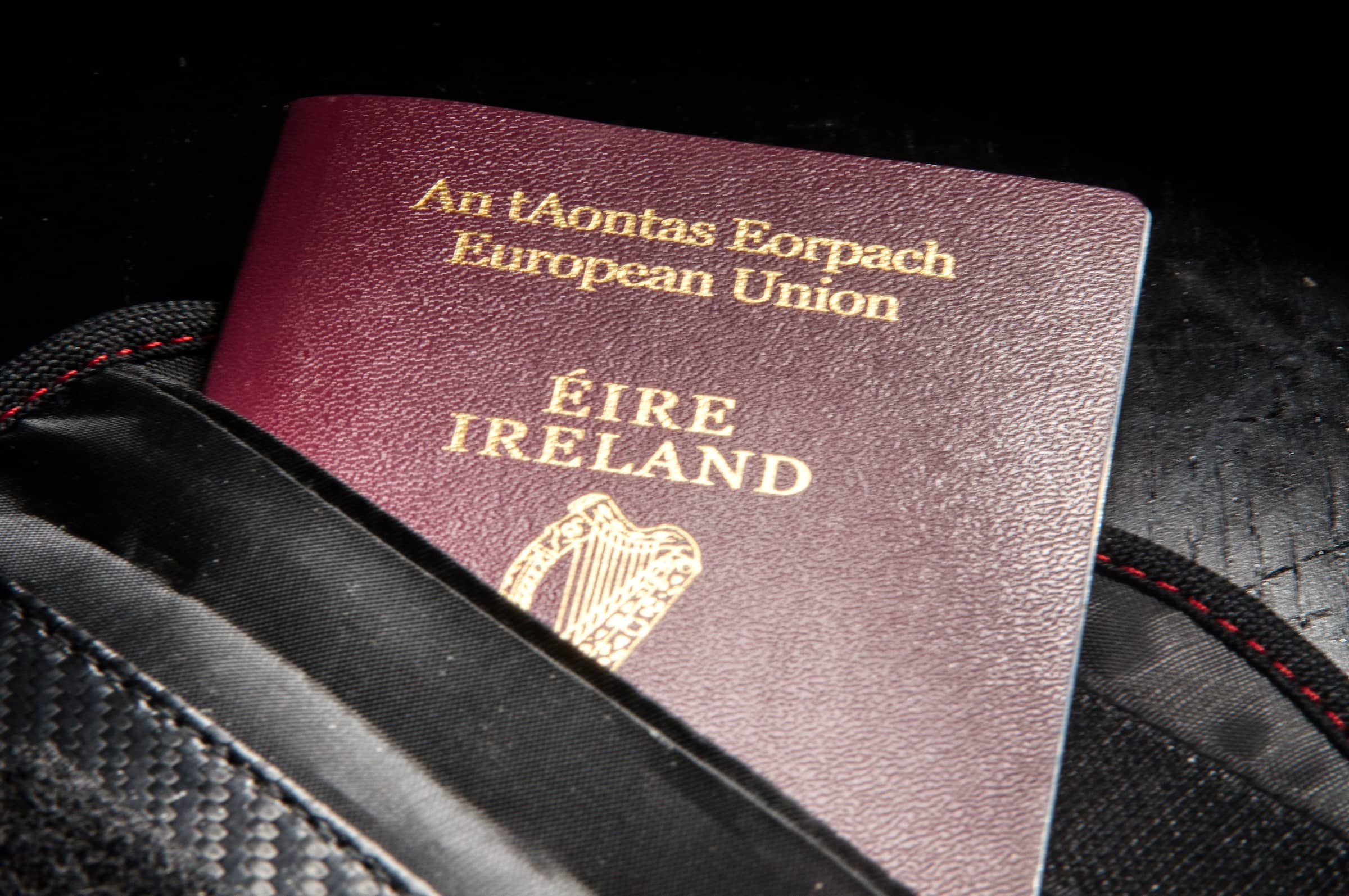
Irish passport searches are rising as travellers chase EU rights, ancestry claims and a practical second-passport Plan B.
Forget gold cards and airport lounge passes. The travel document people are suddenly chasing is green, Irish and potentially life-changing: searches for how to get an Irish passport have surged by 28% year-on-year as Brits and Americans look for EU rights, ancestral escape routes and a very modern thing — options.
New search data analysed by Global Work & Travel shows the term reached 9,000 searches in the past month alone. Interest spiked around October and November 2025, before cooling slightly in early 2026.
Still, the direction of travel is clear. The Irish passport has moved out of the drawer marked “family heritage” and into the folder labelled “serious life options”. For eligible applicants, it can mean EU rights, greater travel flexibility and the quiet satisfaction of having a second set of keys to the world.
Not bad for a document once mainly associated with citizenship offices, old birth certificates and someone in the family insisting their people were definitely from County Clare.
Why The Irish Passport Has Become So Desirable
There was a time when a second passport sounded faintly glamorous, like something owned by spies, shipping heirs or men in linen suits who used the word “Biarritz” without irony.
Not now.
Today, the second passport conversation has gone mainstream. Politics feels volatile. Borders feel less predictable. Travel rules shift. Work is more mobile. Education and healthcare are part of the equation. People are not just asking where they can holiday. They are asking where they could live if life took a sharp left turn.
For many, an Irish passport sits at the centre of that thinking.
For Brits, the gravitational pull is obvious: Brexit. An Irish passport can restore the right to live, work and study across the European Union, which is why so many people with Irish parents or grandparents are suddenly developing an intense interest in baptism records and attic paperwork.
For Americans, the motivation is more mixed: ancestry, lifestyle, education, healthcare, European access and, increasingly, the idea of a Plan B that does not involve muttering darkly at cable news.
Irish Citizenship By Descent: Who May Qualify?
Irish citizenship by descent can be available through an Irish-born parent or grandparent.
For many applicants, particularly those applying through a grandparent, the key stage is Ireland’s Foreign Births Register. Once a person is entered onto the register, they are an Irish citizen and can apply for an Irish passport.
That is the bit many people miss.
Irish ancestry may open the door. It does not fling it wide, hand over a passport and send you skipping towards Dublin Airport with a fiddle soundtrack playing in the background.
There is a process. There are documents. There is proof required. And, as with all serious admin, there is probably a moment when you wonder why no one in your family ever filed anything in a sensible folder.
Jürgen Himmelmann, travel expert at Global Work & Travel, said: “An Irish passport has become one of the most sought-after second passports because it gives people something many now feel they have lost or want to protect: options.
For Brits, Brexit is still the big driver. An Irish passport can restore the right to live, work and study across the EU, which is why so many people with Irish parents or grandparents are now looking into whether they qualify.
For Americans, the motivation is slightly different. It is often about ancestry, lifestyle, education, healthcare, travel and having a genuine Plan B. A second passport can feel like a safety net, especially when politics, cost of living and global uncertainty are making people think more seriously about where they could live in the future.
The spike we saw towards the end of 2025 is interesting because it suggests people are not just casually curious. They are actively searching for the process, which usually means they are checking eligibility, documents and timelines.”
Brexit Still Looms Large For British Applicants
Official figures reported in November 2025 showed 242,772 people applied for an Irish passport in 2024, with more than half coming from Northern Ireland.
The number of people living in Britain who applied via the Foreign Births Register reached 23,456 in 2024 — the highest since the Brexit referendum.
That is more than a bureaucratic footnote. It is a signal.
For eligible British applicants, an Irish passport is not just a travel document. It can be a bridge back to European mobility: living in Spain, studying in the Netherlands, working in Germany, retiring somewhere with better weather and fewer conversations about potholes.
Brexit did not remove the emotional connection many people have with Europe. It simply made the paperwork more interesting — and considerably more annoying.
American Interest Is Rising Fast
Across the Atlantic, the Irish passport story has its own flavour.
Recent reports show American applications for Irish citizenship through ancestry rose 63% in 2025, from 11,601 in 2024 to 18,910.
That rise says plenty. For some Americans, this is about family identity and heritage. For others, it is about future-proofing: access to Ireland, the wider EU, different education options, potential healthcare considerations and a broader sense of personal freedom.
In other words, the Irish passport has become both emotional and practical. A rare combination. Like a family heirloom that also gets you through immigration faster.
The Foreign Births Register Question
For anyone researching how to get an Irish passport through a grandparent, the Foreign Births Register is usually the crucial phrase.
Applicants need to prove the family connection with the correct documentation. That may include birth, marriage and other official records linking each generation. Once the Foreign Birth Registration process is complete, the applicant is recognised as an Irish citizen and can then apply for the passport.
It is not instant. It is not automatic. It is not something that happens because your uncle once owned a green rugby shirt and claimed to know all the words to “The Fields of Athenry”.
Jürgen added: “The biggest mistake people make is assuming Irish ancestry automatically means they can get a passport tomorrow. In reality, people need to prove the family link with the right documents, and if they are applying through a grandparent, they usually need to complete Foreign Birth Registration first.
It is not instant, but for eligible travellers, workers, students and families, it can be life-changing. An Irish passport can open the door to Ireland, the wider EU and a different level of long-term travel freedom.”
Why This Search Boom Feels Bigger Than Travel
The surge in Irish passport searches is not just about holidays. It is about control.
A holiday is choosing where to go for ten days. A second passport is asking where your life could go next.
That is why this topic has such pull. It sits at the crossroads of identity, mobility, family history and modern anxiety. It is about parents, grandparents, borders, rights, opportunity and the faintly terrifying realisation that old paperwork may now be one of the most valuable things in the house.
For eligible travellers, workers, students and families, an Irish passport can offer something simple but powerful: options.
And in a world that has developed a nasty habit of turning certainty into confetti, options are no small thing. They are the difference between staring at a closed door and remembering, with some relief, that your grandmother may have left you a key.