Noémie Lepoutre shocks the MCC as HOKA UTMB Mont-Blanc 2026 opens with PTL history, adaptive athletes and a brutal TDS night ahead.
The HOKA UTMB® Mont-Blanc 2026 week has barely had time to find its rhythm and already produced a result worth remembering.
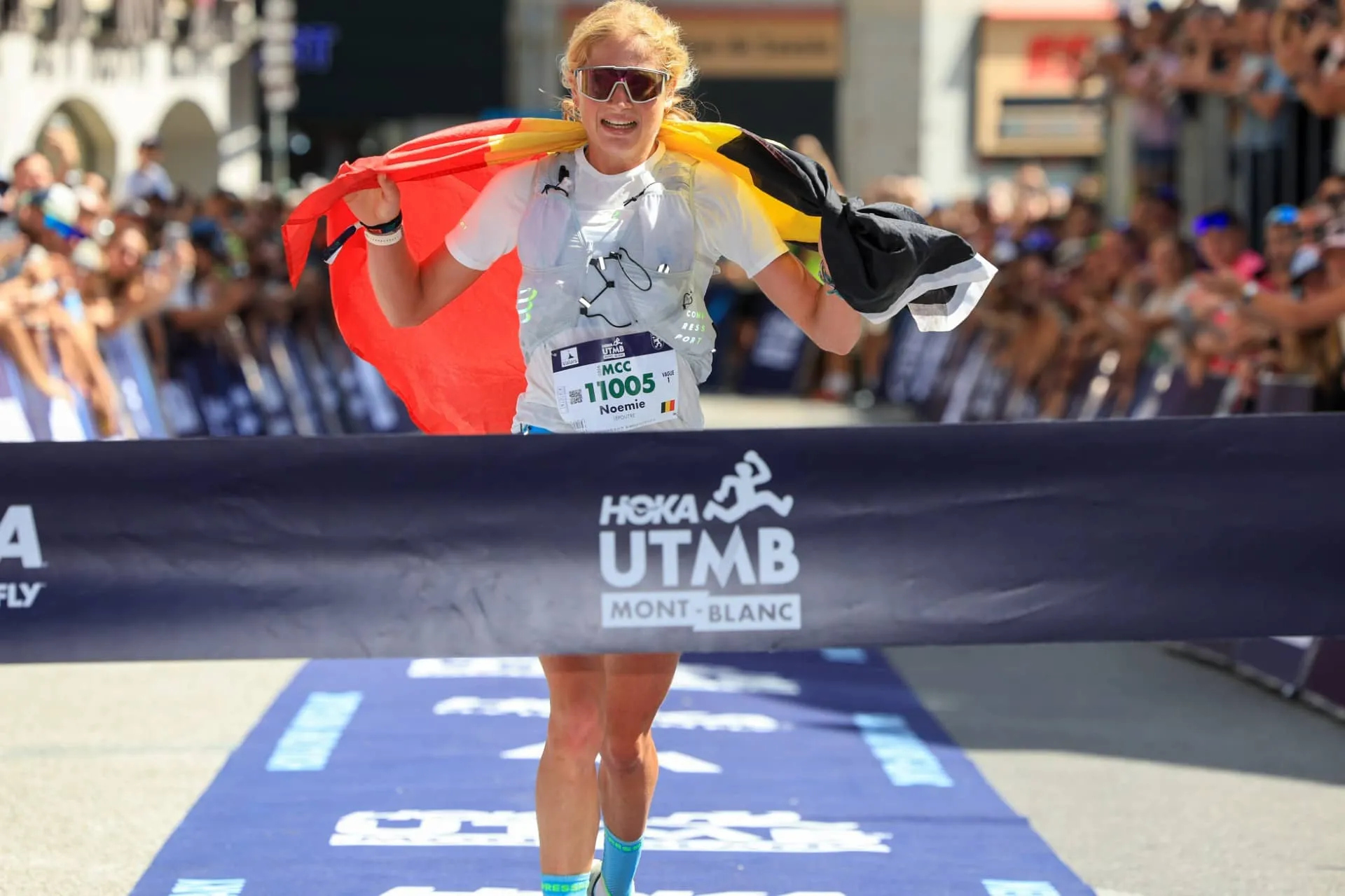
Belgium’s 22-year-old Noémie Lepoutre won the MCC after 40km and 2,350m of climbing, turning the opening day of the 23rd edition into something rather more interesting than ceremonial flag-waving and nervous glances at altimeters.
Noémie Lepoutre Provides the MCC Surprise
Lepoutre, carrying a UTMB Index of 707, came through with a late comeback to finish ahead of Pauline Girardet, whose index stands at 703.
There was a pleasing wrinkle to the result. Lepoutre has been around UTMB since childhood, first attending at six years old to support her father. On Monday, while she was winning the MCC, he was tackling the altogether less civilised proposition of the PTL.
Her victory also represented a significant jump in distance.
“I grew up with the UTMB, going along since I was 6 to support my father, who is currently running the PTL. I’d already taken my first steps on the YCC and the Trail de Verbier Saint-Bernard, but this was my first MCC and my first time running this far.
I had to learn to manage the distance and the heat, but it was a great course that suited me well, with some big climbs and then a more runnable finish.”
Among the men, Gatien Airiau headed an all-French top five and succeeded Yoann Stuck as MCC winner, narrowly beating Florian Bernabeu-Seguy.
The PTL Begins Its Enormous Journey
If the MCC is a race, the PTL feels closer to an expedition that happens to involve running.
Its 125 teams of two or three face roughly 300km and 25,000m of elevation gain across five to seven days. The route is unmarked, changes annually and demands navigation, self-sufficiency and teamwork. Anyone looking for a convenient kilometre marker may be waiting some time.
This year’s start also carries particular significance.
South Africa’s Travis Warwick-Oliver becomes the first amputee athlete to start the PTL, while long-distance specialist Sébastien Raichon is attempting the event for the first time.
Team Adaptive Brings Different Challenges to the Mountain
Some of the strongest opening-day stories had little to do with finishing positions.
Pierre Cabon, paraplegic since the Bataclan attack, started the MCC in an adapted wheelchair with six teammates. Visually impaired athlete Nicolas Ronget, another Team Adaptive member, also took part.
Further examples are already waiting elsewhere in the programme.
Deaf athlete Guillaume Pick and Louis Pech, who became the first cystic fibrosis patient to complete the UTMB in 2025, are due to tackle the TDS. Blind athlete Maria Petit will race the ETC.
The clock matters at UTMB. It simply does not own every story.
TDS Sets Up a Long Night From Courmayeur
Attention now turns to the TDS, scheduled to leave Courmayeur at 11.50 pm with 145km and 9,500m of elevation gain ahead.
Louison Coiffet, winner of the 90K Mont-Blanc, and Tyler Green, holder of the 2026 Scout Mountain 100 Miles record, are among the leading men named before the start.
In the women’s field, Anna Tarasova, winner of the Lavaredo 80K and third at the 2025 CCC, lines up alongside 2018 trail world champion Ragna Debats.
It promises to be the sort of night in which 145 kilometres looks perfectly reasonable on an entry form and rather less persuasive once darkness settles over the mountains.
ETC and YCC Add Speed and Youth
Tuesday’s programme also changes the scale without removing the difficulty.
The ETC covers 15km with 1,200m of ascent, favouring runners comfortable with a shorter, sharper contest. Vivien Bonzi and Marie Nivet are among the women highlighted, with Joey Hadorn and Taylor Stack among the leading men.
The YCC, meanwhile, puts younger runners on the same stage and offers an early glimpse of names that may return to Mont-Blanc with rather larger ambitions.
UTMB week is only beginning. The first lesson has already arrived: around these mountains, the most interesting story is rarely the one printed highest on the start list.