Sport is again proving itself as more than a field of play – it's a platform, and athletes, as they have had through history, possess the ability to speak up, stand up and inspire masses.
Billie Jean King has spent a lifetime proving that tennis is not merely a game of white lines, polite applause and people pretending not to panic on second serve. It is a stage, a microphone, a mirror and, in the right hands, a rather elegant weapon for change.
At a moment when sport is again being asked to look beyond scoreboards and silverware, King’s legacy feels less like history and more like a current affairs bulletin. The Black Lives Matter movement has reminded the sporting world that athletes do not step into public life only when the match starts. They arrive with families, histories, convictions and, occasionally, the spine to say the uncomfortable thing while everyone else is busy admiring the footwork.
Few understand that better than King.
The Athlete Who Saw The Court As A Platform
Katrina Scott
Long before social media turned every player into a broadcaster, King understood the reach of tennis. Not in the sleek, monetised sense we use now, but in the old-fashioned human sense: people watch, people listen, and sometimes people change.
“I had an epiphany when I was 13 years old,” says King. “I didn’t know what a platform was, but I knew that tennis was global, and that maybe through it I would be able to make the world a better place.”
That is an extraordinary thought for a 13-year-old. Most of us at that age were still trying to understand shoe sizes, sarcasm and why adults insisted on ruining weekends with errands. King was already measuring the dimensions of global sport and wondering how to prise open its doors.
Her fight did not remain abstract. It became structural. In 1970, King and the Original 9 signed symbolic $1 contracts, a defiant act that helped give birth to women’s professional tennis. It was not glamour. It was not comfort. It was a line in the sand with a tennis racket attached.
“Then in 1970, when we the Original 9 signed our $1 contracts which gave birth to women’s professional tennis, we really were thinking about the future generations, and that each generation needs to build up on each other. We envisioned three things: that any girl in the world would have a place to compete, that she would be appreciated for her accomplishments, and that she would be able to make a living.”
There it is: access, respect and a wage. Three ideas so reasonable it took a revolution to make them sound obvious.
From Billie Jean King To Katrina Scott
The thread from King’s generation to today’s players is not neat, and nor should it be. Progress is rarely a straight line. It tends to wobble, stall, lurch forward and then require someone brave enough to shove it again.
That is where Katrina Scott enters the frame.
Last week, the 16-year-old arrived in New York City to compete on one of tennis’ biggest stages for the first time. A young Black woman at the start of her professional career, she did so during a global civil rights movement that had already pushed athletes across sport to confront the old and lazy idea that they should simply “stick to sport”.
Scott did not arrive as a slogan. She arrived as a player. But she also arrived with an awareness that the court can carry more than a result.
“It’s incredible to be how young you are, and on that stage,” says Scott as she looks back at her first experience at a major. “But I think it also felt different because I was playing for something greater than just myself and my team.”
That is a lot to carry at 16. Enough pressure comes with a first major appearance: the locker room, the noise, the lights, the invisible weight of expectation. Add a wider social moment, and suddenly the walk to court becomes something closer to a public declaration.
The Small Gesture That Wasn’t So Small
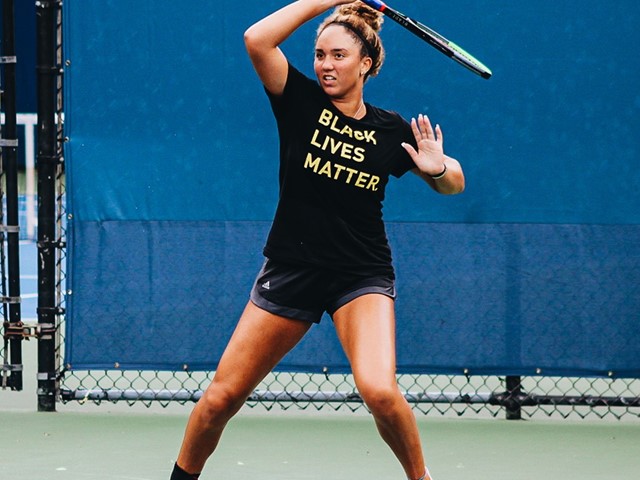
Scott wore a Black Lives Matter shirt while walking onto court in the first two rounds. It was a simple act, visually direct and impossible to confuse. No speech, no grandstanding, no theatrical flourishes. Just a young player using the space available to her.
“Wearing the Black Lives Matters shirt and doing whatever I can to help educate more people and put the word out there. Even though it’s a small gesture, it’s the little things that go a long way.”
There is a useful lesson in that. Athlete activism does not always arrive with a podium, a documentary crew and a dramatic soundtrack. Sometimes it is a shirt. Sometimes it is a question. Sometimes it is the refusal to pretend that silence is neutrality.
King, unsurprisingly, approves of athletes recognising the value of their platform.
“I love seeing athletes using their platforms, I think they should’ve been standing up since day one. We’re so fortunate to have a platform that most people do not have, we need to use it to make positive change.”
It is a sharp reminder that visibility is not only a commercial asset. It is a civic one. Sport sells kit, tickets and television rights, yes. But at its best, it also sells courage to people who may not yet know they need it.
The Question Every Young Athlete Eventually Asks
Scott, a long admirer of Billie Jean King, asked the question that sits beneath nearly every public act of sporting courage: how do you keep going when the fight is bigger than the match?
“What drove you to keep going, and keep fighting – how you dealt with that and still managed to play high level tennis?”
It is a question with teeth. Activism sounds noble from a distance. Up close, it can be exhausting, isolating and inconvenient. It asks athletes to perform twice: once in competition, and again in public conscience. Not everyone has the appetite for it. Not everyone should be expected to. But for those who do, the burden can become part of the purpose.
King’s answer reached beyond her own career. It always has.
“It was always about other people, other generations,” replies King. “I was really thinking about Katrina, and she wasn’t even born yet. That’s what kept me going. I want to have a great legacy, something to continue after I’m here, it will be a constant reminder to everyone but particularly young people to constantly keep going.”
That line lands because it strips legacy of vanity. This is not legacy as statue, suite name or ceremonial blazer. It is legacy as relay. One generation runs until the legs burn, then hands the thing on.
Tennis Has Always Been More Than The Score
Tennis likes to present itself as orderly. Chairs, lines, etiquette, hushed crowds and a scoring system apparently assembled by a committee of eccentric owls. But beneath that surface, the sport has often been a stage for arguments about gender, race, class, money and power.
King knew that. The Original 9 knew that. Scott is learning it in real time.
The connection between Billie Jean King and Katrina Scott is not about pretending the two careers are the same. One is an icon whose work reshaped women’s professional tennis. The other is a young player at the beginning of her journey. But the shared idea is clear: the athlete’s platform is not a decorative extra. It is part of the job if the athlete chooses to use it.
And that choice matters.
Because when a 16-year-old walks on court wearing a message, she is not only speaking to the stadium. She is speaking to the girls watching from home, to the players still finding their voice, and to the people who would rather sport remained comfortably mute.
King spent her career making sure future generations had a place to compete, a chance to be valued, and the possibility of earning a living from their talent. Scott’s moment suggests that the next generation may inherit something else too: the expectation that they can stand for more than themselves.
Tennis will always have its winners and losers. That is the tidy part. The more interesting question is who uses the game to leave the place better than they found it. Billie Jean King has been answering that for decades. Katrina Scott, racket in hand and message on shirt, has begun writing her own reply.