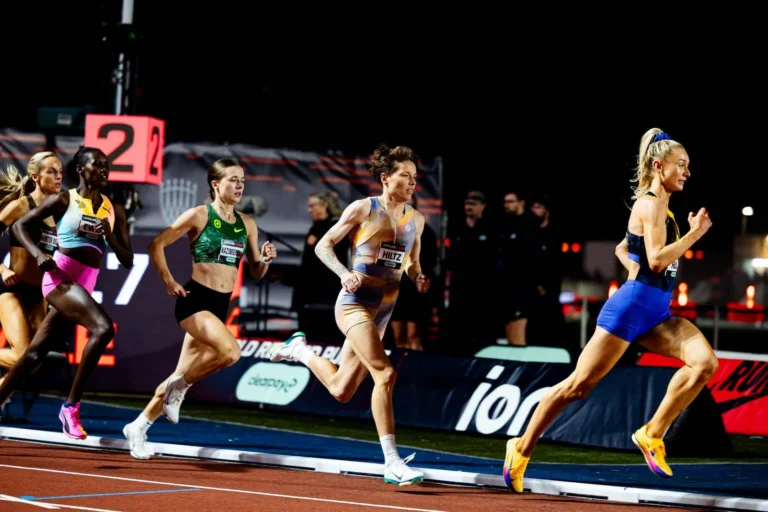
World Athletics’ Iron Sharpens Iron goes inside elite training groups as Bol, Richardson and Hodgkinson build towards Budapest.
Athletics ‘Iron Sharpens Iron’ is World Athletics’ attempt to show the part of elite sport that television usually cuts away from: the repetition, the training-ground hierarchy and the awkward reality that the person helping to make you faster may also be the person trying to beat you.
Across three half-hour documentaries, the series follows leading training groups in the Netherlands, Florida and Manchester as they build towards the World Athletics Ultimate Championship in Budapest on 11-13 September.
Why ‘Iron Sharpens Iron’ Has A Useful Angle
Elite sport has always enjoyed the myth of the lone genius. Training groups are less romantic and, generally, rather more practical. The series is built around athletes who spend their working lives measuring themselves against world-class standards before a starter’s pistol appears.
That gives World Athletics a stronger story than another glossy road-to-the-championship montage. The interesting bit is not simply who trains where. It is how rivalry can be productive when everyone in the room is good enough to expose a weakness.
And there are rather a lot of people here capable of doing precisely that.
Papendal Puts The Event Switch Under The Microscope
The first episode heads to Papendal in the Veluwe woods, near Arnhem, where Laurent Meuwly oversees a group containing Femke Broeders-Bol, Lurdes Gloria Manuel, Lieke Klaver and Nadine Visser.
Broeders-Bol provides the obvious narrative tension. She is turning her attention from the 400m hurdles to the 800m, which changes more than the number painted on the track.
A move into a different event brings different demands, different rivals and a fresh set of questions. The documentary has the chance to show the unglamorous middle ground between deciding on a new challenge and looking comfortable doing it.
That is usually where the interesting television lives.
Richardson And Jefferson-Wooden Share The Same Sprinting Air
The second chapter moves to Star Athletics in Florida, led by three-time Olympic sprint medallist Dennis Mitchell. Melissa Jefferson-Wooden and Sha’Carri Richardson sit at the centre of that story, with Kenny Bednarek and Christian Coleman also featuring.
There is an obvious attraction here. Sprinting sells certainty in tiny fractions of a second, but training rarely feels certain.
Two elite sprinters can work side by side, absorb the same coaching environment and still know that national and global supremacy may eventually come down to who handles pressure best on one afternoon.
That is a richer proposition than treating competition as hostility. Sometimes your most inconvenient benchmark is standing two lanes away.
Hodgkinson And Hunter Bell Bring The Rivalry Home
The final visit is to M11 Track Club in Manchester, run by Trevor Painter and Jenny Meadows. Keely Hodgkinson and Georgia Hunter Bell lead a group that also includes Sarah Healy, Benjamin Robert, Erin Wallace and Lewis Davey.
Hodgkinson and Hunter Bell began 2026 with indoor world titles over 800m and 1500m respectively. Their presence gives the series another version of the same central idea: excellence can be collaborative right up until the race demands selfishness.
Manchester may lack the Dutch woodland postcard setting or Florida sunshine, but it offers something television understands very well — close quarters, recognisable personalities and nowhere much to hide when training starts to bite.
Budapest Gives The Series A Proper Finish Line
The World Athletics Ultimate Championship takes place in Budapest from 11-13 September, with a $10 million prize pot and $150,000 available to each individual champion.
The event is designed to bring together Olympic champions, world champions, Diamond League winners and leading ranked athletes. Its ambition is hardly bashful.
That gives ‘Iron Sharpens Iron’ a useful deadline. These are not training films floating around in search of a climax; they are attached to an event carrying money, status and a deliberately grand claim to sporting supremacy.
The series will succeed if it resists polishing away the friction. Elite training is not interesting because everyone is inspirational before breakfast. It is interesting because progress is repetitive, rivalry is personal and the margins are miserly.
The medal may be won in Budapest, but the more revealing contest is already happening in training.