The 10th Anniversary Superhero Tri drew a record 5,000 participants to Dorney Lake, marking a decade of barrier-free disability sport.
The 10th Anniversary Superhero Tri arrived at Dorney Lake on 15th August with a useful answer to a question British sport still asks too often: what happens if an event is designed around disabled people from the outset rather than adapted for them afterwards?
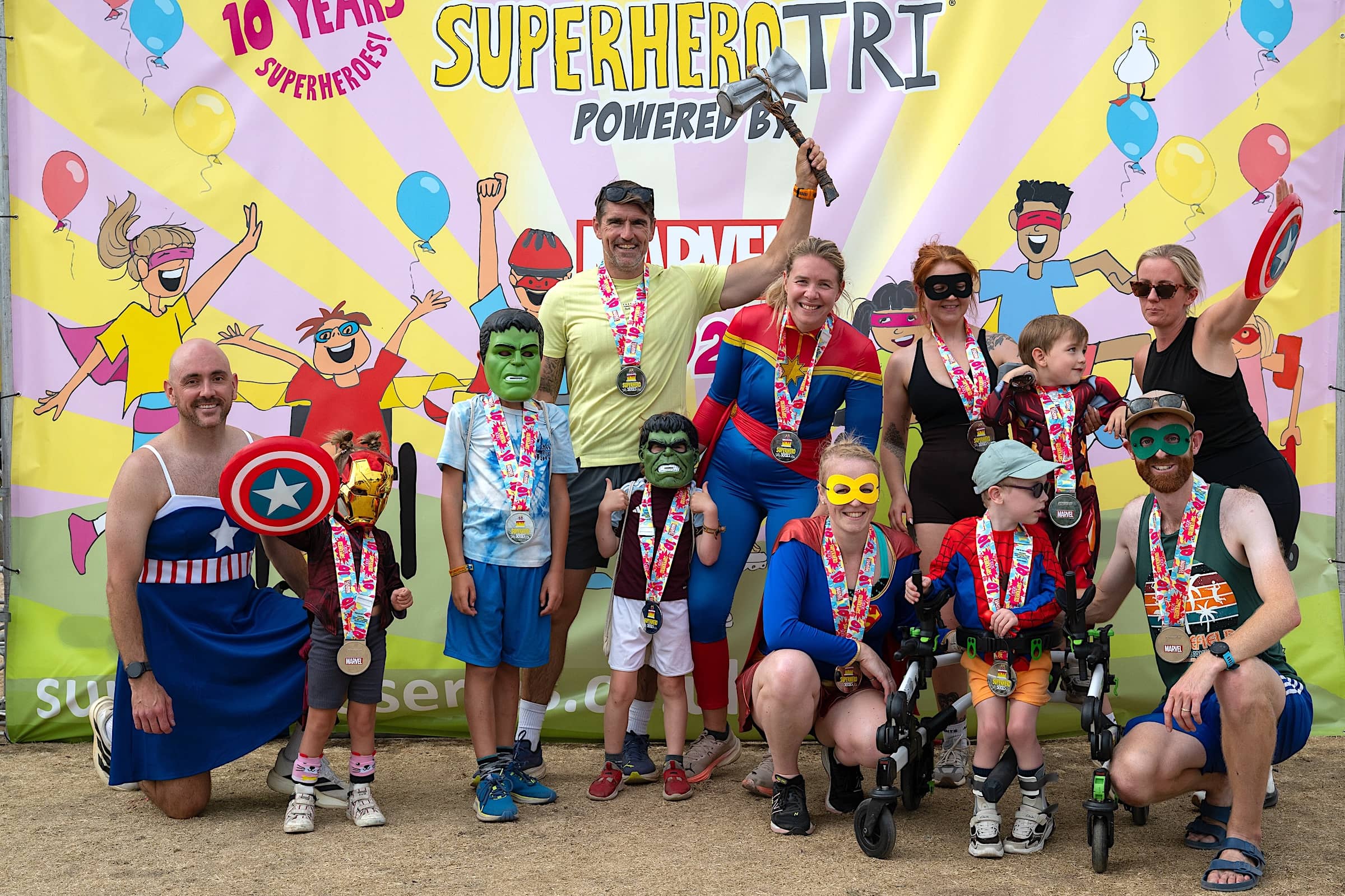
A record 5,000 participants and Sidekicks turned up to provide the reply, in capes, costumes and rather more practical forms of sporting kit.
A record field for Superhero Tri 2026
Founded by British Paralympian Sophia Warner, Superhero Tri has now spent a decade building mass-participation sport on deliberately different terms. There are no cut-off times, no equipment restrictions and no insistence that everybody reaches the finish in the same fashion.
Participants could choose a Sprint mission of a 150m swim, 3km bike and 1km push/run; a Half of 400m, 10km and 2.5km; or the Full distance of 750m, 20km and 5km.
That flexibility is not decorative inclusivity. It is the organising principle.
“When it comes to mass-participation disability sport, inclusion in mainstream events isn’t the answer,” explains Sophia Warner, founder of the Superhero Series. “The Paralympics clearly demonstrate the need for a platform where people with disabilities compete alongside each other.
Lack of confidence can be a huge barrier to participation, but when people see everyone is like them, they feel physically and psychologically safe. That’s what the Superhero Series events provide and that’s what makes us unique.
“As we celebrate our 10th anniversary this year with our biggest turnout yet, it demonstrates clearly that, when given the opportunity, Everyday Superheroes will come.”
Why disability-first design matters
The distinction is important. Plenty of sporting events describe themselves as inclusive; fewer start with disabled participants as the default audience and build every rule around that premise.
Across the Superhero Series’ four annual events, more than 70,000 missions have been completed over the past decade. Families and friends can take part as Sidekicks, while Paralympians and disability ambassadors provide the sort of visible sporting role models that leaflets and mission statements struggle to match.
Activity Alliance’s 2025–26 Annual Disability and Activity Survey underlines the scale of the issue. The figures supplied for the survey say 16 million people in the UK have a disability, 76% want to be more active, yet only 43% can find an opportunity. It also estimates that closing the inactivity gap could generate £10.9 billion in social value.
Clare Balding and a decade of familiar faces
Clare Balding CBE has been attached to the event since Warner first discussed the idea with her at the Rio Paralympics in 2016. She has attended every Superhero Tri since, reporting, supporting participants and presenting Golden Cape honours.
“Superhero Tri is truly powerful and the only event of its kind,” says Clare. “I love how everyone dresses up and gives it their all. I’ve seen children grow up with the event and meet families who get together each summer here.
Best of all, I’ve seen individuals going from strength to strength, achieving more each time they return. The community is extraordinary and I wouldn’t be anywhere else on Superhero Tri weekend!”
That continuity may be the event’s most persuasive statistic of all. Ten years is long enough for children to become teenagers, newcomers to become regulars and an eccentric-looking sporting experiment to become part of the summer calendar.
Marvel support adds theatre, not the purpose
The Walt Disney Company UK & Ireland has supported Superhero Tri through Marvel, giving the day its obvious theatrical flourish. Costumes help, certainly. A cape rarely harmed a finish-line photograph. But the substance is the sporting structure underneath it.
“We are proud to continue championing the Superhero Tri, powered by Marvel, during its 10th year, cheering on countless Everyday Superheroes and celebrating every unique story and incredible achievement they represent,” says Deborah Armstrong, Country Manager UK & Ireland at The Walt Disney Company EMEA.
“When people see themselves reflected in sport, confidence grows and new possibilities open. Once again, it was a joy to see people in costumes and capes making some amazing memories!”
Other supporting partners include Allied Mobility, Bupa Foundation, E.ON, Everyone Active, Fletchers Solicitors, Pfizer, Salutem, Staysure, Swim England and the Superhero Sport Foundation.
The next Superhero Series event
The next Superhero Series fixture is Winter Wonderwheels at Dorney Lake on 6 December.
The larger story, though, is already visible in August’s record field. Superhero Tri has survived its first decade not by asking disabled athletes to fit neatly into somebody else’s sporting template, but by changing the template.
Five thousand people turned up for the birthday party. British sport might care to study the guest list.