ZOE promises personalised nutrition and gut-health insight, but health is rarely as tidy as the product pitch suggests.
You start to notice it quietly.
A name repeated often enough that it begins to feel like fact. Articles circling the same message until it settles in—familiar, unchallenged. Not imposed, just present. Then one day, it’s everywhere—on supermarket shelves, in conversations, in shopping baskets.
Right now, that name is ZOE.
Personalised nutrition. Backed by science. A smarter way to eat. For many people, it feels like the answer they’ve been waiting for. Something intelligent, something measured—something that finally makes sense of the confusion.
But there’s something familiar about it.
Not in what it says—but in how it arrives.
There was a time when whey protein held that position. Shakes became shorthand for discipline. More meant progress. Then Atkins. Carbohydrates removed, fat repositioned, control reframed as restriction. Each one carried evidence. Each one made sense at the time. Each one offered clarity in a space that rarely feels clear.
And each, eventually, softened.
Not because they were wrong, but because they were incomplete.
ZOE sits somewhere along that same line. It brings something useful into focus—the idea that people respond differently to food, that the gut plays a role, that one diet doesn’t fit everyone. That part holds.
Where it begins to stretch is in how that complexity is presented.
Because the gut is not fixed. It responds to stress, to sleep, to movement, to environment. What works after a good night’s rest doesn’t always work after a difficult week. It recalibrates constantly, quietly adjusting beneath the surface.
Yet what reaches people is something cleaner.
A sense that your biology can be measured, interpreted, and translated into a system you can follow. A score you can improve. A structure you can rely on. Something that removes the guesswork.
And it doesn’t take much for that to take hold.
One search. One article. One moment of curiosity. Then the shift begins.
Content appears—not aggressively, just consistently. Podcasts. Interviews. Calm voices explaining the science in a way that feels grounded and reassuring. It doesn’t feel like marketing. It feels like understanding.
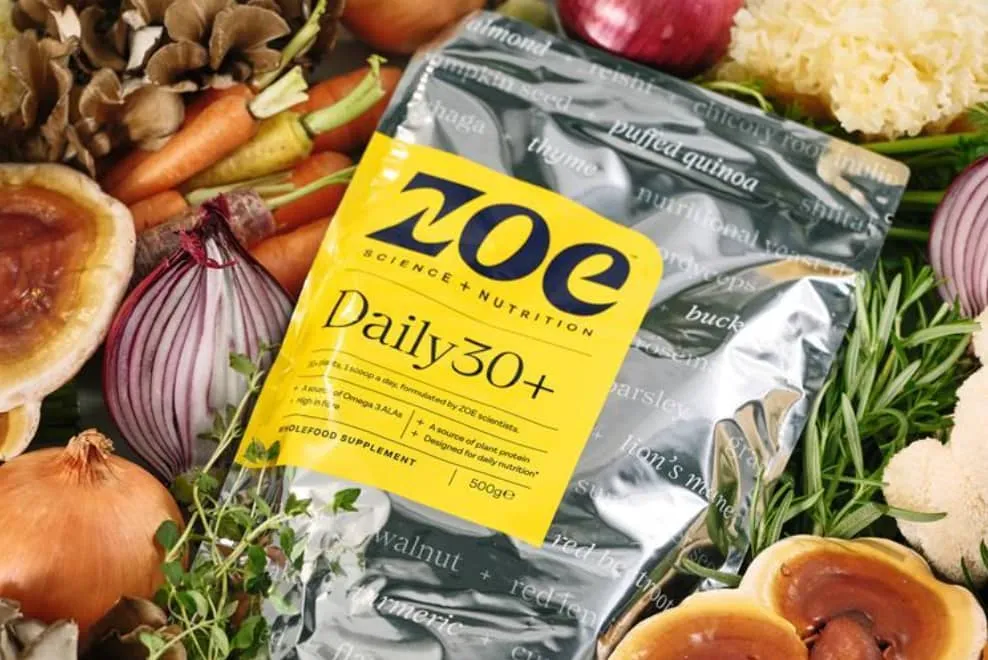
Not entirely without scrutiny. A recent advert for ZOE’s Daily30+ supplement was reviewed by the UK’s Advertising Standards Authority following concerns over how its claims were being interpreted.
And then, as it tends to, the movement continues.
Gradually, it becomes familiar. Then normal. You see it more often. You hear it in conversation. People around you begin to adopt it. The question changes—almost without you noticing—from “does it work?” to “should I be doing this too?”
And by that point, the decision no longer feels like a decision. It feels like catching up.
I’ve watched what happens next.
People who genuinely want to improve their health begin to build their routines around it. Their shopping changes. Their language changes. Their confidence in what they’re doing increases. There’s a sense of alignment, of being on the right track.
But their bodies don’t always follow in the same way.
They don’t move differently. They don’t function differently. They don’t carry themselves differently. The changes are visible—in cupboards, in habits, in conversation—but less so in how the body actually performs.
They’ve changed what they buy.
That part rarely gets discussed.
Because it doesn’t sell.
Health becomes something you purchase. Something you follow. Something that arrives in a package rather than something that develops over time. And in that shift, something far less marketable begins to fall away.
Variety.
Not as a slogan, but as a principle. The body responds to range to different foods, different patterns, and different inputs over time. It adapts. It learns. It adjusts. Balance doesn’t come from narrowing everything down. It comes from exposing the body to enough variation to respond properly.
There is science behind all of these approaches. That’s not in question. But science—especially in this space—is still moving. The problem is how quickly that movement becomes certainty, and how quickly that certainty becomes product.
Atkins simplified. Whey concentrated. ZOE personalises. Each adds something. But none completes the picture.
Because the body doesn’t stay still.
What works now won’t always work later. What feels right today may need adjusting tomorrow. That isn’t a flaw in the system.
That is the system.
And it’s not an easy message to accept, because it requires something that can’t be packaged. Attention. Consistency. A willingness to adjust without being told exactly how.
In the end, the goal isn’t to follow the latest system perfectly.
It’s to remain capable.
To move well. To function independently. To live without becoming reliant on something you don’t fully understand.
And that doesn’t come from a product.
It comes from how you live – Over time.