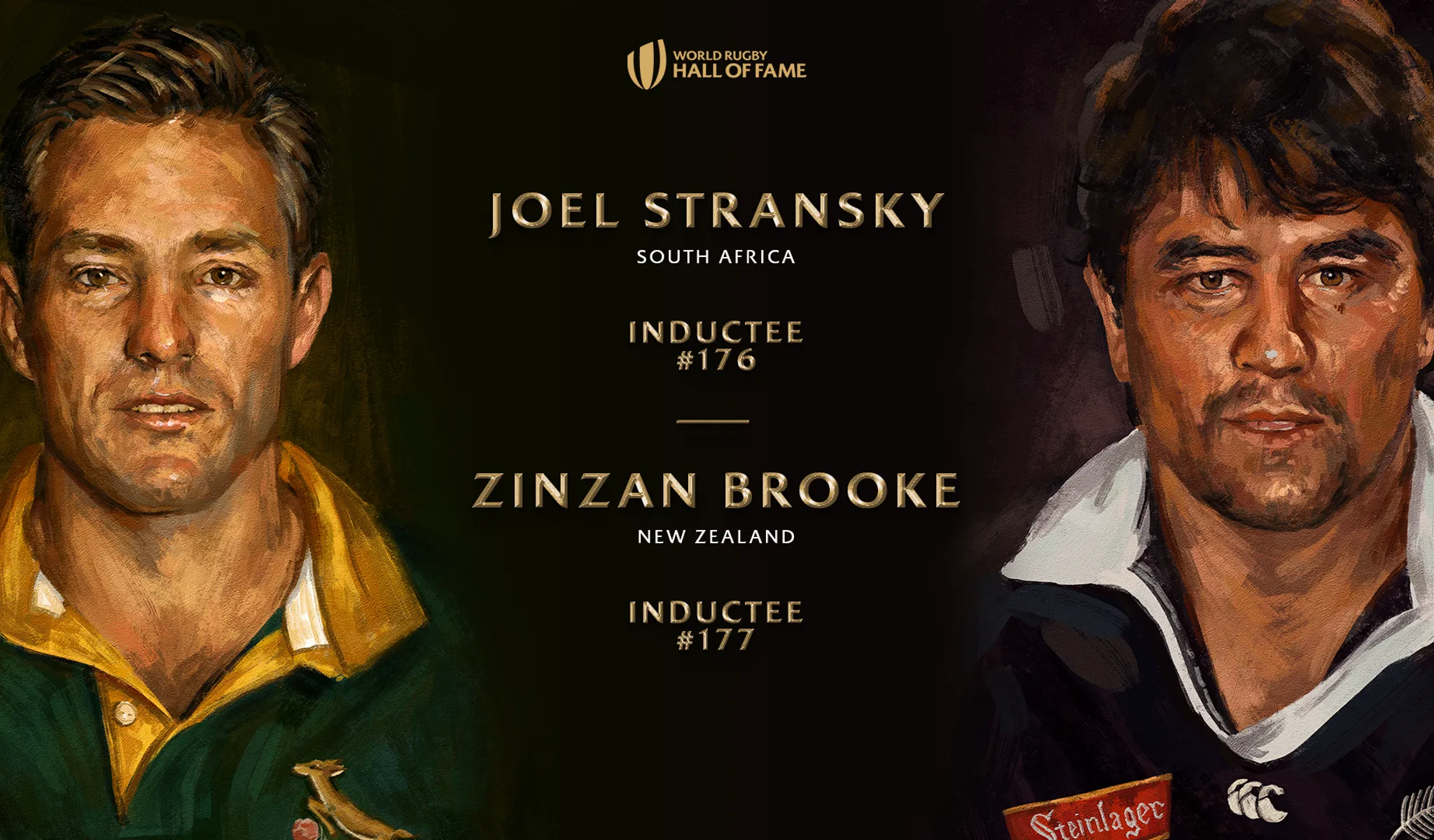
Joel Stransky and Zinzan Brooke become the first inductees in the World Rugby Hall of Fame class of 2026, with five more names still to come.
The World Rugby Hall of Fame class of 2026 has opened with two men whose reputations were secured, in part, by the sort of drop goals that make coaches look clever and defenders look briefly unemployed.
Joel Stransky and Zinzan Brooke are the first of seven inductees, honoured in Cape Town before the second test of the Rugby’s Greatest Rivalry series between South Africa and New Zealand.
Two careers, one remarkably useful skill
There is a pleasing symmetry to the first two names. Stransky was a fly-half, so kicking points was very much in the job description. Brooke was a number eight, which made his habit of dropping into the pocket and behaving like a back rather less conventional.
Both were Rugby World Cup winners on home soil. Brooke was 22 when New Zealand won the inaugural tournament in 1987. Stransky’s defining afternoon came eight years later at Ellis Park, where he scored every South African point in the 15-12 final victory over New Zealand, including the extra-time drop goal that settled it.
Brooke supplied his own piece of 1995 drop-goal theatre in the semi-final against England, landing one from 38 metres. A year later he kicked another, this time to clinch a test series against South Africa. For a back-row forward, this was bordering on impudence.
Stransky: 15 points that never grew old
Stransky’s international career was relatively compact: 22 tests between 1993 and 1996, six tries and 240 points. Yet longevity is not the only currency in a Hall of Fame. Some careers contain a moment that refuses to fade, and his extra-time strike in Johannesburg is one of them.
There was substance around the famous kick. Stransky had helped Natal beat Northern Transvaal in 1990 to win the Currie Cup for the first time, spent two seasons in Italy with L’Aquila and San Dona, then later moved to Leicester after professionalism arrived.
He scored 896 points in 73 appearances for the Tigers and helped them win the Pilkington Cup and Allied Dunbar Premiership title.
After playing, he moved through coaching, business, sports marketing and broadcasting. The 1995 final remains the headline, but it was not the whole newspaper.
Brooke: a number eight with ideas above his station
Brooke’s international record stretched across 12 years and three World Cups. He won 58 caps, started 54 tests and scored 17 test tries, a record for a forward at the time. In total he represented the All Blacks 100 times, including non-international matches, and also played 22 times for the Māori All Blacks.
The numbers explain part of his standing. The manner explains the rest. All Blacks teammate Jeff Wilson once described him as ‘a team in a number eight’s body’, which is a more economical scouting report than most departments manage in 40 pages.
Brooke captained the Auckland Blues to consecutive Super 12 titles in 1996 and 1997, scored 94 tries in 140 games for Auckland and played alongside his younger brother Robin for club and country. His career also took him to Lazio, Harlequins and Coventry. In 1997 he was appointed a Member of the New Zealand Order of Merit for services to rugby.
A rivalry provides the right backdrop
Their inductions were celebrated at a dinner in Cape Town ahead of another South Africa-New Zealand test, a neat setting for two players tied so closely to the rivalry. Stransky and Brooke also faced each other in the last test series between the countries 30 years ago.
The pairing works because their careers are remembered through different forms of nerve. Stransky delivered the kick expected of a specialist under the greatest pressure. Brooke repeatedly attempted the sort of thing his position suggested he should leave to somebody smaller.
That distinction matters. Hall of Fame selections are strongest when they preserve not merely achievement, but character: the way a player altered the possibilities of a role, a match or a sporting memory.
Five more Hall of Fame names are still to come
Stransky is inductee No.176 and Brooke No.177. The remaining five members of the 2026 class are due to be announced on 7 September, taking the overall number of World Rugby Hall of Fame inductees to 182 since it began in 2006.
For now, the class starts with two champions, two very different careers and an oddly shared talent for drop goals.
For a Hall of Fame built on memory, 2026 has begun with two men who were very good at giving rugby something worth remembering.