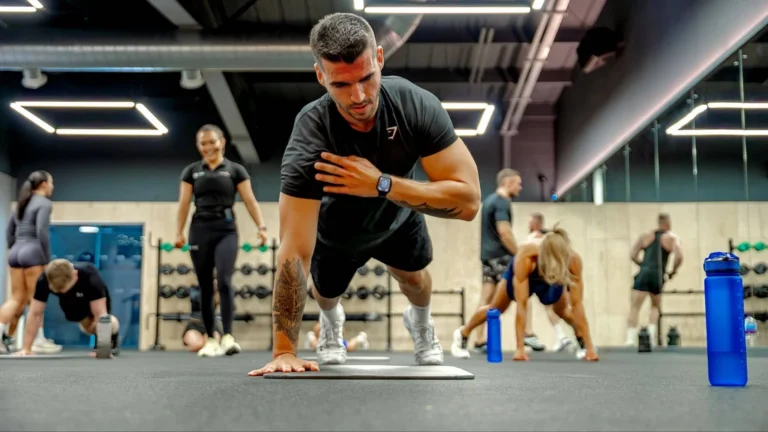
Ideal HIIT setup: 20–45 minutes, smart work–rest ratios, three weekly sessions, heart rate zones, EPOC benefits and recovery.
High-Intensity Interval Training — or HIIT if you prefer your workouts like your espresso — short, sharp, and guaranteed to jolt you awake — has become the modern-day miracle cure for fitness. But what exactly should a proper HIIT session look like, and what’s going on under the hood when your lungs are burning and your heart’s hammering like a snare drum?
Let’s cut through the noise.
The Ideal HIIT Setup
A HIIT workout is built on one simple principle: work hard, rest briefly, repeat. The format is what keeps your body guessing — and burning calories long after you’ve collapsed in a sweaty heap.
The classic timings are 20 seconds on and 10 seconds off, 30 on / 30 off, or 45 on / 15 off, with total sessions running between 20 and 45 minutes.
You can mix up your session in two main ways.
Try five rounds of:
- 20 sit-ups
- 20 Russian twists
- 30 seconds of bicycle crunches
- 30-second plank
- 60 seconds rest
Or build it around five moves done for five minutes each:
- Squat jumps — 20 seconds on, 10 off
- Push-ups — 30 on, 30 off
- Side lunges — 45 on, 15 off
- Burpees — 45 on, 15 off
- Mountain climbers — 45 on, 15 off
Because of its intensity, aim for three HIIT sessions per week with a day’s recovery in between. Your body needs that downtime to adapt, repair, and come back stronger.
How HIIT Changes Your Body

There’s a reason HIIT has taken over gym floors and living rooms alike. It’s not just the calorie burn — it’s what’s happening at a cellular level.
This kind of training fires up your metabolism, reduces body fat, and helps regulate insulin — the hormone controlling glucose in your blood. High insulin levels encourage fat storage, especially around the midsection, so keeping it balanced through exercise is key.
And then there’s autophagy, the body’s natural clean-up crew. “The healthy stress your body undergoes during HIIT sessions triggers autophagy,” the expert explains. “Which, put simply, is the process your body goes through to clean out damaged cells and regenerate newer and healthier cells.” In short, you’re not just burning calories — you’re refreshing your system and even slowing the ageing process.
Heart Rate: The Sweet Spot
During HIIT, your heart should be working between 70 and 90 percent of your maximum heart rate (MHR = 220 minus your age). In the rest intervals, you’ll hover between 50 and 60 percent.
“It is always good to monitor HR,” the expert advises. “This is because it will motivate yourself you push yourself harder. If you’re able to see the effort you’ve put into a workout and you can see yourself getting into the red zone and are hitting the target, you will be aware of the effort your putting in and making sure you stay in that zone.”
Don’t worry if your heart rate doesn’t plummet during the rests — that’s normal. “The higher you keep your heart the more intense your workout will be and the more calories you will burn.”
Understanding EPOC — The Afterburn Effect
After HIIT, your body enters a glorious state known as EPOC (Excess Post-exercise Oxygen Consumption). Think of it as the aftershock of a good session — your body’s still racing to deliver oxygen and repair muscles.
“During this period of time your body’s heart rate is still high and therefore still burning calories.” How long does that last? Typically up to two hours. The science isn’t exact, but what’s certain is that HIIT burns more calories both during and after compared to steady-state cardio.
“Exercise post-oxygen consumption is the body’s natural ability to return to homeostasis after exercise. With HIIT, the total calories burned is greater in EPOC than with continuous low-intensity exercise.”
Avoiding the Common HIIT Mistake
“Intensity is the main aspect of HIIT,” the expert stresses. Yet one of the most common errors — especially among women — is doing longer sessions at lower intensity.
“The whole idea of training is that your body is working out at a higher intensity for a shorter amount of time, so when people attempt HIIT sessions that last an hour (or sometimes more), the effects of the intensity training tapers off towards the end of their session because they can’t keep it up. So, it would be more beneficial to keep your HIIT sessions short and your heart rate up.”
Fuel First: Fasted or Fed?

There’s a lot of talk about training fasted, but science still sides with common sense. “However, the science is that your body requires energy to move, so working out completely fasted will be harder on your body than if you have something small to eat, such as a piece of fruit.”
A banana might not look like much, but it’s often the difference between finishing strong and fizzling out.
Boosting EPOC: The Heavy Hitters
You can dial up your EPOC by lifting heavy or combining HIIT with strength days. “Heavy lifting or strength training, such as legs days, squats and deadlift will boost your EPOC period,” they note. It’s all down to oxygen debt. After heavy exertion, your body scrambles to replace what’s been lost, sending your calorie burn sky-high even at rest.
Nutrition and Timing
When it comes to EPOC, what and when you eat both matter. “Nutrition is a massive factor in all forms of exercise. However, in the case of EPOC, studies have shown that it is not just about what you eat, but how much you eat and when you eat. For example, if you have a healthy and bigger breakfast, it will boost your insulin levels and therefore burn more calories throughout the day.”
Tabata: HIIT’s Tougher Cousin
If your HIIT sessions are starting to feel easy, it might be time to meet Tabata — the meaner, leaner variant from Japan. “Tabata involves a very similar construct to regular HIIT training, however, Tabata strictly involves 20 seconds of activity, followed by 10 seconds rest. It’s usually done for eight rounds and lasts four minutes.”
It might not sound like much, but don’t be fooled. “Four minutes might not sound like much, but as you are required to give 100 per cent effort during the workout time it’s not uncommon to be completely breathless and seeing stars by the end of it.”
Short, savage, and brutally efficient — Tabata is HIIT distilled to its purest form.
Dealing with DOMS

Soreness after HIIT isn’t a sign of weakness — it’s your body rebuilding itself. “Stretching and water intake are by far the best solutions for easing DOMS. Stretching before and after a workout will ensure that your muscles have an efficient amount of blood flow which will reduce muscle soreness.
Secondly, without enough water, your muscles are not getting the electrolytes you need to maintain balance, which results in weakened strength and control, and even dehydration.”
Home HIIT: No Gym, No Problem
If you can’t make it to a gym, combine HIIT with some outdoor cardio. “One thing you can do for a better HIIT workout is by combining it with pure cardio training such as running or cycling.”
A few pieces of kit go a long way: “A good range of dumbbells and a mat are the best additions to your HIIT training. The dumbbells don’t have to be heavy, weights ranging from 2kg to 5kg are usually enough, but if you want to push yourself a bit further, trying including 2kg, 4kg, 6kg and 8kg weights – any heavier and you’re at risk of injury.”
Final Thoughts
HIIT isn’t about punishment — it’s about precision. Keep it short, stay in that red zone, fuel wisely, and recover properly. In twenty minutes, you can achieve what used to take an hour on a treadmill.
For those who crave a challenge and a bit of burn, HIIT remains one of the most effective, time-efficient ways to train your body, sharpen your metabolism, and build real, lasting fitness.