SportIQ and Spalding launch a premium smart basketball built on the TF-1000 platform with real-time shooting analytics.
The smart basketball has moved from clever training gadget to serious hardwood conversation, with SportIQ announcing the launch of a new premium Spalding Smart Basketball built on the iconic TF-1000 indoor game ball platform.
That is the important bit. This is not technology being stuffed into any old ball and sent out with a marching band. The TF-1000 is already one of basketball’s most trusted indoor game balls, widely used in competitive play and familiar to players who know exactly how a proper ball should feel when it leaves the fingertips.
Now, with SportIQ’s patented embedded sensor technology inside, the same ball has been given a connected coaching layer designed to track shots, analyse mechanics and provide real-time feedback through a mobile app.
In short, the game ball has grown a brain. Thankfully, not an annoying one.
A Trusted Game Ball Steps Into The Connected Era
The TF-1000 platform has long carried weight in competitive basketball. According to SportIQ, it is used in approximately 40% of competitive basketball games in the United States and serves as the official game ball in 19 states, including New York and Texas, as well as multiple professional leagues globally.
That gives this launch a certain credibility from the outset. Basketball players can be deeply particular about feel, grip, bounce and balance. Change the ball too much and you might as well ask them to shoot with a melon.
The new Spalding Smart Basketball aims to avoid that trap by integrating the sensor directly into the ball while preserving the authentic bounce, weight and feel expected from a premium indoor basketball.
That matters because smart sports technology only works if athletes actually want to use it. Nobody needs a ball that produces beautiful data and a jump shot that feels like it has been filed under “miscellaneous”.
Real-Time Analytics For Serious Shooters
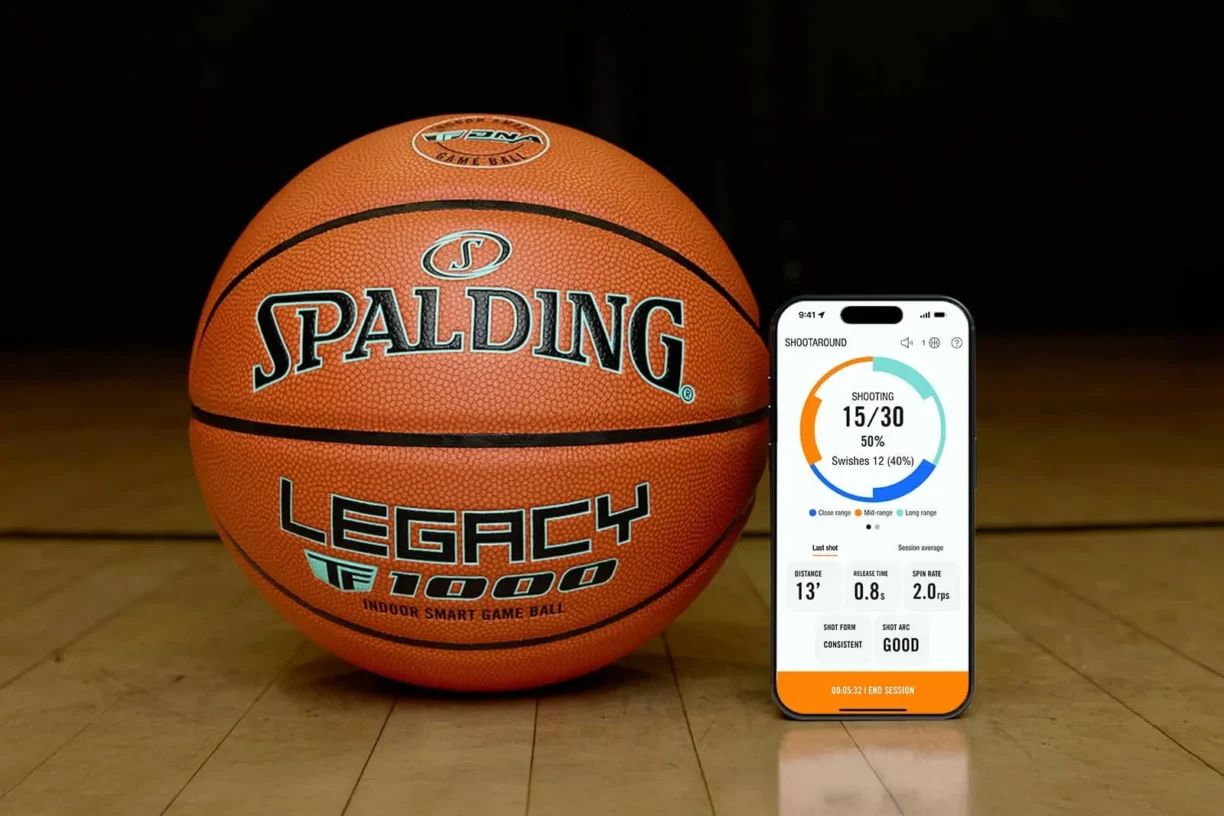
Through the connected app, players receive real-time shooting analytics and AI-powered coaching without changing how the game is played.
The ball tracks every shot through an invisible sensor and provides personalised feedback on shot arc, release angle, consistency and mechanics. Those details can be gold dust for players trying to understand why one session feels smooth and the next resembles a tax audit with sneakers.
The app also includes gamification and challenges, designed to make training more engaging. For younger athletes especially, that could prove useful. Repetition builds shooters, but repetition with a scoreboard, challenge or target has a much better chance of surviving the attention span economy.
SportIQ’s Pitch: Keep The Feel, Add The Intelligence
“This launch is about letting players train with the same ball they play with, now with all the benefits of a connected basketball. Serious players care about feel, performance, and consistency, so bringing our technology into the TF-1000 platform was an important step. We wanted to give players the data, feedback, and coaching benefits of a smart ball without compromising the experience of using a premium game ball,” says Erik Anderson, CEO of SportIQ.
That is the central argument behind the launch. SportIQ is not asking players to choose between tradition and technology. It is trying to make the two share the same locker.
The company says its technology has already tracked more than 40 million basketball shots globally and is used by players of all ages and skill levels, including NBA shooting coaches and competitive youth athletes.
In 2025, SportIQ was also selected for the NBA Launchpad accelerator programme, where its technology is being explored for future use cases related to officiating, analytics and fan engagement.
Smart Basketball Technology Is Growing Up
The launch arrives at a time when connected sports equipment is becoming less of a novelty and more of a genuine development tool.
Golf has launch monitors. Tennis has connected rackets and swing-tracking systems. Football has wearable GPS units. Basketball, with its obsession over repetition, rhythm and shooting efficiency, was always going to become fertile ground for smarter training tools.
The difference here is the decision to build the technology into a respected game ball rather than asking players to compromise on feel. That gives the Spalding Smart Basketball a cleaner route into serious gyms, youth development settings and family driveways where the dream is still alive and the net is hanging by one hook.
The product has also gained wider recognition, with the Spalding Smart Basketball recently named by TIME as one of the Best Inventions of 2025.
Making Player Development More Measurable
“Our vision is to make every ball smart, but it starts with products that players genuinely love using. Basketball players spend thousands of hours practicing, and we believe technology should make that process more rewarding, motivating, and accessible for everyone, whether you’re training for professional competition or simply trying to become the best player at your local court,” Anderson continues.
That line gets to the heart of where this market is heading. The best sports technology is not there to replace coaches, instincts or old-fashioned graft. It is there to make practice more visible.
A player can shoot for an hour and feel they have worked hard. But data can show whether their release angle drifted, whether their arc flattened late in the session, or whether consistency improved after a specific drill.
That is where the smart basketball concept becomes more than a shiny announcement. It turns invisible habits into something a player can see, measure and refine.
A Ball Built For The Next Generation Of Training
The new premium Spalding Smart Basketball is aimed at ambitious basketball players, young athletes and families investing in long-term player development.
That positioning is important. This is not being presented as a gimmick for casual play. It is a development tool wrapped inside a premium indoor basketball, designed for players who already care about improving and want a clearer view of their progress.
For coaches, it could offer a useful additional layer of feedback. For parents, it provides a more structured way to support practice. For players, it turns every shot into information.
And in basketball, information is useful only if it helps the ball find the bottom of the net more often.
Final Word
SportIQ and Spalding have taken a sensible route with this launch. Rather than making technology the star and basketball the supporting act, they have built the smart features into a ball that already carries credibility.
That gives the Spalding Smart Basketball a better chance of being judged by the right standard: not whether it looks clever in an app demo, but whether players trust it in their hands.
Because the future of training may be full of sensors, analytics and AI-powered coaching, but the oldest truth in basketball remains wonderfully simple.
The shot still has to go in.