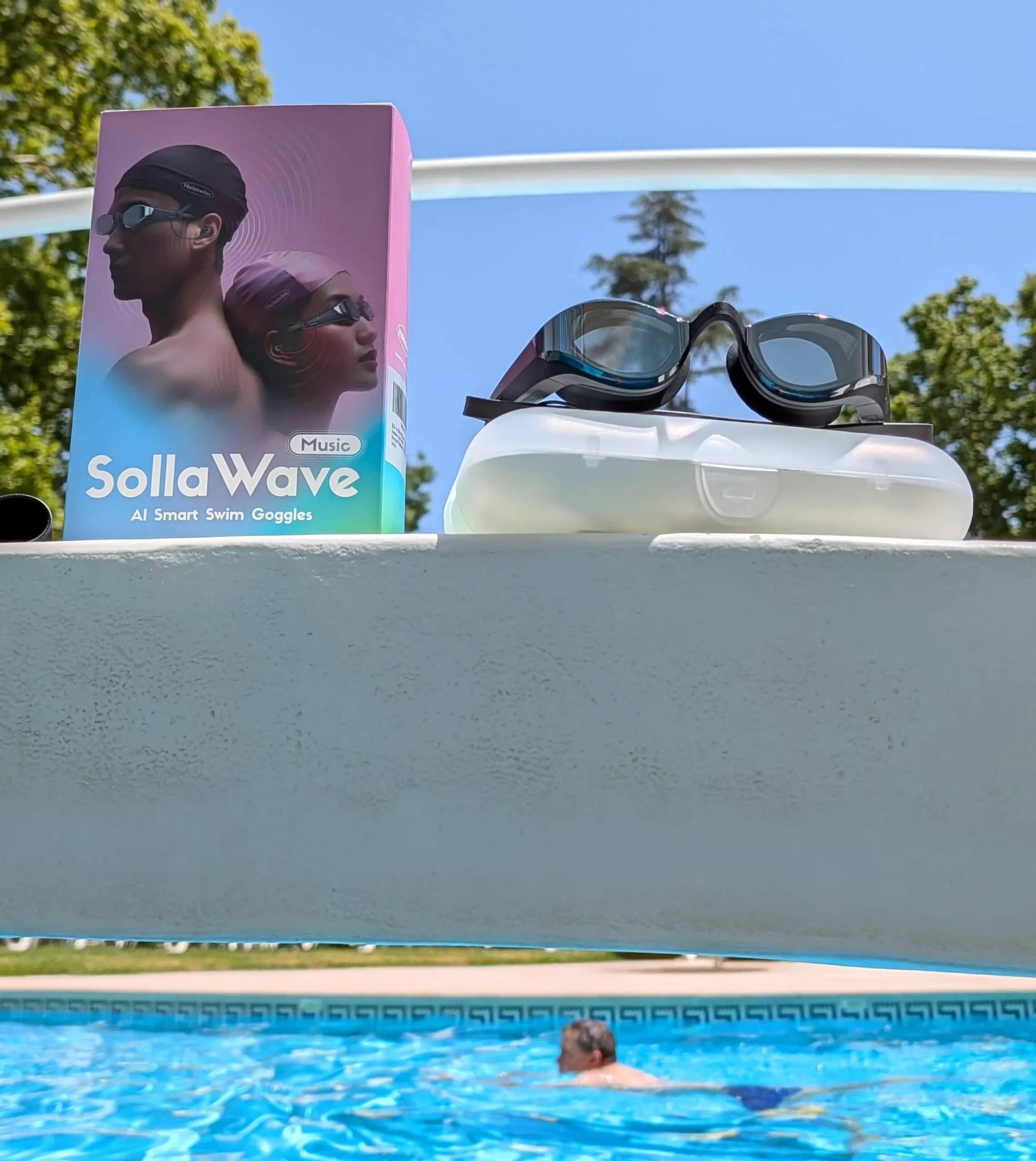
SollaWave swimming goggles combine swim tracking, voice feedback and underwater audio for swimmers bored rigid by silent laps.
SollaWave swimming goggles are aimed squarely at the swimmer who enjoys training, values data, and yet occasionally wonders whether following a black line for 40 minutes is a subtle form of aquatic punishment.
Smart Swim Goggles For The Bored But Serious Swimmer
Swimming is one of sport’s great contradictions. It is clean, efficient, joint-friendly and brutally honest. It is also, for long spells, rather quiet. The pool gives you rhythm, yes, but it does not give you company. It gives you fitness, discipline and shoulders like a minor Greek statue. It also gives you the same ceiling light every fourth breath.
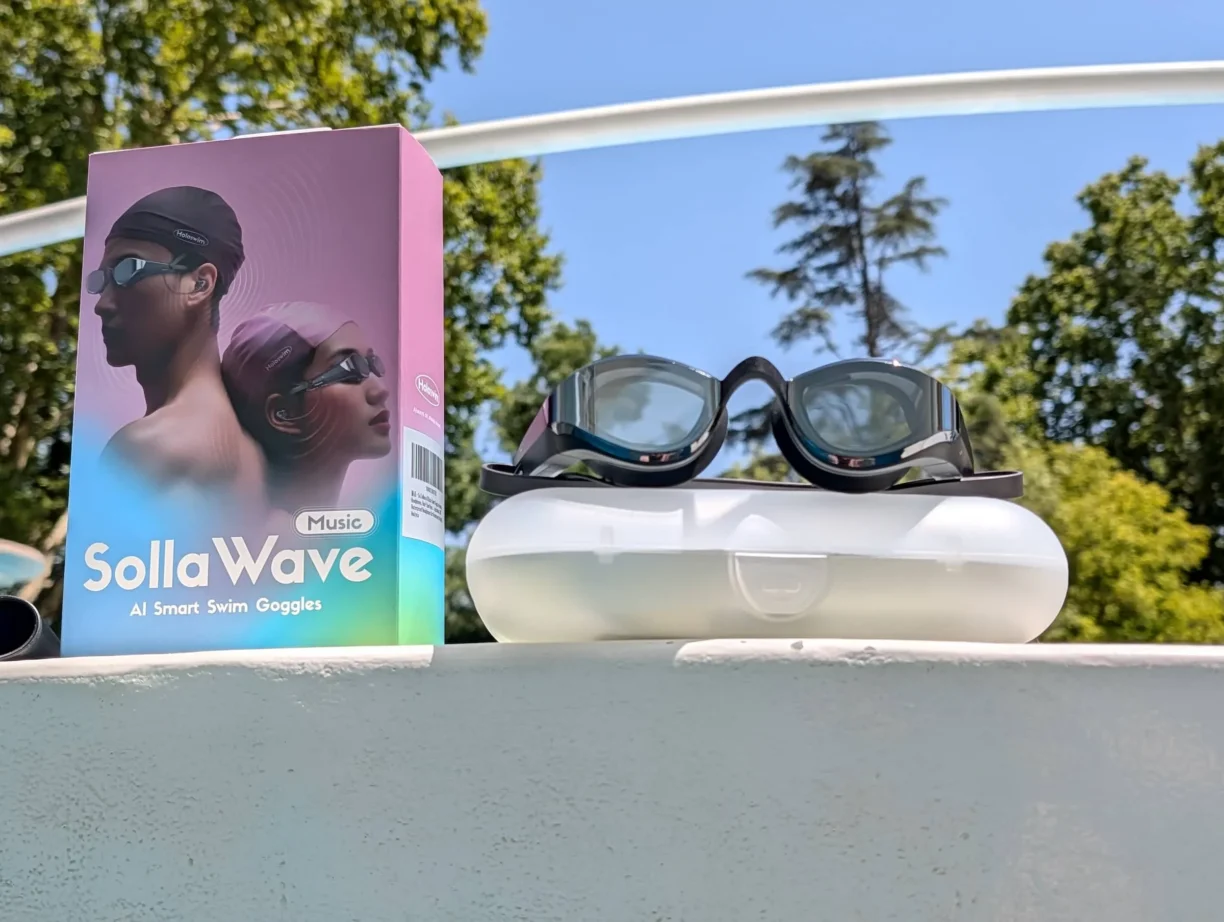
That is where SollaWave AI Music Swim Goggles enter the lane.
Developed under the Holosport smart eyewear line, SollaWave is positioned as a companion-style swimming product rather than a pure performance display device. In plain English, it is less about pretending you are Iron Man in lane three and more about giving swimmers useful feedback, a soundtrack and a reason not to climb out early.
The Main Trick: Swim Data Without A Screen In Your Eye
Unlike the Holoswim 2 and Holoswim 3 series, which focus on visual data display, SollaWave uses voice feedback to deliver real-time swimming updates. That distinction matters.
Not every swimmer wants a display in their field of view. Some simply want to know how they are doing without breaking stroke, stopping at the wall, or performing that familiar ritual of squinting at a watch through fogged-up goggles like a mole checking train times.
SollaWave tracks key swimming metrics and provides voice updates so swimmers can keep pace and performance under control during a session. For fitness swimmers, triathlon dabblers, masters competitors and anyone trying to keep their training honest, that makes practical sense. Feedback is only useful if it arrives while you can still do something about it.
Underwater Audio: The End Of Silent Suffering?
The more intriguing part is the audio.
SollaWave supports offline playback of music, podcasts and audiobooks, which is a neat answer to one of swimming’s oldest complaints: the pool is healthy, but it can be mentally sparse. Runners have playlists. Cyclists have podcasts. Gym-goers have aggressively curated motivational noise. Swimmers have bubbles and existential reflection.
The product material describes the experience as an underwater “music hall” — a phrase that sounds wildly optimistic until you remember how starved most swimmers are for anything beyond splash, inhale, splash, regret.
Professionally tuned audio is intended to create a more immersive training environment, and while that does not turn a municipal pool into the Royal Albert Hall, it does suggest SollaWave swimming goggles are being pitched at people who want more than a stopwatch and a stern inner monologue.
Design, Fit And Fog: The Unromantic Bits That Matter
Swim technology lives or dies in the practical details. A clever device that leaks, fogs or drags through the water is not a clever device. It is an expensive way to become annoyed.
SollaWave is described as having a sleek, low-drag design, with “Interstellar fluid” aesthetics combining industrial design with hydrodynamics. That is a marvellously grand phrase for something that still has to survive a wet kit bag, but the intent is clear: the goggles are meant to look modern without acting like a small parachute on your face.
The lenses feature a high-adhesion, super-hydrophilic nano anti-fog coating and high-hardness, scratch-resistant construction. That is not glamorous copy, but swimmers will recognise its importance immediately. Clear vision is not a luxury when you are sharing a lane with someone doing breaststroke like they are opening a garden gate.
Published product parameters also list SollaWave at around 73g, with Bluetooth 5.3, a 170mAh Li-ion battery, magnetic pogo-pin charging, OTA update support and an IP68 waterproof rating. Sensible numbers, in other words, rather than theatre.
Where SollaWave Fits In The Holosport Line-Up
Guangli and Holosport are not only working on music goggles. Their wider sports eyewear ecosystem includes Holoswim AR smart swim goggles, Holotrek AR outdoor sports glasses and the HandPlus B2 multifunctional heart rate monitor.
The company’s broader pitch is built around AI and AR sports eyewear, supported by optical display technology, motion algorithms and artificial intelligence. Guangli says it holds more than 300 domestic and international patents and has built capability across holographic resin waveguide display technology, including a fully integrated “design–materials–manufacturing” value chain.
That matters because SollaWave is not arriving as a novelty trinket in isolation. It sits inside a wider attempt to make sports eyewear more intelligent, more connected and more useful across swimming, cycling, running, hiking, trail running and mountaineering.
The corporate vision is certainly ambitious: making smart eyewear a “new organ” for humanity. A bold image, although one suspects most swimmers would settle for clear lenses, reliable audio and a calm voice telling them they have not completely lost the plot by lap 32.
Pros And Cons
Pros
At £136, reduced from £154, SollaWave swimming goggles become a much stronger value proposition. The £18 saving, roughly 25%, shifts them from interesting smart swim gadget to a more tempting training upgrade for regular pool users.
The biggest advantage is the combination of swim tracking and underwater audio in one product. Instead of choosing between performance feedback and entertainment, swimmers get both: real-time voice updates for training and offline playback for music, podcasts or audiobooks.
The voice feedback system is also a smart choice for swimmers who want data without visual distraction. Some athletes will prefer AR-style display goggles, but others simply want a calm update without having numbers floating in front of their eyes mid-length.
The anti-fog and scratch-resistant lens features are practical positives, while the low-drag design and IP68 rating suggest SollaWave has been built with actual swim use in mind rather than merely photographed beside a pool by someone in white trainers.
Cons
Even at £136, this is still a premium purchase compared with conventional swimming goggles. If all you need is clear vision and a comfortable seal, a standard pair will do the job for far less money and with considerably fewer charging cables.
The value depends heavily on whether you will use both main features. Buy SollaWave only for swim metrics and you may want to compare it with more performance-focused smart swim goggles. Buy it only for music and dedicated underwater audio devices may also deserve a look.
The available information does not provide detailed battery life by usage mode, audio format compatibility or app subscription details, so some practical buying questions remain unanswered.
Swimmers who want visual real-time data in the lens may be better suited to Holoswim models. SollaWave is clearly more about voice-led coaching and audio companionship than full AR-style swim display.
Who Is This Best For?
SollaWave is best suited to regular pool swimmers who train often enough to justify smarter kit. That includes fitness swimmers, endurance swimmers, triathletes working through winter pool sets, and anyone trying to make structured sessions feel less repetitive.
It also suits swimmers who enjoy tracking progress but do not necessarily want to stare at metrics while swimming. Voice feedback is a more natural fit for those who want data delivered quietly in the background rather than placed directly in their line of sight.
The strongest audience, though, may be swimmers who get bored. Not lazy swimmers. Not casual dabblers. Bored swimmers. The ones who want to keep training but would rather not spend another 45 minutes alone with chlorine, lane ropes and the slow collapse of morale.
For that group, music and audiobooks are not gimmicks. They are adherence tools. Anything that keeps you in the pool longer, more often and with better pacing has a legitimate place in the kit bag.
Is It Worth £136?
At the sale price of £136, SollaWave swimming goggles make considerably more sense than they would at the full £154 regular price.
The saving gives them a clearer role in the smart swim goggles market. They are still not cheap, but the price now sits closer to an attainable performance-and-entertainment upgrade than a speculative luxury for tech collectors with waterproof wallets.
The value case is strongest if you will use SollaWave as both a training tool and an audio companion. Voice feedback helps with structure. Offline playback helps with motivation. Together, they address the two great enemies of swim training: poor pacing and crushing boredom.
If you swim once a month, save your money. If you swim several times a week, use structured sets, listen to podcasts obsessively, or need something to make long aerobic work more bearable, SollaWave starts to look genuinely useful.
No pair of goggles can make swimming easy. That would be sorcery, and probably against pool rules. But at £136, SollaWave may make the hard work more enjoyable, more measurable and a little less like being locked in a tiled corridor with your own thoughts.