South Africa beat France in Tbilisi to retain the Junior World Championship and extend their winning run to 11 matches.
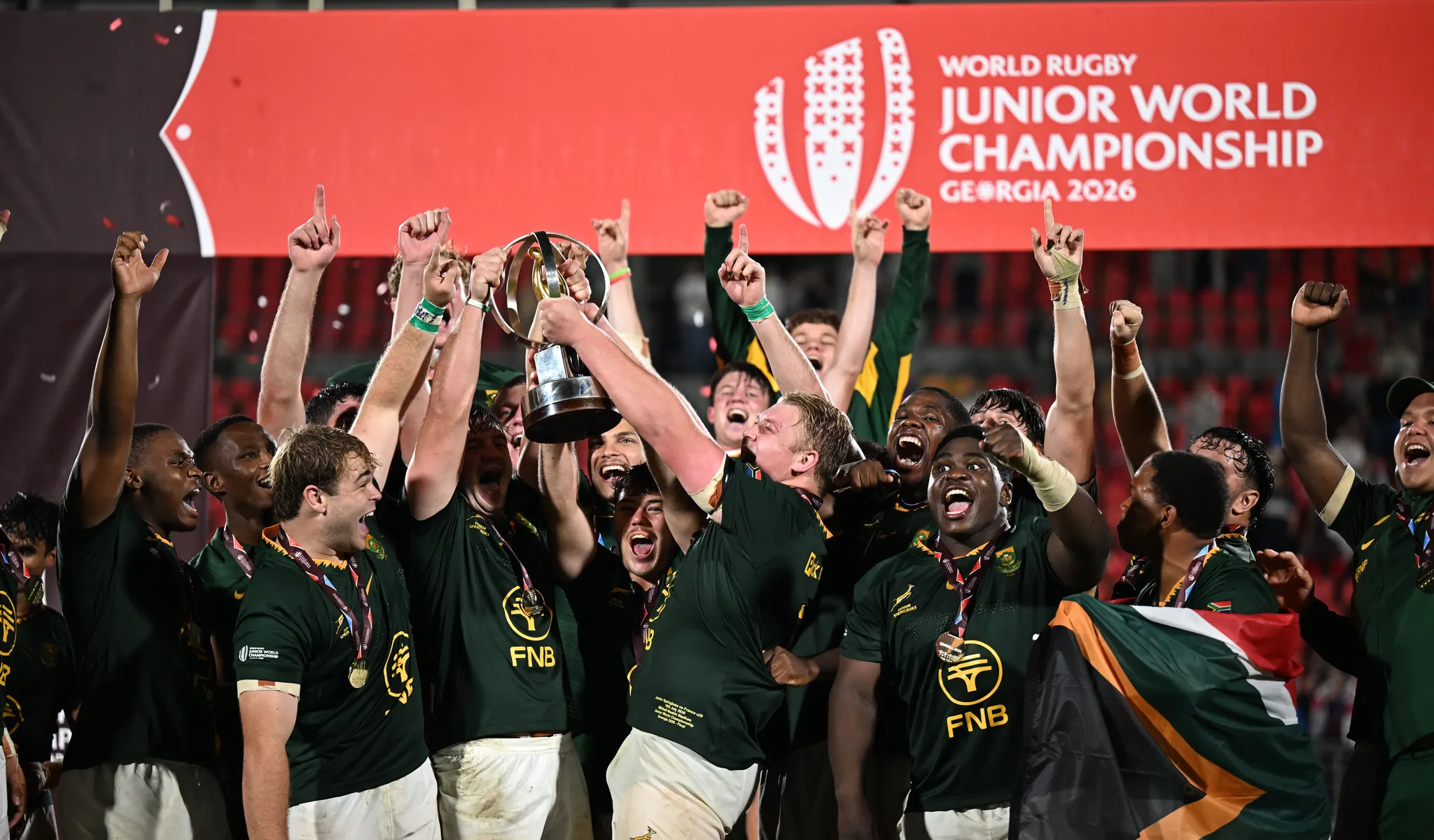
South Africa are the Junior World Championship winners 2026 after defeating France 16-5 at Mikheil Meskhi Stadium in Tbilisi, successfully defending their title and extending an imposing winning run to 11 matches.
There was little decoration about it. This was a final built from collisions, defensive resolve and the sort of pressure that makes every whistle sound suspiciously personal. Four tries were disallowed, three of them belonging to South Africa, yet the Junior Springboks refused to allow frustration to become the most influential player on the field.
By the end, South Africa had become only the fourth nation to win consecutive Junior World Championship titles, joining New Zealand, England and France in that select group.
France Strike First as the Final Tightens
Finals often arrive carrying promises of expansive rugby before becoming arm-wrestles with goalposts. This one followed the traditional script.
France brought their familiar attacking ambition but paired it with size and physical force. South Africa were required to absorb both, remaining within striking distance as several apparent scoring opportunities disappeared under official review.
The match remained finely balanced until France flanker Raphael Audebert scored the opening try early in the second half. It was the sort of breakthrough capable of changing not merely the scoreboard but the mood of an entire final.
South Africa’s response was immediate in spirit, if not effortless in execution.
Second-row Markus Muller eventually crossed for the Junior Springboks, while fly-half Yaqeen Ahmed supplied the control and accuracy that tense finals demand. Ahmed contributed 11 points from the kicking tee, giving South Africa the scoreboard authority their broader physical effort deserved.
The Junior Springboks did not win by overwhelming France with spectacle. They won by repeatedly dealing with inconvenience. In knockout rugby, that is usually the more valuable skill.
An 11-Match Winning Run Built on Resolve
South Africa’s latest triumph extended their Junior World Championship winning sequence to 11 matches.
That run is particularly notable given the long gap that had previously separated the country’s first two titles. Having returned to the summit in 2025, the Junior Springboks have now defended it at the first attempt.
Captain Siphosethu Mnebelele, who was also part of the successful 2025 side in Italy, described lifting the trophy again as a “flipping great feeling”.
The phrase was uncomplicated, much like South Africa’s approach when the final became difficult. There was no appetite for self-pity after the disallowed tries and no visible inclination to turn the match into something prettier than circumstances allowed.
Coach Kevin Foote believed his players’ capacity to withstand France’s challenge proved decisive.
“France played with their usual flair and they were also big and physical, so we had to soak that up,” Foote said.
“But that’s the story of this team – they never give up and it means everything to us and our country. Rugby is in a very special place in South Africa now and we’re very lucky to represent them – to go back-to-back is very special so I’m very grateful.”
That ability to soak up pressure defined the contest. France had the first try and enough physical presence to make South Africa uncomfortable, but the defending champions remained composed when the match became attritional.
The title of Junior World Championship winners 2026 therefore belongs to a side that demonstrated more than talent. South Africa showed the emotional discipline required to keep playing after key moments had gone against them.
New Zealand Claim Third Ahead of England
New Zealand secured third place with a 41-26 victory over England in a repeat of the 2017 final at the same stadium.
Second-row Finn McLeod scored twice in the second half as New Zealand pulled clear, concluding their campaign with the final podium position.
England finished fourth, while Scotland matched their best Junior World Championship placing by beating Wales 28-21 in the fifth-place match.
Scotland’s victory required a nervous finish. They were reduced to 13 players following two yellow cards but held on to equal the fifth-place finish achieved when Georgia previously hosted the tournament in 2017.
For a team defending a narrow advantage while two players short, the final minutes must have felt considerably longer than the clock was willing to admit.
Australia, Ireland and Fiji Finish With Victories
Australia closed their campaign with a 52-29 victory over Argentina to finish seventh. Hooker John Greenfell scored twice during a high-scoring contest that allowed Australia to end the tournament positively.
Ireland claimed ninth place by beating Italy 34-26 in Kutaisi, while Fiji defeated hosts Georgia 30-10 to finish 11th on their return to the Junior World Championship.
The final classification matches may not carry the grandeur of the championship decider, but they remain important measures of development, resilience and tournament progress. For several teams, the final round provided evidence that their campaigns contained more value than their eventual positions initially suggested.
USA Make History as Japan Reach a Milestone
The final round also produced two notable results lower in the standings.
USA recorded their first Junior World Championship victory at the 15th attempt, recovering from an early deficit by scoring 39 unanswered points in a 39-15 victory over Uruguay.
Japan then defeated Spain 34-26 to finish 13th. The result gave Japan two wins in a single edition of the tournament for the first time.
Those achievements offered a reminder that youth championships are not solely about identifying the eventual winner. They also reveal which programmes are progressing, which teams can respond under pressure and which players are beginning to look comfortable on an international stage.
South Africa’s Young Champions Earn Their Place
South Africa’s triumph was neither straightforward nor polished, which may ultimately make it more revealing.
The Junior Springboks faced a powerful French side, saw three tries ruled out and fell behind after half-time. They still found a route to victory.
Ahmed supplied the points, Muller delivered the try and the South African pack ensured the final was played on terms they could survive. Around them stood a team that appeared unwilling to confuse adversity with defeat.
Back-to-back titles place this group in distinguished company. More importantly, the manner of the victory suggested South Africa’s success is supported by composure as much as physical strength.
The trophy was won in Tbilisi, but the defining quality travelled rather well: when the final became uncomfortable, South Africa looked entirely at home.