Laura Woods joins Farncombe Youth FC as M&S research shows only 15% of grassroots coaches feel confident giving nutrition advice.
Grassroots football asks a great deal of its volunteers, but nutrition is increasingly becoming part of the brief.
New research from M&S Food suggests grassroots football nutrition remains a weak spot: while 31% of coaches surveyed would welcome training to help them advise players, only 15% currently feel confident doing so.
It was against that backdrop that Laura Woods visited Farncombe Youth FC, where the practical answer came not in the form of a seminar, but a chicken and rice one-pot cooked with M&S senior nutritionist Sophia Thistlethwaite and the club’s own matchday volunteers.
The confidence gap behind grassroots football nutrition
The issue is not a shortage of goodwill. M&S Food surveyed more than 200 grassroots football coaches nationwide and found that 31% would welcome training to help them offer nutritional advice. Only 15% said they felt confident guiding players or parents when asked.
That is a fairly revealing mismatch.
Grassroots coaches are expected to teach technique, manage personalities, organise matchdays and, increasingly, field questions that drift well beyond the touchline. Nutrition is one of them. Expertise, unsurprisingly, does not arrive free with the cones.
Woods joined M&S senior nutritionist Sophia Thistlethwaite at Farncombe Youth FC after the pair stopped at the new M&S Foodhall in Godalming to pick up high-protein ingredients. At the club, they cooked alongside Emma Branson, whose job list already includes referee, pitch and training coordinator, and matchday cook.
That last detail tells you rather more about grassroots sport than any glossy campaign slogan could.
A volunteer-run club with 670 players

Farncombe Youth FC was founded in 1975 and now supports more than 670 players across 46 teams. Nine are girls’ teams, with around 150 girls playing regularly.
The club is run entirely by volunteers, which gives its scale a slightly absurd edge: hundreds of children, dozens of teams and a handful of locals making sure the whole operation does not come off its hinges.
Co-chair Ed Fenner put it simply: “We’re all volunteers and that increases the community feel of the club, it brings us all together, it’s like spending time with your friends, like a wider family.”
That sense of family matters because habits formed at a club do not necessarily stay there.
Branson, who feeds players on matchdays, said: “Our coaches work hard to create a nurturing environment.” Her hope is that “if the girls see a healthy example set at the club, they’ll take those habits home too.”
It is an ambitious aim, but not an implausible one. Young players spend enough time around coaches, teammates and club routines for those environments to shape more than first touch and defensive positioning.
The 2-2-2 recovery idea, without the lecture
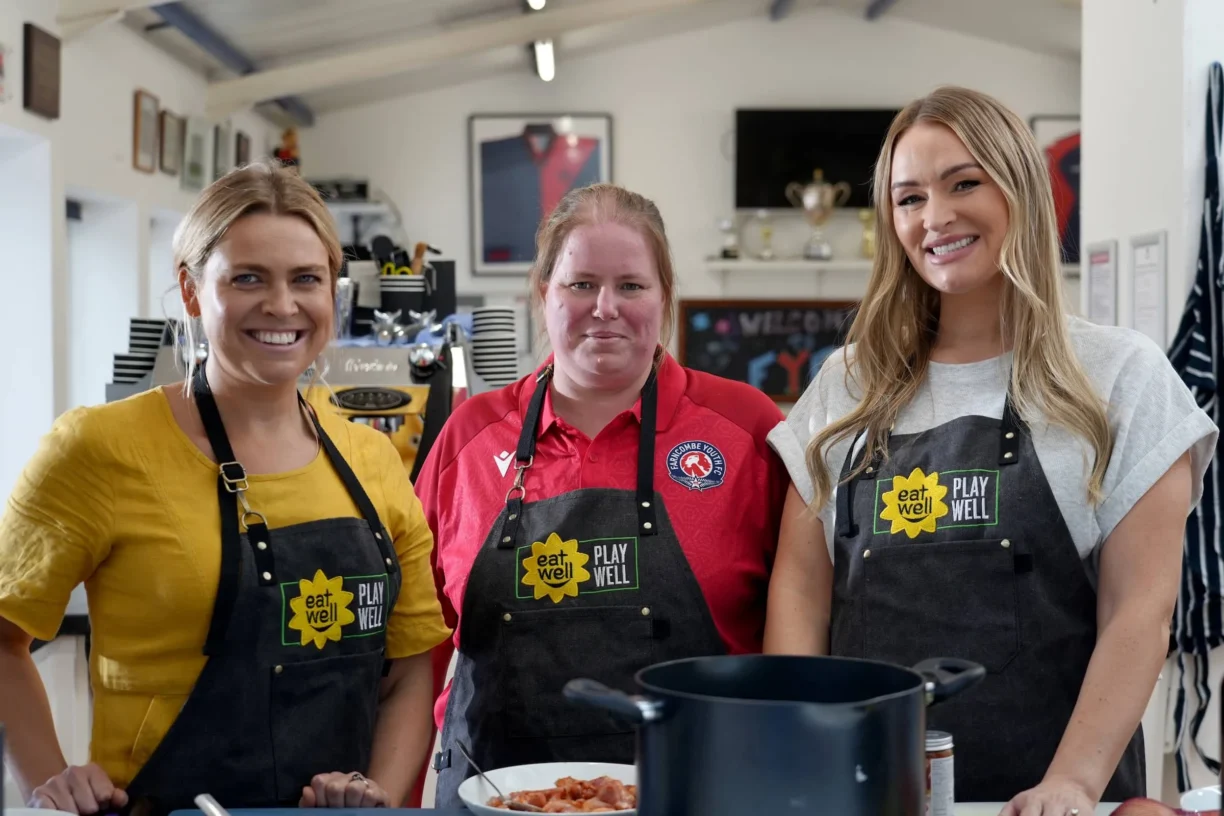
The chicken and rice one pot cooked at Farncombe was based on M&S and The FA’s Food Formations guidance, developed by FA nutritionists to make balanced eating easier for young players and families to understand.
The meal followed elements of the “2-2-2: Eating for Recovery” formation, bringing together carbohydrates, protein and vegetables after training.
The principle is straightforward: carbohydrates help replenish energy, protein supports muscle repair and vegetables contribute to recovery and general wellbeing.
None of that requires a teenager to carry a food diary like a Tour professional. The useful part is the simplicity. For a volunteer-led club, advice only has value if somebody can actually use it on a wet Tuesday evening with limited time, limited money and a queue of hungry players.
The verdict from those players was pleasingly less technical: “10 out of 10”.
Why the gap reaches beyond one post-training meal
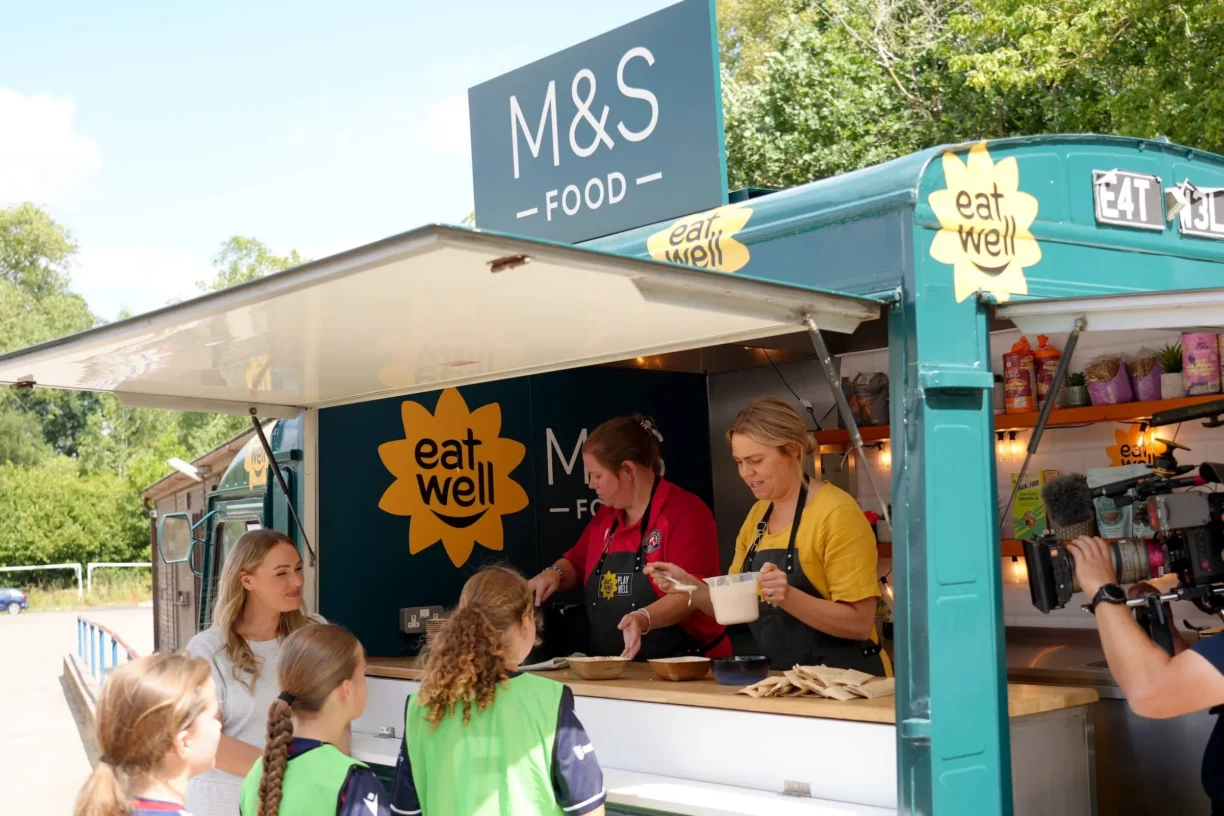
Woods framed the visit around the wider role of community clubs.
“Whether these players grow up to play in the park with their friends or for their country, community clubs like Farncombe Youth FC are absolutely vital for the UK’s footballing future and run entirely by volunteers, so I’m so pleased to help them learn more about their nutrition with M&S Eat Well, Play Well.”
Thistlethwaite added: “Nutrition plays such an important role in helping young players feel their best, both on and off the pitch. We’re delighted to bring the Eat Well, Play Well Grassroots Edition to Farncombe Youth FC, and show that eating well can be simple, enjoyable and accessible for everyone, while helping young players build healthy habits that can last a lifetime.”
The larger case for looking after grassroots football is difficult to dismiss.
The FA’s Social Return on Investment Report 2024 values grassroots football’s contribution to society at £15.9bn a year, including £3.2bn in healthcare savings. It attributes 200,000 fewer cases of obesity and 60,000 fewer cases of anxiety and depression to football-playing children, with an estimated £110m in savings for the NHS.
Those are hefty numbers attached to places that often run on volunteer rotas, donated hours and whoever remembered to buy the tea bags.
Practical help has to survive the Tuesday-night test
M&S Food is developing practical, affordable recipes for clubs and plans to continue its Eat Well, Play Well grassroots work with selected clubs across the UK.
The useful test will be whether coaches and volunteers can turn the guidance into something repeatable rather than merely admirable.
That is why Farncombe is a sensible setting. The club already has the scale, the volunteers and the weekly chaos. Nutrition advice has to survive all three.
A chicken and rice one pot will not transform grassroots football on its own. But if better habits are going to stick, they are far more likely to begin in a clubhouse kitchen than in a PowerPoint deck.
To find out more about the campaign, visit https://www.marksandspencer.com