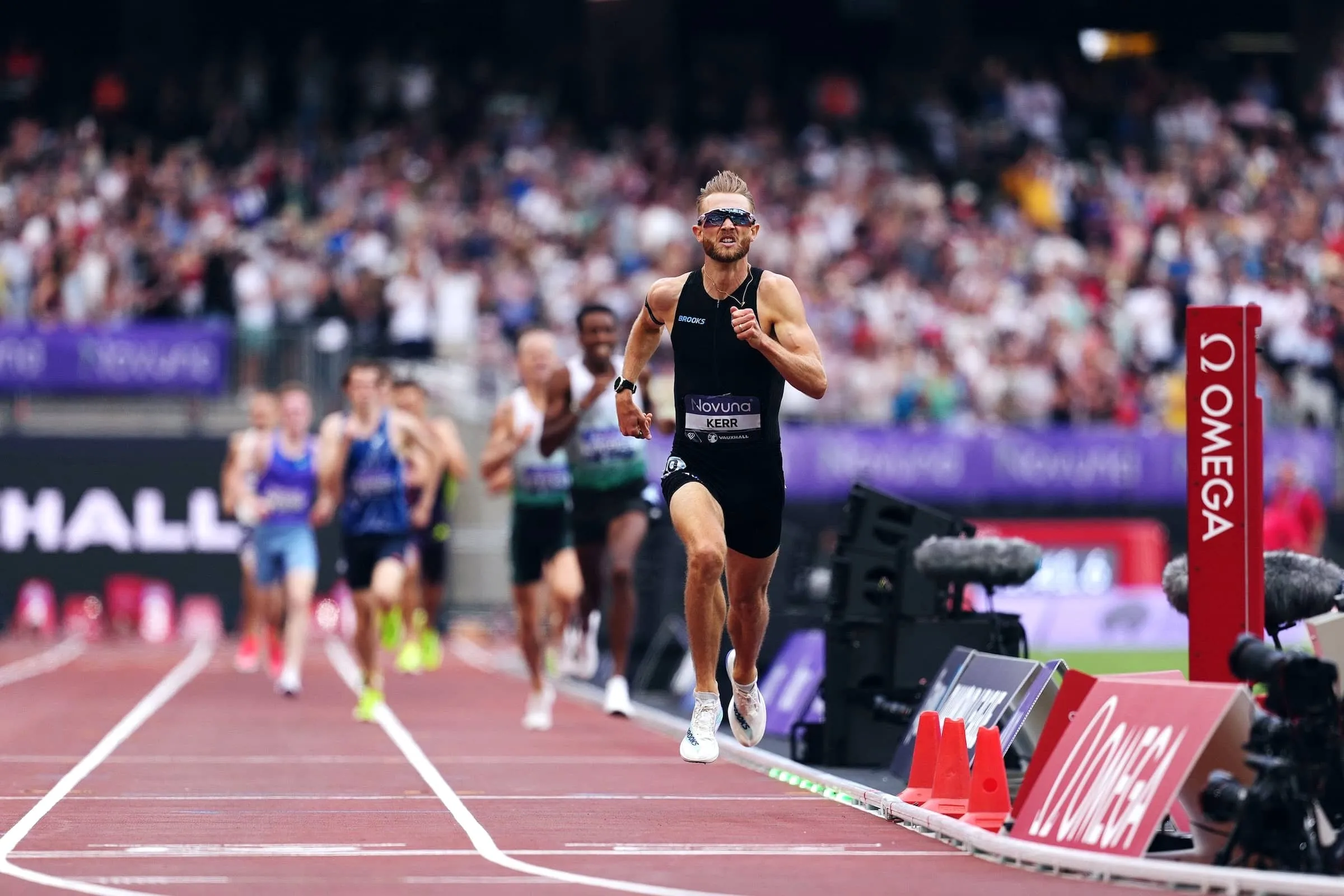
Josh Kerr runs 3:42.66 at the London Athletics Meet, breaking Hicham El Guerrouj’s mile mark subject to ratification.
Great Britain’s Josh Kerr produced a provisional world mile record of 3:42.66 at the Novuna London Athletics Meet, beating Hicham El Guerrouj’s mark during a thunderous Emsley Carr Mile at London Stadium.
The mile is a wonderfully unforgiving distance. It is too long to sprint without consequences and too short to repair a tactical blunder. Kerr left himself no room for either.
His mission had been announced in advance and packaged, with admirable simplicity, as “Project 222”: a plan to cover the distance in 222 seconds and improve on the 3:43.13 recorded by El Guerrouj in Rome in 1999.
Kerr did rather better than merely fulfil the brief. His 3:42.66 made him the first athlete to break the 3:43 barrier, pending the usual ratification procedure.
Project 222 Meets the Stopwatch
Publicly declaring an assault on a world record is a splendid way of removing every available hiding place.
There could be no soft tactical race, no patient shuffle before a frantic final lap and no consoling discussion about position afterwards. Kerr had supplied the target himself. The clock was the opposition.
His training partner Brannon Kidder and Žan Rudolf were entrusted with giving the attempt its early shape. Kidder reached 400 metres in 54.75, right on world-record tempo, before taking the field through 800 metres in 1:50.63.
Those figures mattered. A record attempt can unravel long before the crowd notices, often through an opening lap that is fractionally too eager or a second circuit that quietly leaks time. Here, the pace remained severe without becoming reckless.
Once the pacemakers stepped aside, Kerr was left with the less administrative portion of the evening: finishing the thing.
Kerr Takes Control in Front of 60,000
Kerr reached 1200 metres in 2:46.39, with the 60,000-strong London Stadium crowd supplying enough noise to make subtle coaching advice largely redundant.
By then, the attempt had become a test of whether ambition could survive the final lap.
Kerr reached 1500 metres in 3:27.62, faster than his own British record for the distance. It was an extraordinary split within an even more demanding race, but the mile still had to be completed.
USA’s Yared Nuguse had tracked Kerr and remained the principal threat. He could not stay with the closing pace, however, and Kerr drove clear to stop the clock at 3:42.66.
The margin over El Guerrouj’s former record was 0.47 seconds. In most areas of life, less than half a second is scarcely enough time to regret pressing “send”. In elite middle-distance running, it can redraw the record book.
Nuguse, Heyward and Farken Follow Kerr Home
Nuguse finished second in 3:45.69 after being unable to match Kerr’s final acceleration.
Behind him, Great Britain’s Jake Heyward secured third place with a personal best of 3:46.73. Robert Farken followed in fourth, setting a German record of 3:46.82.
Those performances might ordinarily have commanded the evening. Instead, they became part of a race defined by the athlete disappearing up the track ahead of them.
That is the peculiar brutality of a world-record contest. Several runners can produce the finest performances of their careers and still find themselves cast as witnesses.
A Record Built on Precision Rather Than Hope
Kerr’s run was not a speculative charge assembled on the back straight. It was a deliberately constructed attempt, paced around known targets and carried through under the pressure of a public declaration.
The significance lies not only in replacing one number with another. El Guerrouj’s 3:43.13 had stood since 1999, surviving changing generations, training systems and repeated advances across elite sport.
Kerr approached it without mystery. Project 222 gave the attempt a number, a narrative and no shortage of scrutiny. He then ran inside that target.
The performance also reinforced the value of a well-executed record race. Kidder and Rudolf supplied the platform. Kerr supplied the commitment once the assistance disappeared.
There was no tactical fog and no need for interpretation. Four laps, one clock and an athlete prepared to make the arithmetic hurt.
Ratification Remains the Final Formality
The 3:42.66 performance remains subject to the usual ratification procedure.
That qualification should be included prominently in publication until the result is formally confirmed. Ratification is an essential part of record administration, even when the evidence on the stadium clock appears agreeably uncomplicated.
Subject to that process, Kerr has removed one of middle-distance running’s most durable marks and become the first athlete to cover the mile in under 3:43.
Project 222 was conceived around the pursuit of 222 seconds. Kerr finished in less, which is an efficient way to conclude both a race and an argument.