Golf is more than a stroll: burn calories, build core and glutes, boost mood, and escape screens outdoors.
If you’ve ever watched someone play 18 holes and thought, “That looks like a slow walk with a few polite swings,” allow me to introduce you to the real golf health benefits—the ones that show up in your step count, your core, your posture and, occasionally, your mood after a 10-footer that refuses to cooperate.
Golf is a proper cocktail of low-impact cardio, strength, mobility and coordination. It asks your body to rotate, stabilise, and repeat a technically demanding movement pattern dozens of times—while covering serious ground outdoors. It’s sport dressed up as leisure, like a salad that somehow contains 2,500 calories.
Walking, calories, and the great “it’s not exercise” myth

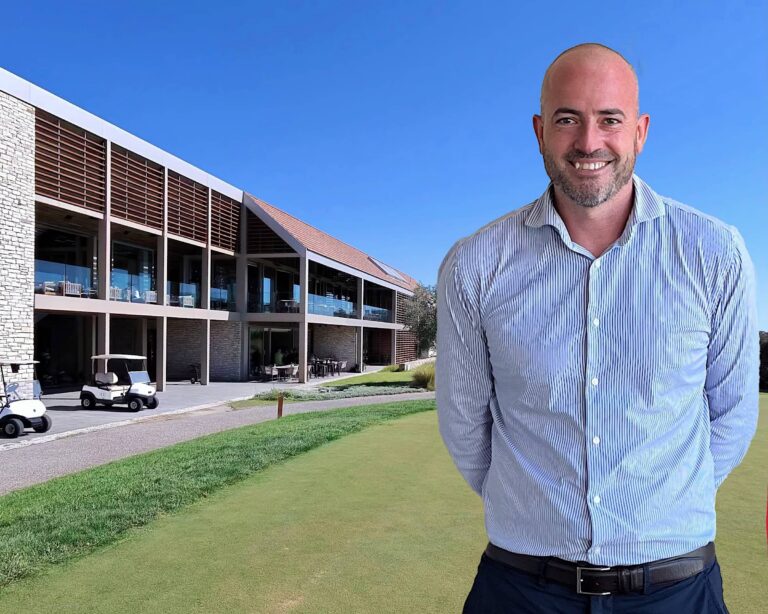
The part golf tries to downplay is the walking. Conor Russell, director of golf at Portmarnock Hotel and Golf Links, says: “With a round of golf, you typically walk four miles. If you use your fitbit, it can be 8,000 to 9,000 steps, which is good exercise. That would tend to burn 280-500 calories per hour. Or if you look at it over 18 holes you could burn 2,500 calories.”
That’s not a gentle amble—it’s sustained movement over varied terrain, often with a bag, and usually with a few heart-rate spikes when you realise the ball has developed a personal grudge.
And if you carry rather than trolley, you add load to the equation. Russell adds: “Not only are you walking, but in a lot of cases the golfer has to carry their golf bag,” he adds. “You’re increasing your heart rate and blood flow, and it improves your balance and posture. It makes you very aware of your posture and you’ll find most golfers are wary of their posture.”
Those are golf health benefits that stack up quietly over time: more steps, more time on your feet, better body awareness.
The muscles golf actually targets (yes, the bottom is involved)
Are you ready for the first tee? The next approach shot? That 10-footer for birdie?
— Titleist Europe (@TitleistEurope) May 5, 2020
Whether you're back on the course or still preparing at home, make sure your game is ready. #StaySharp pic.twitter.com/Fe1M9aaKhL
Golf’s signature movement—rotation—puts serious work through the gluteus maximus, the muscles you sit on when you promise yourself you’ll stretch later. Strong glutes support interior and exterior rotation and help you generate power without asking your lower back to do the heavy lifting.
Then there’s the core, which doesn’t just “help” the swing—it holds it together. Russell points out that conditioning has become far more central to golf performance, with many players using structured approaches such as TPI (Titleist Performance Institute) programmes.
He says: “The conditioning side of golf has become much more important,” says Russell. “A TPI coach will give certain stretches to help with movement.”
The upshot? Golf can be a gateway sport into better mobility and strength work—because once your swing starts creaking, you suddenly become very interested in stretching.
Core strength: the “glue” that holds the swing together
Core on fire!🔥😅
— Jamie Greaves | Golf Fitness (@JGGolfFitness) May 7, 2020
Are you keeping your power levels up during lockdown for the return of golf?⛳️
If you have a resistance band and a KB then give this band resisted lateral swing a go 😎💪
Great way to help generate power from the ground up in a more specific way👌@MyTPI pic.twitter.com/W1s0WDrtZ5
A golf swing is a chain reaction: ground → glutes → core → upper body → arms → club. Russell explains where the engine room is: “The core would be considered the glue that holds the swing together,” says Russell. “The forearms transmit the force that’s created by the body into the golf club. So if you’re thinking of getting your body in shape for golf, you’d start with the glutes, then the chest, core and arms. Then, after that, speed training has become the next step. With increased strength and speed, the ball will travel further.”
That’s a neat summary of why the golf health benefits aren’t only about burning calories. Golf encourages functional training priorities: stability first, then strength, then speed—useful for everyday movement as much as for distance off the tee.
The mental health boost: moving therapy with a scorecard
Some of our favourite health and wellbeing benefits of golf⬇️
— Me and My Golf (@Meandmygolf) April 17, 2019
🌳Exposure to the outdoors
🤝Fosters relationships
💪🏼Burns calories
❤️Increased heart rate
🧠Good for your brain
👀Improved vision
💤Improved sleep
☺️Reduced stress
What's yours? #golfhealthweek
Golf has an underrated psychological advantage: it gives your attention a single job. One shot. One decision. One target. For a few hours, your brain isn’t juggling 47 tabs.
Russell puts it plainly: “Golf to me represents good therapy. It’s four hours of long walks and good company, where your focus from everything else in the world just seems to be forgotten about and you’re at one with the course.”
It also nudges you away from constant screen time. Russell adds: “From a rules perspective, phones can’t or shouldn’t be used on the golf course, because you could use apps to improve your game such as GPS devices in them.”
And on the wider wellbeing piece—connection, calm, being outdoors—he says: “Mindfulness and personal wellbeing has been extremely important during the pandemic and golfers have missed their camaraderie, and how important it is for your own state of mind and mental wellbeing. “Nothing represents, for a golfer, anything better than being outdoors and your mind being off everything else, just solely occupied by a ball and four miles of a walk.”
(Those words come straight from Russell, and they land because they’re true: golf is one of the few sports where the “headspace” is part of the package.)
So, is golf a good sport to take up for fitness?
If you want a low-impact activity that can still challenge your heart, lungs, muscles and mind, golf makes a compelling case. It’s social without being chaotic, technical without being brutal on the joints, and it rewards consistency—turning “I should move more” into something you actually look forward to.
In short: the golf health benefits aren’t a marketing gimmick. They’re baked into the walk, the swing, the posture, the fresh air—and the fact you’ll happily do it for four hours without noticing you’ve basically completed a workout.
FAQs
Q: What are the golf health benefits?
A: Golf can improve cardiovascular fitness through walking, support strength via rotational movement, enhance balance and posture, and reduce stress.
Q: Does golf count as exercise?
A: Yes—walking a course (especially carrying clubs) raises heart rate and adds meaningful daily movement.
Q: What muscles does golf work?
A: Glutes and core are key, supported by chest, shoulders and forearms through the swing’s power chain.