Dental implants in Turkey can cost considerably less than private treatment in Britain. But the advertised price is only the beginning. From surgical planning to recovery and long-term aftercare, here is what patients should establish before booking.
Replacing a missing tooth is one of those jobs that slides down the to-do list. It rarely hurts, the gap is often at the back, and the quote from the local practice runs well into four figures. But a missing tooth is more than a cosmetic issue. The bone beneath it slowly shrinks once there is no root to stimulate it, neighbouring teeth can drift into the space, and chewing quietly shifts to the other side of the mouth.
For a growing number of UK patients, the answer has been to look abroad, and Istanbul has become one of the busiest destinations in Europe for dental work. The savings are real. So are the horror stories. This guide sets out what a dental implant actually involves, what it should cost, and how to tell a careful clinic from a risky one before you book a flight.
Why UK patients are looking abroad
Dental implants are generally not available on the NHS except in specific clinical circumstances, so most adults who want one pay privately. A single implant with a crown in the UK typically costs somewhere between €2,300 and €3,700 (roughly £2,000 to £3,200), and that is before any bone grafting.
In Turkey, the same treatment is usually listed for a fraction of that. The gap is not mainly about cheaper materials: many Istanbul clinics use the same implant systems found in British practices. The difference comes largely from lower labour, rent and laboratory costs, combined with high patient volumes.
Implants are not “Turkey teeth”
The phrase “Turkey teeth” became shorthand for a very specific problem: full sets of crowns or veneers fitted onto healthy teeth that had been filed down heavily to make room for them. That kind of treatment can leave people with sensitive, weakened teeth and long-term problems that UK dentists are then asked to fix.
A single implant is a different procedure with a different purpose. It replaces a tooth that is already missing, and the teeth on either side are left untouched. That is one of its main advantages over a traditional bridge, which requires grinding down the neighbouring teeth to hold crowns.
The risks with implants are real, but they are of a different kind: poor planning, insufficient bone, infection, and a lack of follow-up once you are home. If you go to a clinic for a single gap and come away with a recommendation to crown a row of healthy teeth, treat that as a warning sign rather than an upgrade.
What a single implant involves
An implant has three parts:
- The implant itself: a small titanium post placed in the jawbone, which acts as the new root.
- The abutment: a connector that sits on top of the implant.
- The crown: the visible tooth, made to match the shape and colour of your natural teeth.
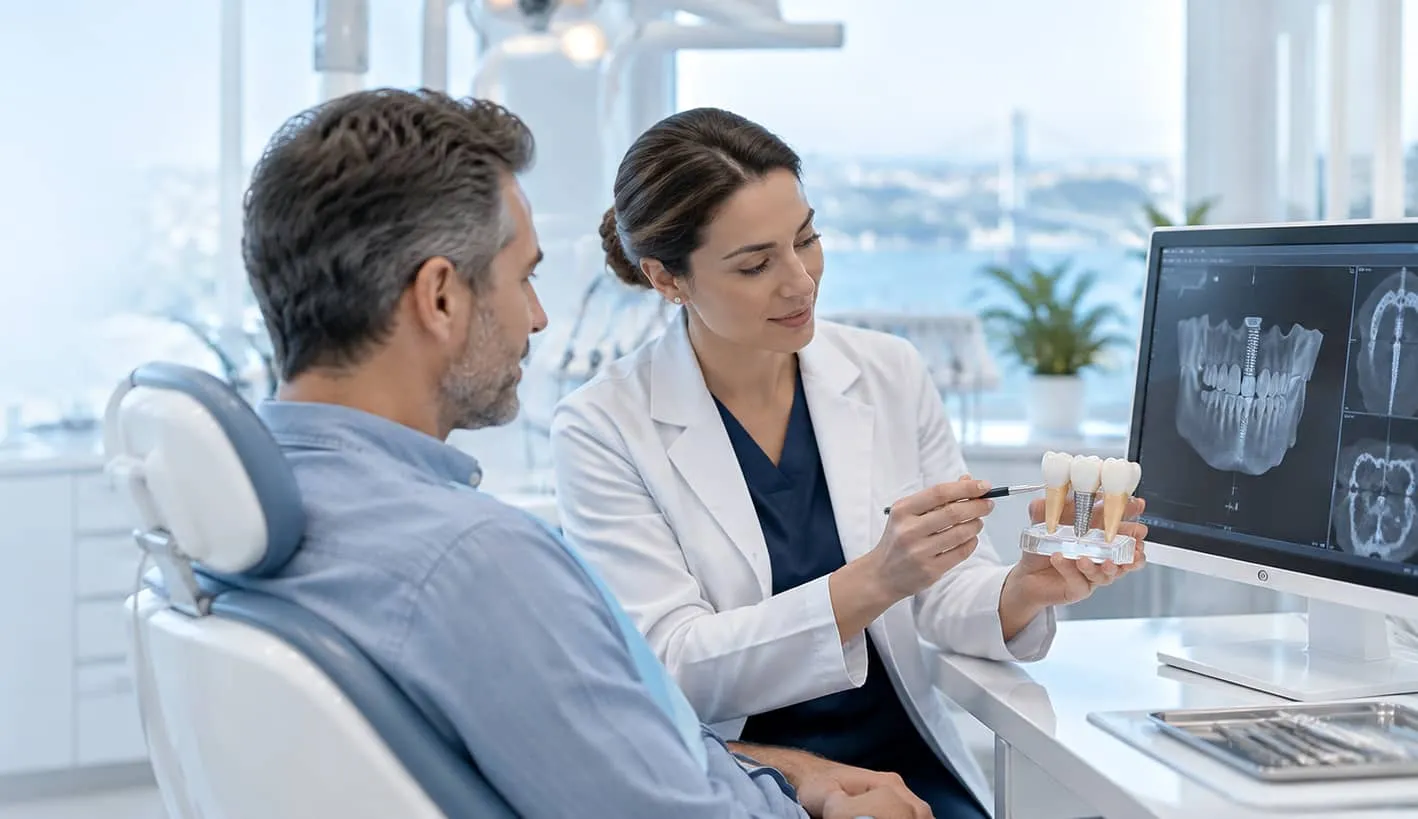
A well-run treatment starts with a CBCT scan, a 3D X-ray that shows bone height, width and the position of nerves and sinuses. From that scan, the dentist plans the implant position digitally and, in many clinics, prints a surgical guide that fits over your teeth and directs the drill to the planned spot. Placement itself is done under local anaesthetic and usually takes under an hour for a single tooth.
What it costs, and what changes the price
Typical prices for a single implant with crown:
| Country | Typical price |
|---|---|
| United Kingdom | €2,300 – €3,700 |
| Germany | €1,850 – €3,200 |
| United States | €2,750 – €5,050 |
| Turkey (Istanbul) | Implant from a few hundred euros, abutment and crown extra |
Natural Clinic in Istanbul, one of the clinics offering dental implants in Turkey, lists the implant itself from €230 with a Swiss implant system, rising to around €900 for premium brands such as Straumann or Nobel, with the abutment and crown priced separately. Headline prices like these are where comparison starts, not where it ends. Before you compare quotes, ask exactly what each one includes.
The factors that move the final figure:
- Implant brand. Premium and value systems differ in price. Widely used brands make future maintenance easier, because any dentist can source compatible parts.
- What’s included. Check whether the quote covers the implant only, or the abutment and permanent crown as well.
- Crown material. Zirconia and porcelain-fused-to-metal crowns are priced differently.
- Bone grafting. Needed only if the scan shows there is not enough bone to hold the implant securely. A good clinic will tell you from the scan, not on the day.
- Travel. Implants usually require two trips. Some clinics include hotel, airport transfers and an interpreter; others don’t.
Seven questions to ask before you book
- Will I have a CBCT scan, and can I see the plan? A clinic that plans from a standard 2D X-ray alone is guessing more than it should.
- Which implant brand will you use, and will I get the details in writing? You want the brand, model and size recorded, so any future dentist knows exactly what is in your jaw.
- Who will place the implant? Ask for the dentist’s name and qualifications, and check them.
- What exactly is in the price? Implant, abutment, crown, temporary tooth, grafting, X-rays and follow-up visits should all be itemised.
- What does the guarantee cover, and what happens if something fails after I’m home? Get it in writing, including who pays for travel if a repair is needed.
- Will I receive a written treatment plan before I travel? Changes to the plan once you are in the chair should be explained and agreed, not sprung on you.
- Are you suggesting any work on my healthy teeth? If so, ask why, and consider getting a second opinion from your UK dentist before you agree.
Two trips, not one
A single implant is rarely a one-visit job, and any clinic promising a finished permanent tooth in a long weekend deserves a careful question about how.
Trip one: scan and placement. Plan a few nights. The first visit covers the consultation, the CBCT scan, planning and placement of the implant. A good clinic will check the site before you fly home rather than sending you straight from the chair to the airport.
The healing gap: three to six months. The implant needs time to fuse with the jawbone, a process called osseointegration. For a front tooth, a temporary tooth can often be fitted so the gap is not visible in the meantime.
Trip two: the permanent tooth. Allow around four to five days. Once X-rays confirm the implant has integrated, the abutment is fitted, a digital impression is taken, and the laboratory designs and finishes the crown to match the teeth beside it. The bite is then adjusted in the chair so the new tooth sits comfortably.
If your timeline is tight, ask about it at the planning stage. Squeezing healing time to fit a holiday is not a trade worth making.
Getting back to training
For active readers, the practical question is often how long implant surgery will keep them out of the gym. For a single implant, the answer is usually not long, but the first few days matter.
- First 48 to 72 hours: skip strenuous exercise. Raising your heart rate and blood pressure can increase bleeding and swelling at the site. Gentle walking is fine.
- The first week: build back gradually. Avoid heavy lifting and anything that has you clenching your jaw or holding your breath under load, and stop if the site starts to throb.
- Contact sports: a blow to the face during healing can disturb the implant. Wear a mouthguard when you return, and ask your dentist whether it needs adjusting around the new tooth.
- Nutrition: stick to soft, cool foods for the first days and chew on the other side. Protein shakes and smoothies are useful here, though many clinicians advise drinking them from a glass rather than through a straw at first.
- Smoking and alcohol: smoking is one of the best-established risk factors for implant failure. If you smoke, the weeks around surgery are the time to stop. Alcohol is best avoided while the site is healing.
Most people find that placing a single implant feels more like pressure than pain, and soreness and mild swelling usually settle within a day or two.
Risks, and why aftercare at home matters
Complications are uncommon, but they do happen wherever the implant is placed. The main ones are an implant that does not integrate with the bone, infection around the site, and, over the longer term, inflammation of the gum and bone around the implant, known as peri-implantitis. Smoking, poorly controlled diabetes and inconsistent oral hygiene all raise the risk.
The part of dental travel that most often goes wrong is not the surgery itself but what happens afterwards. Before you leave, make sure you have:
- Copies of your scans and X-rays
- The implant brand, model and size in writing
- Your written treatment plan and guarantee terms
- A named contact at the clinic for questions after you get home
Tell your UK dentist about the treatment and bring those records to your next check-up. An implant needs the same care as a natural tooth: brushing twice a day, cleaning carefully around the gum line with floss or an interdental brush, and regular hygienist visits. Looked after properly, an implant can last for many years.
The bottom line
An implant abroad can be a sound choice, and for many people the savings make treatment possible that otherwise would not happen at all. The patients who do well tend to have one thing in common: they choose a clinic on the quality of its planning and transparency rather than on the lowest headline price.
Ask for the scan, the brand, the names and the full itemised cost in writing. A clinic that is happy to answer all of that before you book is usually one worth trusting with the rest.