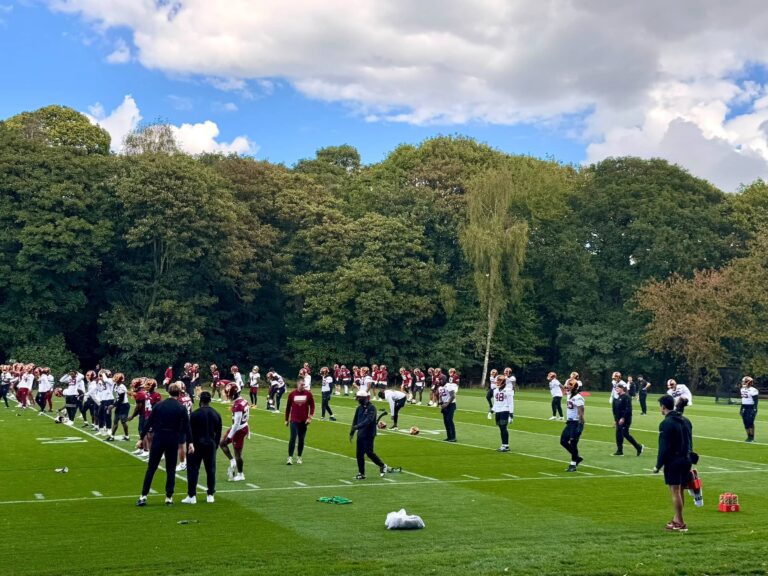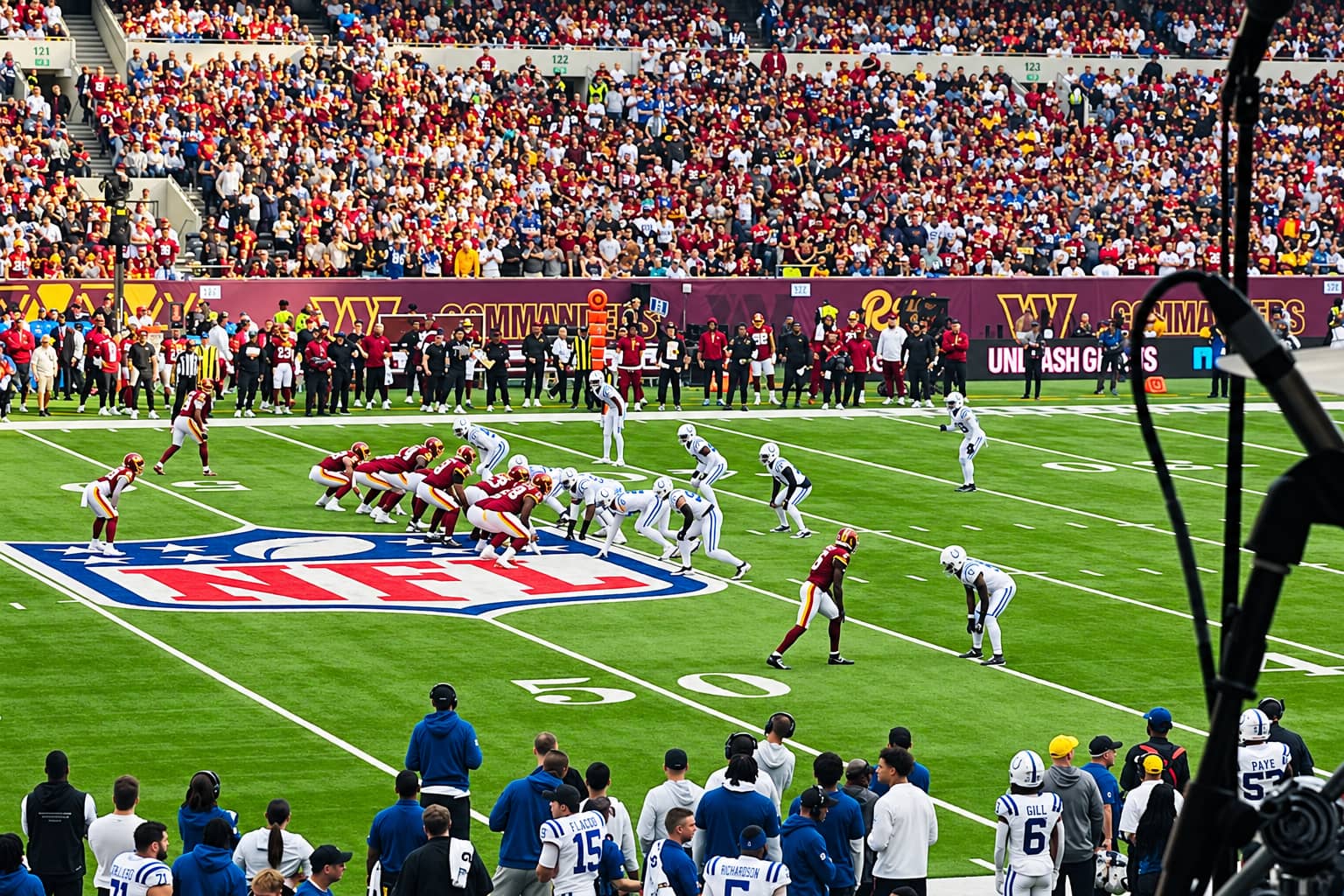
Indianapolis overcame an ugly opening at Tottenham Hotspur Stadium to beat Washington 30-13, in a London game that became as much about routines, recovery and readiness as the score itself.
For the Indianapolis Colts, the interesting thing about a 30-13 victory over the Washington Commanders at Tottenham Hotspur Stadium was not that everything worked. Quite a lot of it did not.
Indianapolis started slowly, turned the ball over and spent much of the opening quarter being frustrated by a Washington defence that allowed only one yard across the Colts’ first three drives. By the end, however, Jonathan Taylor was grinding away at the clock, the Colts’ defence had repeatedly bailed out its offence and a team that began the season 0-2 was heading home from the 2026 NFL London Game at 2-2.
It was an exercise in staying functional when circumstances were anything but tidy.
“Didn’t start the way we wanted to but defence played great,” Colts head coach Shane Steichen said. “I think they were three for 15 on third down.”
That statistic told much of the story. Washington had opportunities. Indianapolis kept taking them away.
A defence that kept the game from getting away
The Commanders began with considerably more energy than the final score suggests.
Frankie Luvu, back in the Washington line-up, said the early objective had been to restrict Taylor and “keep 28 in the phone booth”. For three Indianapolis possessions, it worked magnificently.
The Colts’ offence stumbled through a series of three-and-outs and an early communication error involving tackle Bernhard Raimann. Daniel Jones accepted responsibility for failing to get the ball away on one costly play.
“I got to get the ball out of my hands there,” Jones said. “Yeah, that was my fault there. Can’t let that happen.”
Yet Washington could not translate its early control into touchdowns.
Indianapolis twice forced field goals in situations that Steichen described as “four-point plays” — the difference between trailing 14-0 and staying within six.
Then came another defining moment: fourth-and-one near midfield.
The Colts stopped Washington.
“That’s a big momentum swing there as well,” Steichen said.
DeForest Buckner saw the same thing from inside a defence that understood its job had temporarily become keeping the match alive while the offence found some rhythm.
“We all talk about playing complementary football,” he said. “Obviously, the offence was struggling early on, and we had to step up as a defence. That was the perfect opportunity for us to do that and show us we had their back.”
Cornerback Justin Walley described precisely the same mentality. One side picks up the other. No melodrama required.
In a sport fond of elaborate terminology, sometimes the useful bit is remarkably simple: survive the bad spell.
Jonathan Taylor changes the shape of the afternoon
Eventually Indianapolis found its answer, and it wore No. 28.
Taylor scored twice on the ground and became increasingly influential as the game progressed, giving the Colts an option that did not depend on everything around him being perfect.
Jones called having Taylor “huge”. Raimann went rather further, describing him as “the best running back in the league”.
Buckner’s assessment concentrated less on Sunday’s production than on what supports it.
“Honestly, just the way he’s been able to sustain and consistently play at a high level is just the way he works,” Buckner said. “Seeing him each year, each and every day, the way he comes in and handles his business, you know what I mean?”
That was a recurring theme in London: performance as the visible result of considerably less glamorous repetition.
Wide receiver Laquon Treadwell spoke about receivers taking pride in their blocking because they know what can happen once Taylor reaches open field.
“We know once he get’s free, he is going to do something special,” he said.
Washington linebacker Sonny Styles felt the Colts’ second-half progress was less about one spectacular tactical shift than steady accumulation: stretch, counter and toss, then three yards, four yards, another three and a first down.
There were not many huge plays downfield. Indianapolis simply became harder to stop.
“We started out fast, but we didn’t finish,” Styles said. “We’ve got to find a way to finish.”
That distinction proved decisive.
Daniel Jones responds, but turnovers remain the blemish
Jones’ afternoon was less straightforward.
He scored himself after keeping the ball on a run towards the pylon and helped Indianapolis establish momentum either side of half-time. He also acknowledged that his ball security has to improve.
“Definitely got to play better. Got to clean that up. Can’t afford to turn the ball over like that,” he said.
Steichen was similarly measured. Jones has done good things through four games, he said, but there remains work to clean up.
What improved was the Colts’ response to Washington’s pressure.
Treadwell said Washington showed plenty of Cover Zero, requiring Indianapolis to reconsider parts of its attack. The half-time conversation centred on identifying what Washington was doing at the line and in the secondary, getting back on schedule on first down and adjusting accordingly.
Jones described the process from the quarterback’s perspective as recognising the defence more quickly and getting the ball out faster.
It was hardly an immaculate offensive performance. That was rather the point.
Indianapolis had enough composure to repair the afternoon without pretending the first quarter had never happened.
Washington’s quarterback problem changes the contest
The Commanders’ task became considerably harder when Marcus Mariota left the game and rookie Athan Kaliakmanis was sent in.
Buckner later said he had heard Mariota had suffered a knee injury and offered his prayers for the quarterback. The Colts also left London with injuries of their own: Steichen listed JC Carlies with a rib issue and both Arden Key and Ashton Dulin with hamstring injuries. Raimann temporarily left with an ankle problem before returning after having it strapped.
For Washington, Kaliakmanis’ entrance produced one of the afternoon’s most compelling subplots.
The rookie was under pressure immediately, with Indianapolis attacking aggressively, but he completed a touchdown pass to Treylon Burks after recognising the safety moving towards a crossing route and throwing over the top.
“It was surreal, man. It was absolutely surreal,” Kaliakmanis said of the aftermath of his first touchdown.
He did not allow himself much celebration.
“Right now I’m just thinking about the loss. It’s not about me. It’s about this team.”
There was also frustration. A potential touchdown to Antonio that could have altered the game was wiped away, but Kaliakmanis’ response was to return to a lesson that appeared repeatedly throughout the afternoon: control the controllable thing, then move.
“Yeah, it hurts for a second, but now you’ve got to go into next play,” he said.
One interception provided a harsher lesson. Kaliakmanis admitted he had tried to do too much and returned to advice familiar to backup quarterbacks everywhere: there is no requirement to arrive wearing a cape.
“There’s no need to put the cape on,” he said. “There’s no need to try to do something different.”
Instead, his emphasis was on trusting his training.
Readiness before opportunity arrives
Kaliakmanis’ comments offered an unusually clear look at the preparation demanded of a player who may spend an entire week uncertain whether he will take a meaningful snap.
His approach is to prepare as if he will start regardless of where he sits on the depth chart.
That means whiteboard work, studying game plans and spending time with his coaches long before anyone knows whether he will be needed.
When he was needed, support came quickly.
Stefon Diggs approached him on the sideline and told him to remain calm and keep his spirit high. Jayden Daniels, meanwhile, was offering observations about the Indianapolis defence and potential play calls.
“I think Jayden Daniels is the ultimate leader, just coaching me throughout the game,” Kaliakmanis said.
Styles said that confidence in the next player is something Washington’s coaching staff has tried to establish throughout an injury-disrupted season.
“When Marcus got hurt today, everyone was instilling confidence into our rookie Athan [Kaliakmanis],” he said. “No matter who it is, just letting that guy know, hey, we know what you can do, we believe in you. Let’s ride.”
Luvu put the principle more starkly: whoever is available inherits the standard.
Nobody in the NFL waits for ideal conditions.
How NFL players manage a London week
The overseas setting added another performance variable.
Indianapolis arrived on Friday, leaving players to manage a long flight, altered sleep patterns and an unfamiliar environment before Sunday’s game.
The players’ accounts offered slightly different versions of the same objective: establish enough routine that the novelty does not interfere with the job.
Jones, who has travelled internationally for games before, said experience had helped.
“You kind of learn what works for you, try to get sleep and try to stay as much on your normal schedule as possible,” he said.
Treadwell described deliberately adjusting sleep and waking times after arrival, guided by the team’s preparation plan.
Raimann was less romantic about international travel.
“Obviously it’s exhausting but it’s exhausting for all of us,” he said.
Spencer Shrader had perhaps the most unusual perspective. Before becoming an NFL kicker, he played football — the round-ball variety — and grew up watching the Premier League. Playing inside Tottenham Hotspur Stadium, complete with Wayne Rooney appearing on the screens, required a certain amount of professional tunnel vision.
“There are those moments where you look around the stadium like, I cannot believe we’re in Tottenham Stadium,” Shrader said.
Then came the routine.
Shrader repeats the same cues before every kick: “tempo, eyes down, follow through straight”.
He described kicking as mentally exhausting precisely because his involvement is intermittent. Unlike his former life as an attacking midfielder, he cannot simply disappear into the flow of 90 continuous minutes. He waits, not knowing exactly when his next opportunity will come, then has to reproduce the same action.
Different sport, different demands. Same fondness for a dependable process.
London delivers, then the calendar moves on
The atmosphere made an impression on both teams.
Treadwell said the volume and the number of Washington supporters made the game feel like a genuine Commanders home fixture. Styles called Tottenham a “cool setting”. Steichen praised the stadium, supporters and hospitality.
Raimann, meanwhile, left Britain with a pleasing personal statistic: 3-0 in Europe.
“Should probably start playing more games over here,” he joked.
For Indianapolis, though, Sunday’s most useful achievement was simply returning to level ground after an 0-2 start.
Buckner called reaching .500 evidence of the team’s character. Steichen was rather less inclined to celebrate the mathematics.
“2-2 is not where we want to be but it’s better than being 0-4, I’ll tell you that.”
Pittsburgh comes next.
Washington leaves London with the more complicated task: injuries to manage, mistakes to correct and a rookie quarterback who may have discovered that an NFL debut can contain a first touchdown, an interception, a bruising defeat and several lessons worth remembering before teatime.
Kaliakmanis already knew what Monday would look like.
“I don’t know what the situation is going to be like, but I’m going to wake up and prepare like I’m the starter.”
After an afternoon built on readiness, routine and recovering from difficult moments, that may have been the most fitting line spoken in the building.