Three in ten parents admit secretly redecorating the Christmas tree after their children have gone to bed. But a child psychologist suggests those wonky baubles might deserve a little more respect.
There comes a point in decorating the family Christmas tree when someone has to decide whether five baubles on one branch is an artistic statement or a cry for help.
The angel is leaning at an alarming angle, the tinsel has taken on a life of its own, and somewhere among the branches hangs a glitter-covered creation that began life as a toilet-roll tube.
The children are delighted. The parents? Well, some are already planning a little corrective work once bedtime arrives.
According to a nationwide survey of 2,000 parents commissioned by Crayola, 30% admit secretly redecorating the Christmas tree after their children have gone to sleep.
And that’s only the beginning. Almost half (45%) confess to moving baubles their children have carefully positioned, while 15% have removed decorations altogether because they felt they spoiled the finished look.
Apparently, even Christmas magic has its limits when you’ve spent an afternoon trying to achieve something resembling a coordinated colour scheme.
When the Family Christmas Tree Becomes a Design Project
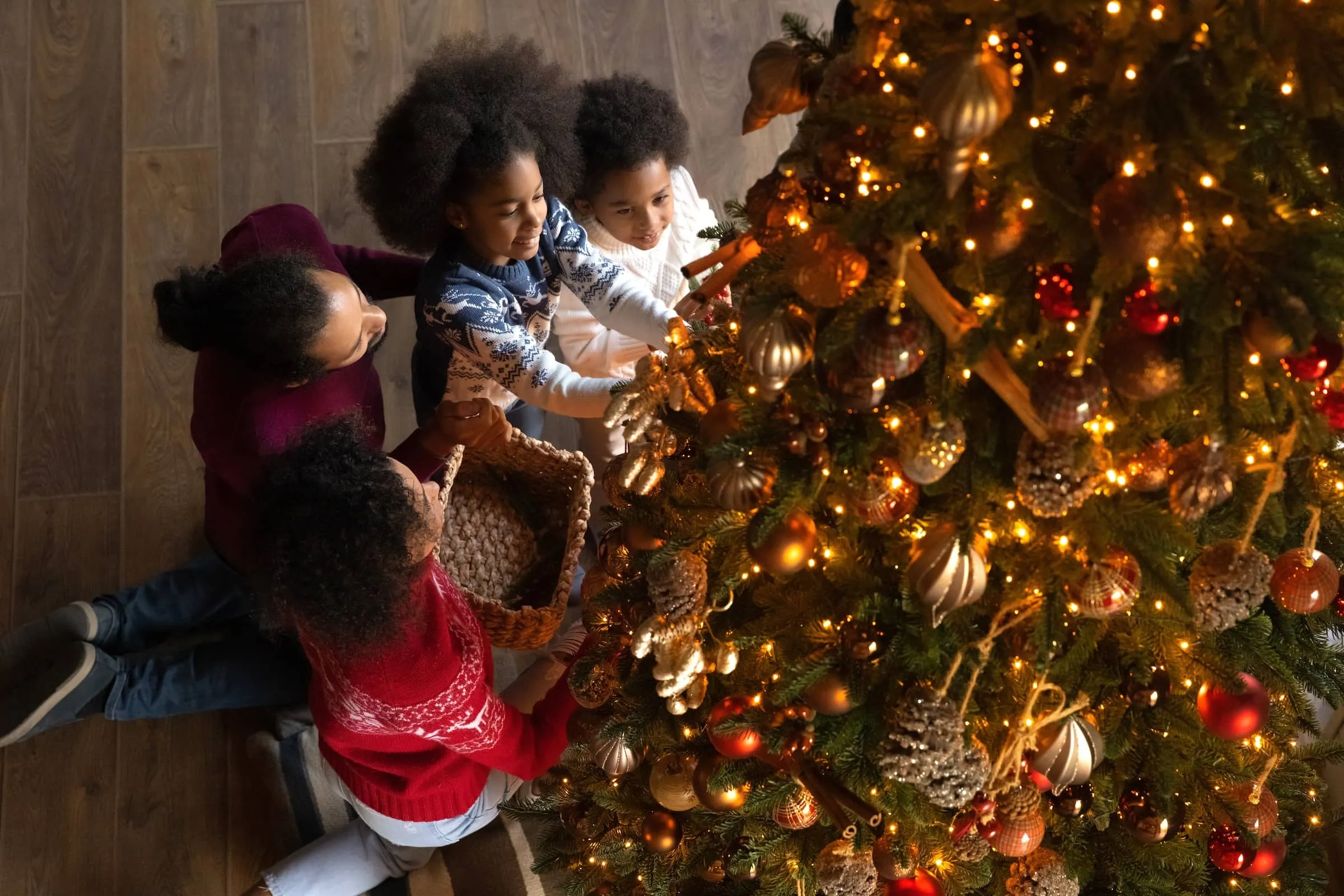
For some households, decorating the Christmas tree has become less of a family free-for-all and more of an exercise in interior design.
A quarter of parents (25%) insist on a strict colour scheme, 27% want decorations evenly spaced, and 18% have gone as far as banning tinsel.
The decorating offences don’t stop there.
More than a third (35%) object to baubles clustered together on the same branch, while 21% struggle to tolerate a crooked star or angel.
Of course, anyone who has ever handed a box of decorations to an enthusiastic five-year-old will recognise the problem. Symmetry rarely features highly on the agenda.
But there’s another influence at work, and it has rather more to do with the photographs than the festivities.
Two-thirds of parents surveyed (67%) say social media has increased the pressure to create a picture-perfect Christmas tree.
A quarter (25%) have rearranged decorations before taking photographs, while 21% admit hiding the messier side of the tree from the camera.
It seems the family Christmas tree now has two audiences: the people who actually live with it, and everyone scrolling past it.
Why Children’s Homemade Decorations Matter

The temptation to straighten a bauble might seem harmless enough. After all, nobody is suggesting that every homemade snowman deserves a permanent place in the National Gallery.
But according to Dr Becky Spelman, clinical director at The Private Therapy Clinic, children’s decorations can carry considerably more emotional meaning than parents realise.
“For children, decorating the Christmas tree is about imagination, self-expression and feeling they’ve contributed to something special. Perfection doesn’t really come into it.”
For a child, hanging something they’ve made isn’t necessarily about making the tree look beautiful. It’s about taking part, being included and seeing something of their own become part of a family tradition.
And that makes the response to their efforts important.
Spelman isn’t suggesting parents should feel guilty about every repositioned decoration. Her concern is what happens when children repeatedly see their contributions corrected or hidden.
“Wanting a tree that looks lovely is completely understandable, and moving the odd bauble doesn’t make anyone a bad parent. But it’s the bigger pattern that matters, and if children regularly see their creations quietly fixed or moved out of sight, some may start to feel their efforts aren’t good enough. Giving them their own branch, or a small tree to decorate however they like, can be a good middle ground.”
It’s a sensible compromise for parents who prefer their decorations coordinated without turning Christmas into an annual assessment of their children’s artistic abilities.
The Decorations Families Actually Treasure
Thankfully, the survey also suggests that plenty of parents are perfectly happy to let their Christmas trees reflect the rather unpredictable talents of their youngest decorators.
Almost half (48%) proudly display their children’s homemade decorations, regardless of how polished they look.
A third (33%) believe decorations made by little hands are more special than expensive shop-bought alternatives, while 41% think a Christmas tree should tell the story of the family it belongs to.
And some of those stories have been hanging around for quite a while.
More than one in five parents (21%) have kept childhood creations for over a decade, while 15% say they’ve held on to every single one.
That attachment isn’t particularly surprising when you look at what parents say they value about making decorations together.
For 36%, it’s the memories. Another 34% appreciate the creativity involved, while 32% treasure the time spent making things together.
There’s also a healthy resistance to the idea that Christmas decorations need to follow whatever happens to be fashionable this year. Nearly a third (31%) believe trees should be fun rather than fashionable, and 33% think children should be allowed to decorate however they like.
These are parents’ reported attitudes and habits, rather than evidence that one style of decorating produces better outcomes for children. But they do highlight the difference between a tree designed to impress and one filled with things that mean something.
A Little Less Perfection, a Few More Memories
The point isn’t that parents must surrender every branch to an enthusiastic child armed with a fistful of baubles.
Spelman’s suggestion of giving children their own branch, or even a smaller tree, offers a practical middle ground. It allows them the freedom to create something without constantly being corrected.
The important part is recognising that their contribution matters, even if the finished result wouldn’t survive a particularly demanding interior designer’s inspection.
After all, the matching decorations will probably look much the same next Christmas. That slightly wonky handmade angel, on the other hand, is a reminder of a particular child at a particular age.
And once that child has grown up, it might be the decoration nobody wants to move.