Blu, Rolex culture, Bond nostalgia and the quiet difference between real recognition and lazy assumption.
You don’t expect to recognise yourself in someone half your age. But sometimes, before anything is said, something is already understood.
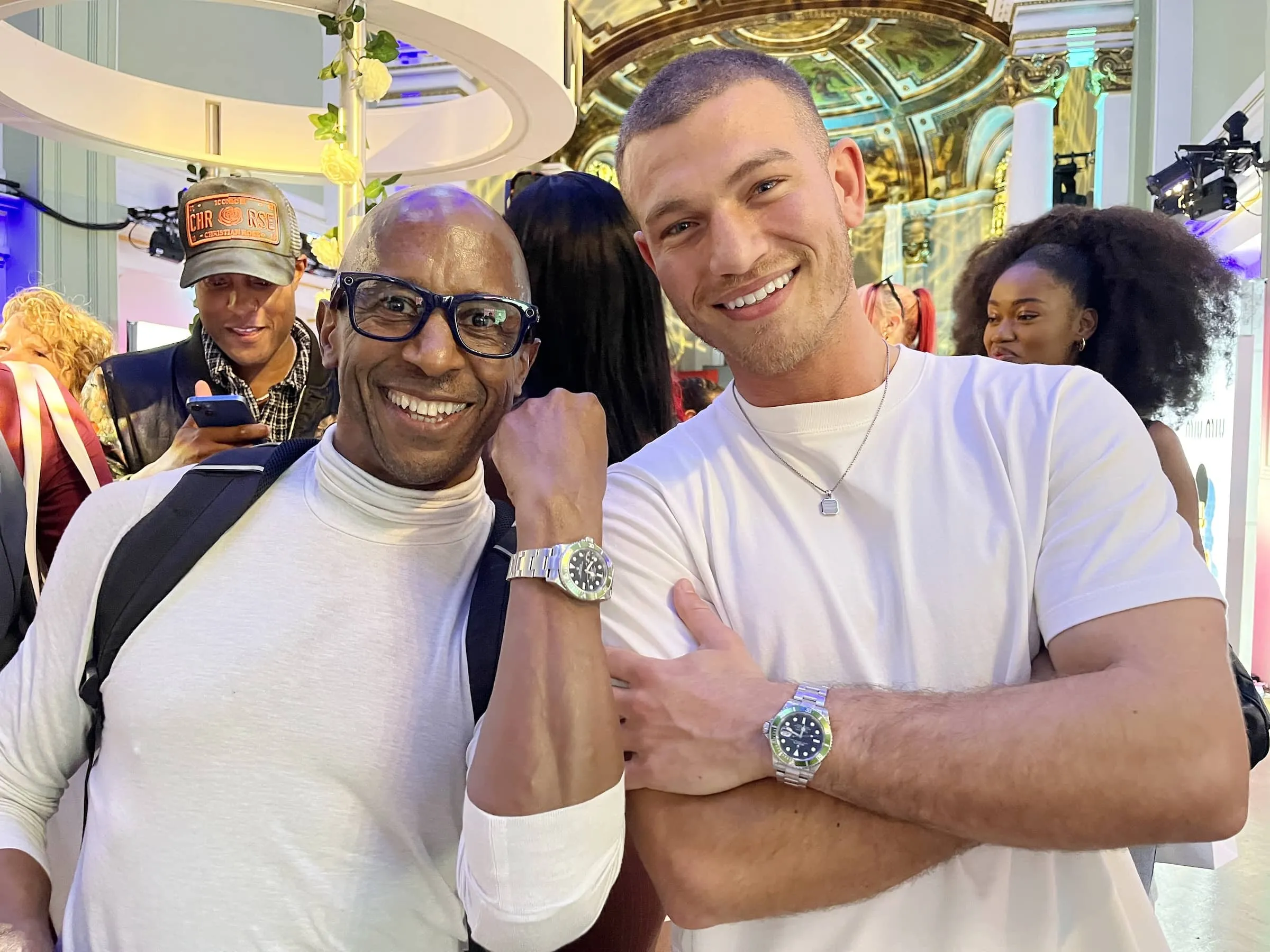
I also crossed paths with Blu at The Bloom Room, hosted by The Fragrance Shop. He’s a former Love Island contestant, someone whose world is shaped by visibility and performance. We had only met briefly a year before, yet this time, for reasons neither of us could explain, we greeted each other like long-lost friends.
There was no hesitation. No awkward reintroduction. Just ease.
Looking back, it made sense. Because what followed revealed something neither of us had consciously registered yet—we had more in common than either of us expected.
And then it happened.
I clocked his watch. A Rolex Submariner with a green bezel. The Kermit.
I wear the same watch.
When I rolled up my sleeve, he laughed immediately. Not in surprise. Not in admiration. Just recognition. The kind that doesn’t need explaining. That moment did more than confirm a shared taste. It revealed alignment.
We spoke for a while after that. It didn’t take long for the overlaps to surface. He’s a Chelsea fan. Loves training. Enjoys boxing. The conversation flowed easily, not because we were trying to find common ground, but because it was already there.
It made me realise something simple. Sometimes connection doesn’t come from time spent. It comes from something carried. An energy. A way of being. A set of habits and interests that quietly shape how you show up in the world.
And when that alignment is there, the rest follows naturally. Age becomes irrelevant.
A watch has always been more than a timekeeper. It’s one of the few things worn daily without explanation, yet it communicates something every time it’s seen. Not loudly. Not deliberately. But consistently.
Ian Fleming once wrote: “A gentleman’s choice of timepiece says as much about him as does his Savile Row suit.”
For my generation, that idea was embedded early. Sean Connery as Bond. The Rolex on the wrist. It wasn’t just an accessory—it was a marker. A signal that something had been achieved.
I remember buying my first Rolex with my first proper salary. I didn’t hide it.
Whatever I wore, the watch was visible. Not out of vanity, but pride. A quiet acknowledgement of a milestone reached through effort.
Over time, that relationship changes. The watch doesn’t speak louder. You do less. People, however, don’t always see what’s there.
They assume. I remember standing in an airport queue behind two young couples, returning from Thailand. One of the lads glanced at my wrist. “Nice watch,” he said. I thanked him. Then, without hesitation, “They do brilliant fakes here, don’t they?”
It was said with certainty. Not curiosity. He had already decided.
He began explaining what he believed he knew—the model, the bezel, what a “real” one should look like. His tone carried confidence. Authority, even. His friend stood beside him, quietly embarrassed, occasionally glancing at me as if to apologise.
I didn’t interrupt. I let him speak. Not to correct him—but because it was interesting. How quickly people construct certainty from so little.
He was convinced. Completely wrong. Then we boarded the plane. He and his friends turned right. I turned left. First class. Behind me, I heard his friend laugh and say: “You got that one wrong.”
Blu didn’t assume. He recognised. He saw the watch and understood something beyond it. Not cost. Not status. Just familiarity. Discipline. A shared reference point built over time. There was no need to prove anything. No need to explain. Just recognition.
The lad in the airport saw the same thing and created a story. Blu saw it—and understood. That’s the difference.
Two people, both half my age. One performed certainty. The other recognised truth. And that difference extends far beyond a watch.
It shows up in how people train. How they carry themselves. How they connect. Whether they observe—or assume.
Blu and I are decades apart. But we share something that isn’t immediately visible. Consistency. Not the loud, performative kind. The quiet kind. The kind that doesn’t announce itself, but shows up anyway—in how you move, how you think, how you respond.
That’s what he recognised. Not age. Not status. Not appearance. Just alignment.
A watch tells a story. So does the person wearing it. And so does the person looking at it. Some people see what’s there. Others see what they expect to see. And if that’s what shows up at one of Stefan’s events, then I’ll keep turning up.
Fragrance is a silent extension of who you are.
So is what you wear.
And how you choose to see.
Meta-Age.