Amazfit-backed HYROX Elite 15 athletes reveal how data, composure and hybrid training shape their Stockholm World Championship plans.
Amazfit heads to the HYROX World Championships in Stockholm with selected Elite 15 athletes preparing for the sort of sporting examination that makes a treadmill look like a chaise longue and a sled push feel like a small domestic argument with gravity.
HYROX, now billed as the world’s fastest-growing sport, is not a gentle shuffle between disciplines. It is hybrid fitness with its collar up: running, strength stations, tactical pacing and the constant possibility that your carefully constructed plan may be fed through a woodchipper by lap four.
The Stockholm World Championships begin on June 18, and for the athletes involved, the margin between triumph and a particularly public unravelling may be measured not only in seconds, but in heart-rate control, composure and the ability to suffer intelligently.
Why Hybrid Training Is The Real Battleground
HYROX is often described as a test of strength and endurance. That is true, in the same way that the sea is a bit damp.
The reality is more awkward. A brilliant runner can bleed time at the workout stations. A powerful athlete can make the sled obey, then find the next kilometre feels like it has been laid out by a sadist with a measuring wheel.
“You can be incredibly fast when running, but without sufficient strength training you will lose many seconds at the workout stations. And vice versa. Without endurance and strong running training, efficiently pushing the sled will not deliver a good result,” says Jesús Carrero, General Manager EMEA at Amazfit, and explains: “The key to success is hybrid training, which, supported by sports technology, allows athletes to build and maintain the necessary balance between strength and endurance. The challenge is not simple due to the overlap of different types of exercises that create different stimuli. Physiological data and subjective feelings, which our solutions record, provide a more complete picture of whether and for which type of exercise the athlete’s body is ready.”
That balance is the central obsession. HYROX does not reward the athlete who simply trains harder until their legs file a complaint. It rewards the one who can identify the weakness, hit it precisely, and arrive on race day sharp rather than cooked.
Hidde Weersma And The Art Of Training With Restraint

Hidde Weersma, the 2026 European Champion and the first HYROX Elite 15 athlete to officially break the barrier in the Men Pro Solo category, uses Amazfit sports technology in his preparation.
His approach is not the usual chest-beating gym sermon. It is more clinical than that. Less “destroy yourself”, more “find the leak and plug it before Stockholm exposes it in front of everyone”.
“In HYROX, the solution is not training harder,” says Hidde Weersma, adding: “The key is to precisely identify weaknesses and directly target them in training. My plan regularly includes high-density EMOM sessions, as well as so-called threshold run bricks, meaning threshold runs interspersed with strength exercises. This allows me to prepare my body exactly for the situations I will face during competition.”
There is a lesson in there for anyone who has ever mistaken exhaustion for progress. Weersma’s week includes two or three hard sessions, but much of the work is done at low intensity, building the endurance base required to keep moving when the race begins to bare its teeth.
Threshold training is another key part of his system. Rather than relying on long, draining intervals that leave the body feeling like an abandoned shopping trolley, he uses shorter repetitions with minimal rest. The aim is to accumulate serious work around lactate threshold without paying for it with excessive fatigue in the next session.
The Fourth Heart Rate Zone May Decide The Race
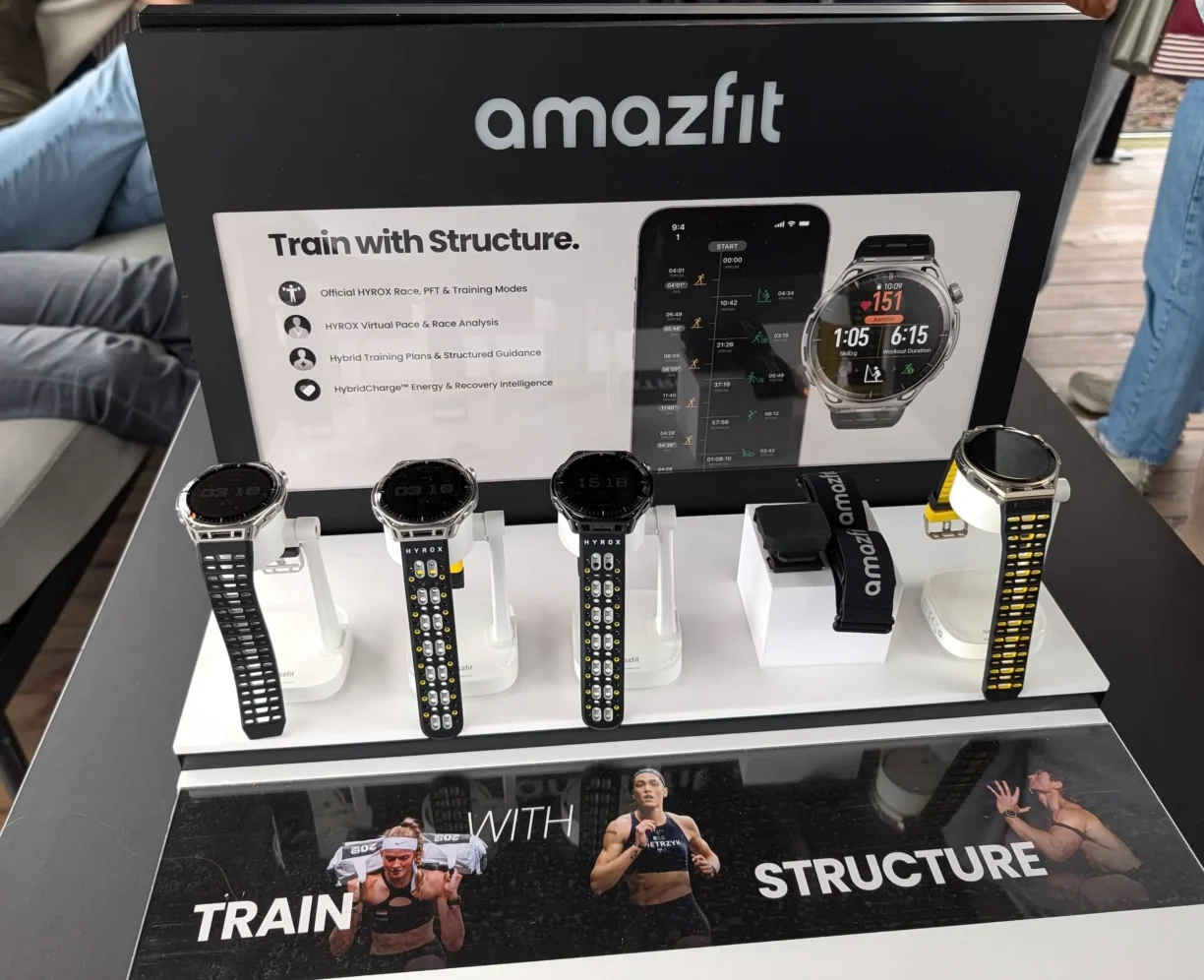
For all the noise and theatre of HYROX, the decisive work often happens in a very specific internal place: hard enough to hurt, controlled enough not to implode.
“HYROX largely comes down to who can move fastest in the fourth heart rate zone, around the aerobic threshold. That’s why during training I pay special attention to the time spent at this intensity level. My Amazfit watch or Helio Strap allows me to continuously monitor this parameter and ensure I am delivering exactly the training stimulus I planned,” adds the European Champion.
That is where Amazfit’s role becomes more interesting than simply being a logo on the kitbag. Wearable sports technology, used properly, becomes a governor, a warning light and occasionally a stern little accountant on the wrist. It tells an athlete whether the session is doing what it was designed to do, rather than merely producing heroic sweating and an Instagram caption.
For HYROX athletes, that matters. The fourth heart rate zone is no place for guesswork. Push too little and the stimulus is soft. Push too hard and tomorrow’s training may be reduced to a mournful shuffle and some creative lying about “active recovery”.
Emilie Dahmen And The Calm Before The Storm
Not every decisive HYROX moment is physical. Some happen before the first station, when the crowd is loud, the body is sharp and the mind starts behaving like a badly tuned radio.
Emilie Dahmen, the youngest Elite 15 athlete, finished third at the last European Championships and will compete at the HYROX World Championships for the second year in a row. Her path to Stockholm was not exactly a spa weekend. Qualification came late, and that brings a particular flavour of pressure.
“For Elite 15 athletes, preparation for the World Championships begins at the start of the season. Along the way, however, qualification had to be earned – the sooner the better, in order to better periodize preparation for the June race. I only secured qualification in April. I was stressed then. It was my last chance. But I was able to stay calm and almost perfectly execute my tactical plan,” says Emilie Dahmen.
That sentence carries the quiet menace of elite sport. Dahmen did not blast off in blind panic. She started calmly, conserved energy and monitored her heart rate on her Amazfit watch. Station by station, kilometre by kilometre, she moved up the standings and earned the place she needed.
It sounds simple, which is generally how difficult things disguise themselves after the fact.
Linda Meier’s Chicago Lesson: Control The Uncontrollable
Linda Meier, winner of last year’s HYROX World Championships in Chicago, knows better than most that the race does not always follow the script. Like Dahmen, she uses Amazfit sports technology in training.
In Chicago, Meier was not regarded as one of the main favourites. Then came the 80-metre burpee station halfway through the race, that charming stretch of competitive punishment where athletes discover new dimensions of personal resentment.
It was there that Meier took the lead. With others forced to chase and the pressure tightening around the race, she stayed composed, held her pace and crossed the finish line first.
That is HYROX in miniature. The best athletes do not merely absorb pain. They manage disruption. They make better decisions while the body is suggesting several worse ones.
Stockholm Is Set Up For Twists
The Stockholm World Championships should provide exactly the sort of volatility that makes HYROX compelling. Early leaders may fade. Strong station athletes may rise. The clever pacers may appear from nowhere, having spent the first half of the race looking almost suspiciously sensible.
“During the HYROX World Championships in Stockholm, I expect similar emotions and twists. After all, this is the most important event of the season. Athletes who are further back in the first part of the race may move forward because they perform better at subsequent workout stations, manage pace more intelligently, and handle stress better,” says Jesús Carrero, adding: “I will be cheering for all Elite 15 athletes.”
That final point is the heart of it. HYROX is not just about power, speed or lung capacity. It is about combining them without letting any one of them wreck the others. The athlete who wins in Stockholm may not be the one who looks best in the first kilometre. It may be the one who knows exactly when to push, when to hold, and when to trust the numbers rather than the panic.
In a sport built on suffering, the smartest athlete may simply be the one who suffers with the most accurate watch and the coolest head.