For ABA clinics, data collection software is no longer just an administrative convenience. The right platform can shape clinical decisions, staff confidence, billing accuracy and audit readiness.
Collecting behavioural data on paper while actively running a session is one of the most frustrating parts of ABA practice. The right ABA Data Collection Software changes that completely. BCBAs and RBTs deal with real pressure every day: keeping session notes accurate, staying HIPAA and BACB compliant across multiple devices, and making sure clinical records hold up to insurance audits.
After reviewing the leading platforms in this space, the differences between them matter far more than most practices realise. This guide breaks down the top options and what actually separates them.
The Shortlist Methodology
Platforms were evaluated using publicly available information pulled from user reviews, official product pages, case studies, and directory listings. Only tools with a proven track record inside applied behaviour analysis workflows made the final cut. Features, compliance posture, and real-world usability were weighed against what BCBAs and RBTs actually need.
→ See the full research breakdown
- Theralytics – Best for ABA practices prioritising real-time data sync and clinical-operational alignment
- CentralReach – Best for large autism and IDD care providers needing an end-to-end platform
- ABA Matrix – Best for practices of all sizes wanting flexible, unit-based pricing
- Raven Health – Best for ABA clinics needing fast staff training and mobile-first data collection
- Rethink Behavioural Health – Best for ABA clinics and pediatric therapy providers needing built-in staff training
Why the Right ABA Data Collection Software Makes a Difference
Picking the wrong platform doesn’t just slow your team down. It creates gaps in behavioural data that affect treatment decisions, insurance claims, and supervision audits. Manual, paper-based data collection during active sessions splits a therapist’s attention at exactly the wrong moment.
Real-time accuracy matters because behaviour data informs program adjustments. When that data is delayed, incomplete, or entered post-session from memory, the clinical picture blurs.
Specialised platforms designed for ABA workflows carry a clear advantage. They’re built around how BCBAs think, not how generic health tech teams assume they think.
The difference shows up in inter-rater reliability scores between therapists, in the percentage of session notes completed on time, and in how many active learner programs can actually be tracked per client without things falling through the cracks. That kind of consistency is rare without the right tool behind it.
Top 5 ABA Data Collection Software: Quick Specs at a Glance
Note: All data in this table is sourced from review platforms and the official websites of the listed companies.
| Company Name | Established | Team Size | Headquartered In |
| Theralytics | 2017 | 11-50 | St. Petersburg, Florida |
| CentralReach | 2012 | 357 | Fort Lauderdale, FL |
| ABA Matrix | 2017 | 11-50 | Florida, United States |
| Raven Health | 2020 | 51-200 | Wilmington, Delaware |
| Rethink Behavioural Health | 2007 | ~500 | New York, NY |
- Theralytics – Best for Clinical-Operational Sync Across the Full Practice

What Competencies Help Theralytics Grow?
Theralytics is built around an idea that most ABA platforms miss: clinical data and operational data should live in the same place and update in real time. The platform ties together scheduling, billing, parent portals, and session-level data collection so BCBAs and supervisors aren’t bouncing between disconnected tools.
Automated graphing and progress monitoring remove a layer of manual work that usually falls on already-stretched clinicians. Security is built in from the start, with AES-256 encryption and SOC 2 Type II certification covering data at rest and in motion.
What Makes Theralytics Stand Out for ABA Data Collection Software?
Theralytics solves the data silo problem that slows down treatment adjustments in busy ABA practices, where clinical notes and billing records often live in completely separate systems. Practices that run everything through one synchronised platform tend to make faster, better-informed clinical decisions and spend less time on redundant documentation.
The Verdict from Users:
Feedback consistently points to the tight connection between clinical and administrative workflows as the standout feature. Users flag that third-party add-ons may need custom API work, but the platform earns strong marks for compliance and speed of clinical insight.
For practices tired of toggling between five different tools, Theralytics is a genuinely practical answer.
- CentralReach – Best for Enterprise Autism and IDD Providers Needing End-to-End Coverage
What Competencies Help CentralReach Grow?
CentralReach has built the kind of platform that large ABA organisations actually need. Trusted by more than 4,000 practices and over 200,000 professionals, they cover everything from IEP and behaviour data collection to ABA-specific billing automation and intelligent scheduling.
Their proprietary AI system, called cari, was trained on more than a billion data points developed alongside 40-plus BCBAs. That kind of clinical collaboration during development is hard to match, and it shows in how precisely the features map to real ABA workflows.
What Makes CentralReach Stand Out for ABA Data Collection Software?
CentralReach addresses the problem of fragmented tools across clinical, administrative, and billing functions by pulling everything into a single, purpose-built platform for autism and IDD care. That usually means less time spent reconciling data across systems and more time focused on actual treatment delivery.
The Verdict from Users:
CentralReach has picked up more than 40 industry awards, including recognition from Deloitte and Inc. Magazine, which shows they’re credible at the enterprise level. Users tend to appreciate the depth of features, though practices with simpler needs sometimes find the platform broader than they require. It earns its reputation most strongly in larger, multi-site organisations.
- ABA Matrix – Best for Solo Practitioners and Growing Clinics Watching Their Budget
What Competencies Help ABA Matrix Grow?
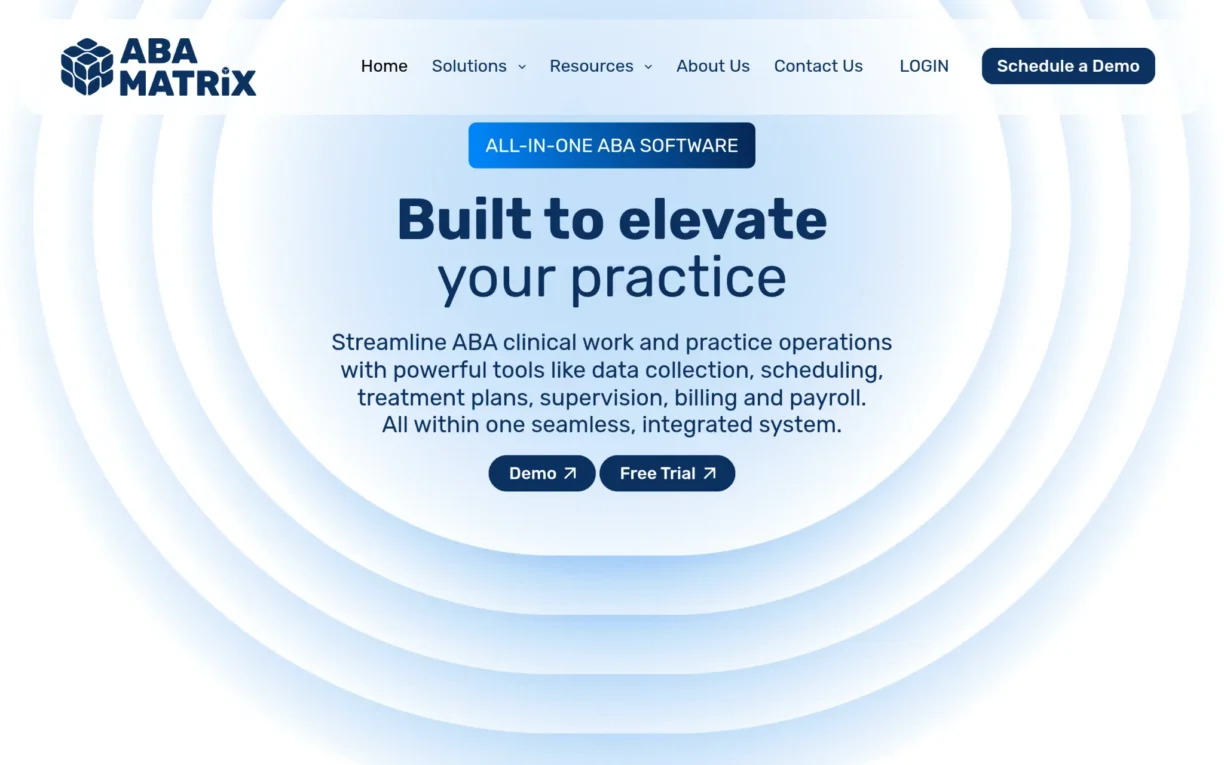
ABA Matrix takes an all-in-one approach without the enterprise-level pricing that usually comes with it. Their platform covers data collection, scheduling, billing, progress notes, assessments, graphing, reporting, compliance alerts, and payroll in one place.
The unit-based pricing model is a real differentiator (not cheap at the high end, but genuinely fair for smaller practices). Running as an independent, bootstrapped company means they’re not chasing investor timelines, which tends to translate into steadier product development focused on what clinicians actually need.
What Makes ABA Matrix Stand Out for ABA Data Collection Software?
ABA Matrix handles the challenge of finding a platform that serves a solo practitioner just as well as a large private practice, without forcing either one into a pricing tier that doesn’t fit. That kind of scalability is rare in a space where most tools are built for one size of operation.
The Verdict from Users:
ABA Matrix was named the Top ABA Therapy Data Collection and Practice Management Platform 2026 by Healthcare Tech Outlook Magazine, which adds real credibility to the user praise. Case studies point to improvements in assessment accuracy and day-to-day operational flow.
For practices that need compliance coverage without paying enterprise prices, this one comes up consistently.
- Raven Health – Best for ABA Clinics That Need Fast Staff Training and Mobile Flexibility
What Competencies Help Raven Health Grow?
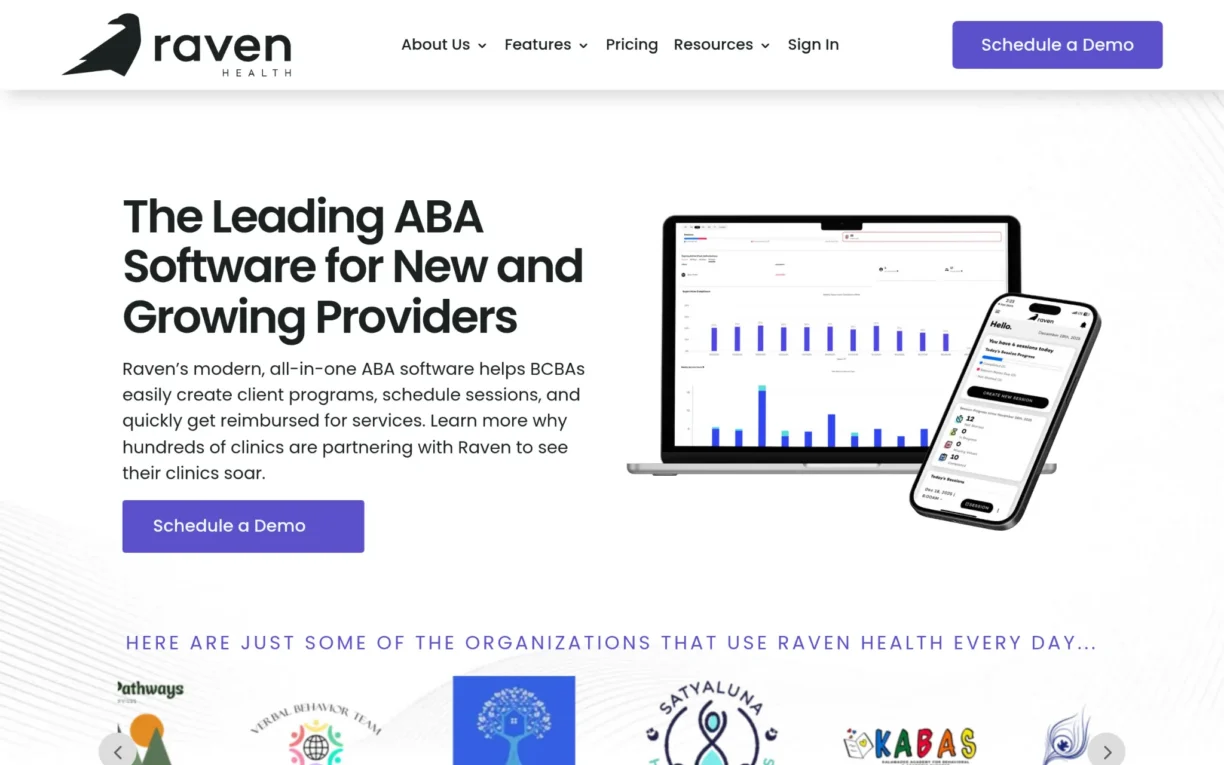
Founded in 2020, Raven Health has moved quickly to build a platform that clinicians actually want to use. Their design philosophy starts with healthcare provider requirements, not technology assumptions, and the result is an interface most users pick up in under 15 minutes (which matters a lot when you’re training new RBTs).
The platform supports offline data collection, which solves a real problem for providers working in home or community settings without reliable internet. Their Managed Billing Bundle charges only a percentage of collected claims, so the revenue model works with client success.
What Makes Raven Health Stand Out for ABA Data Collection Software?
Raven Health tackles the steep learning curve that typically slows software adoption in ABA clinics by building mobile-first and keeping the interface genuinely intuitive for frontline staff. That design choice has a direct effect on how consistently RBTs complete session notes on time.
The Verdict from Users:
Client implementations like Crescent Bloom and Pair Tree Autism Services give a real-world picture of what the platform delivers operationally. The mobile-first approach and fast staff training come up repeatedly as reasons practices choose Raven over older platforms. That kind of practical usability is hard to fake when the reviews are this consistent.
- Rethink Behavioural Health – Best for ABA Clinics Needing Built-In Staff Training Alongside Data Collection
What Competencies Help Rethink Behavioural Health Grow?
Rethink Behavioural Health has been in this space since 2007, and that experience shows in how the platform is structured. With nearly 500 team members and more than 2,000 customers worldwide, they serve everyone from startup ABA practices to enterprise organisations.
The platform includes over 1,500 customizable care plans, mobile data collection, and a Medical Necessity Assessment tool that has been completed over 23,000 times with 87% average agreement with clinicians. The fact that the platform was built by clinicians for clinicians comes through in how the features are organised.
What Makes Rethink Behavioural Health Stand Out for ABA Data Collection Software?
RethinkBH addresses the reality that ABA staff training and clinical programming are often handled on completely separate systems, creating extra administrative burden for supervisors and BCBAs.
Their combination of built-in training tools alongside data collection means new staff get up to speed faster, which has a measurable effect on inter-rater reliability across a care team.
The Verdict from Users:
RethinkBH’s largest published ASD dataset and patent-pending features point to genuine investment in research, not just product marketing. Practices that use it tend to appreciate the all-in-one nature, particularly the way training and clinical workflows sit side by side. It’s especially strong for organisations managing large teams across multiple programs.
The Research Behind These Recommendations
Establishing Your Information Foundation
Building the longlist started with a broad sweep across ABA-specific software directories, behavioral health technology review platforms, and independent case study databases. The goal was to surface every platform with a meaningful presence in the applied behaviour analysis space, not just the ones with the highest advertising budgets. Product category listings, professional community forums where BCBAs discuss tools, and curated directories focusing on behavioural health technology all fed into this initial pool. That foundation meant the shortlist was shaped by where practitioners actually go for information, rather than by marketing visibility alone.
Reducing to Your Top Contenders
Once the longlist was assembled, platforms without verifiable real-world use in ABA settings were removed. Review patterns across multiple independent sources were analysed to separate tools with genuine user adoption from those generating surface-level attention.
Platforms where review sentiment skewed heavily toward staff training frustration, missing ABA-specific features, or compliance gaps were filtered out early. What remained were tools that showed consistent, positive use across diverse practice sizes and clinical contexts, from solo practitioners to multi-site organisations.
Checking Facts Against Available Evidence
Each platform’s stated capabilities were cross-referenced against what users actually reported in reviews, case studies, and community discussions. When a company claimed real-time data synchronisation or HIPAA and BACB compliance, those claims were checked against available documentation and user reports.
Gaps between marketing language and real-world performance were flagged during this phase. Tools that showed strong agreement between what they promised and what users described moved forward.
Where Each Pick Stands in the Industry
Industry recognition was factored in as a signal of standing, not as a deciding factor on its own. Awards from healthcare technology publications, recognition from behavioural health associations, and appearances in independent rankings all contributed to the picture.
Platforms that showed up consistently across multiple credible sources carried more weight than those with a single prominent mention. Longevity and growth trajectory were also considered, since a platform that has grown steadily over multiple years in a specialised field typically reflects genuine clinical value.
ABA Data Collection Software-Specific Validation
The final validation step focused on ABA relevance. Each platform was checked for dedicated features covering DTT, naturalistic teaching environments, behaviour reduction plans, and session note formats that meet payer requirements.
Verified reviews from BCBAs and RBTs describing clinical workflows were weighted more heavily than generic software praise. Case studies showing measurable outcomes, like improved billing claim acceptance rates or reductions in time spent on data entry per session, confirmed that the platforms on this list deliver results where it counts most.
User’s Guide: Choosing the Right ABA Data Collection Software
Picking the right platform comes down to matching the tool’s actual capabilities to how your practice runs day to day, not just to a feature checklist. The best ABA data collection software fits your team size, your clinical model, and your compliance requirements without requiring a second full-time job to manage.
- Industry/Domain Experience: Look for platforms built for ABA, not general health tech adapted for behavioural use. Purpose-built tools understand DTT, behaviour reduction planning, and payer documentation requirements from the ground up.
- Features and Services: Confirm the platform covers your full workflow: real-time data collection, session notes, graphing, progress monitoring, and billing, ideally in one place to cut down on toggling between tools.
- Pricing Structure: Unit-based, per-learner, and percentage-of-collections models all exist in this space. Match the pricing structure to your practice size so costs scale predictably as you grow.
- Results Measurement: Ask how the platform tracks goal mastery rates, inter-rater reliability, and session note completion. If you can’t pull those numbers easily, clinical decision-making slows down.
- Industry Knowledge and Compliance: HIPAA and BACB compliance, audit trail completeness, and multi-device access are non-negotiable. Confirm certifications and ask how the platform handles data access controls before signing anything.
What This Means for You
The ABA data collection software market has matured enough that practices no longer have to choose between clinical depth and operational coverage. The best platforms on this list handle both.
What separates a good fit from a costly mistake is knowing your practice’s actual workflow before you evaluate any tool.
Clinics that match the right platform to their size, team structure, and compliance needs tend to see faster session note completion, stronger inter-rater reliability, and better audit readiness. That combination will only matter more as payer documentation requirements continue to tighten.