
Winmau has introduced four new Blade 7 dartboards, with revised sisal construction, thinner wiring around the bull and separate designs for the PDC ProTour and stage. Prices start at £59.99, but what exactly changes as you move up the range?
A dartboard is one of those bits of sporting equipment that tends to get noticed most when something goes wrong. A dart catches the wire, drops to the floor, and what looked like a perfectly respectable throw suddenly counts for absolutely nothing.
Winmau cannot do much about your aim, unfortunately, but its new Blade 7 collection is designed to tackle some of the other frustrations that come with the game.
The manufacturer has introduced four new boards, ranging from the £59.99 Blade 7 to two £89.99 Triple Core editions associated with professional darts. There is also a new protective surround for anyone whose grouping occasionally extends beyond the board itself.
Beneath the different names and finishes, though, the important distinction is relatively straightforward: three approaches to the board’s internal construction, with the two most expensive models sharing the same Triple Core playing specification.
Winmau Blade 7: What’s New Across the Range?
Four boards, three core constructions
The standard Winmau Blade 7 introduces the latest version of the company’s Single Core Technology, using longer sisal fibres to bring the material specification into line with its more expensive Dual Core and Triple Core models.
Made from East African sisal, the £59.99 board features Winmau’s patented density-control technology, intended to maintain an even playing surface and help darts remain securely embedded.
The longer fibres are an important part of the update. Winmau says they should improve dart retention and durability, although those are manufacturer claims rather than findings from independent testing.
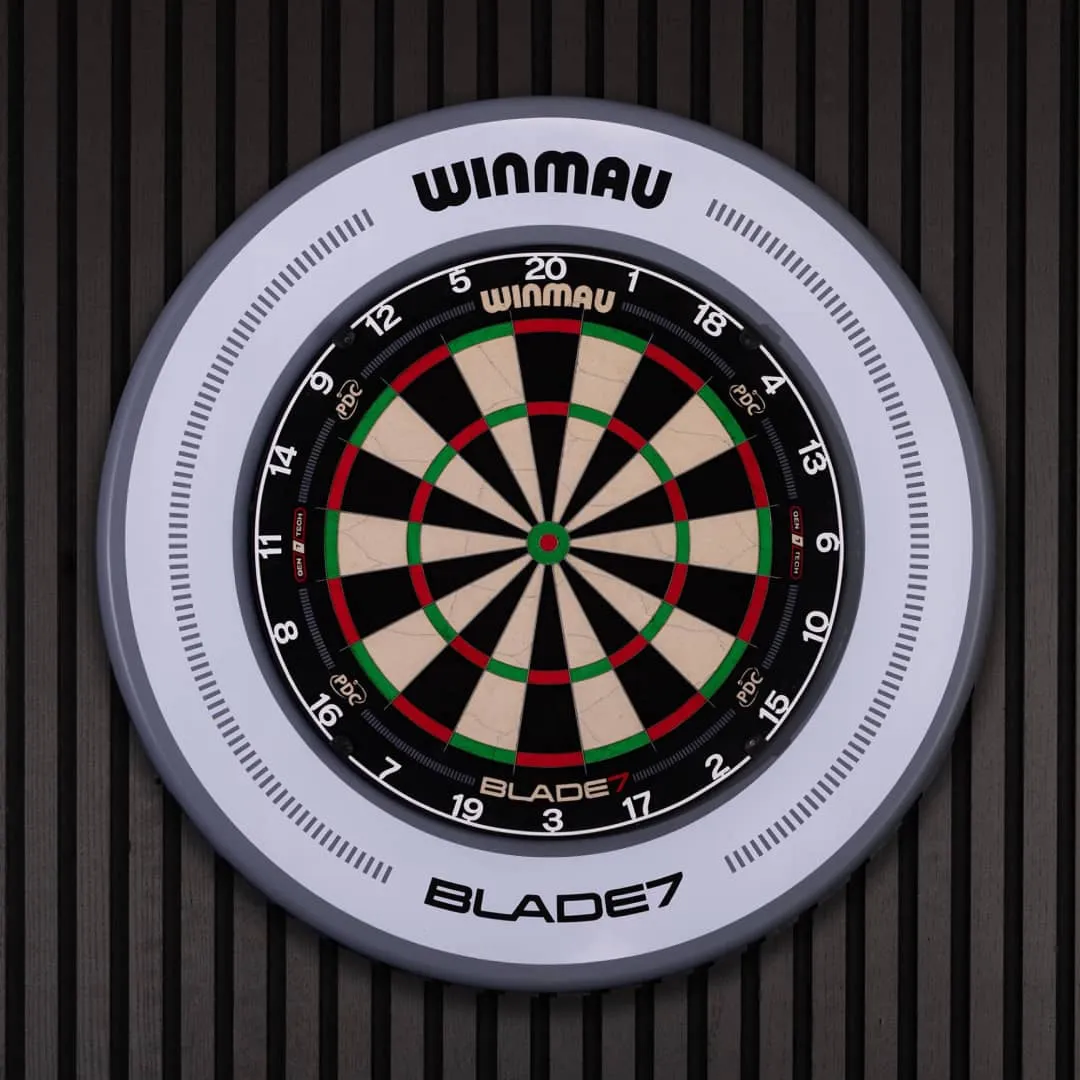
Visually, the standard Blade 7 also has a noticeably different identity, with an all-white finish that distinguishes it from the higher-priced boards.
At £69.99, the Blade 7 Dual Core 360 introduces a two-layer construction.
A lower-density outer layer is designed to allow smoother dart penetration, while a denser inner layer absorbs excess kinetic energy. The aim is to balance retention with durability, particularly under repeated use.
The Dual Core also features ultra-thin Blade wiring, angled at 60 degrees to guide darts towards the scoring sections rather than allowing them to catch on the metal.
Its symmetrical 360-degree design incorporates ten balanced rotation points, making it easier to turn the board regularly and distribute wear around the playing surface.
That is a useful consideration for anyone who spends rather more time aiming at treble 20 than the rest of the board.
Blade 7T Championship and Stage Editions: What’s the Difference?
At the top of the range sit the Blade 7T Championship Edition and Blade 7T Stage Edition, both priced at £89.99.
These share Winmau’s Triple Core Technology, which combines two layers of sisal with a third, high-compression layer carbon-bonded to the backboard.
According to Winmau, this arrangement is intended to improve fibre density, dart retention and scoring consistency while maintaining a seamless playing surface.
The Championship Edition is designated as the official dartboard of the PDC ProTour, including the Players Championship circuit.
It incorporates a symmetrical 360-degree design with ten rotation points, alongside a laser-cut steel number ring with a grey anti-glare finish.
The Stage Edition uses the same Triple Core playing specification but adopts a different visual identity associated with the PDC’s televised stage events.
That distinction matters for buyers. Based on Winmau’s published specifications, the Stage Edition is not being presented as an upgrade in playing performance over the Championship model. The difference is principally its stage-specific design and association.
Both boards also come with a spirit level to assist with installation.
The launch follows Winmau’s earlier introduction of the Blade X dartboard, which brought a different ProCore construction and steel mounting system into the company’s professional equipment range.
Thinner Wiring and a Simpler Mounting System
Some of the changes extend across all four Blade 7 models.
Winmau has redesigned the outer bull, or 25-point ring, making it 15% thinner with a lower-profile construction.
The idea is to reduce the amount of metal surrounding the bullseye, giving darts more opportunity to reach the scoring surface rather than striking the ring.
All four boards also receive a laser-cut steel number ring, with anti-glare finishes featured on the Dual Core and Triple Core editions.
Each model includes a hardened bullseye and a steel thread-lock mounting system carried over from the Blade X. This is designed to secure the mounting hardware without drilling directly into the dartboard itself.
Winmau’s Rota-Lock system is also included, allowing players to adjust the board against the wall for a stable, level fit. Fixing screws and wall plugs are supplied.
These are practical details rather than glamorous ones, but a properly mounted board that can be rotated without unnecessary fuss is useful whether you play league darts or occasionally throw a few legs at home.
Autodarts Plus and the New Blade 7 Surround
Winmau is also including a one-month free Autodarts Plus subscription with each dartboard.
The subscription connects the launch to the company’s wider digital darts offering, including scoring and connected play. Sustain Health previously covered Winmau’s Autodarts LENS system, which uses a smartphone camera to handle scoring and connect players online.
For home players interested in tracking their games, the subscription provides an opportunity to explore that side of the sport alongside the traditional board.
There is also the separate Blade 7 Dartboard Surround, priced at £49.99.
Made from impact-absorbing foam, it is designed to protect the wall around the board from stray darts while reducing the likelihood of damage to dart tips.
The surround fits without additional tools or mounting hardware and is compatible with Winmau, Red Dragon and Nodor bristle boards.
It is a sensible addition for a home set-up, particularly if the surrounding plasterwork has already witnessed a few ambitious attempts at double top.
Winmau Blade 7 Prices and Availability
The new range is listed through Winmau’s official website at the following recommended retail prices.
For the occasional home player, the standard Blade 7 offers the revised playing surface without the additional cost of a layered construction.
The Dual Core gives regular players a different internal design and a more substantial emphasis on rotation and durability, while the two Triple Core models provide Winmau’s highest specification within this particular collection.
Whether those differences justify the extra money will depend on playing frequency, personal preference and how the boards perform over time.
The interesting thing about the Blade 7 range is that Winmau has given players a choice of construction rather than simply four different appearances.
And while no amount of engineering will rescue a badly aimed dart, making sure the board does its job when one arrives in the right place seems a perfectly reasonable starting point.