Karsten Warholm’s 46.87 in Stockholm clipped history, one final hurdle and Kevin Young’s world record still in his sights.
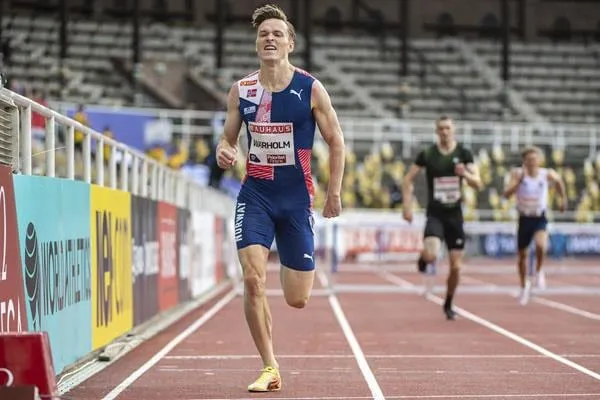
Karsten Warholm did not so much run the 400m hurdles in Stockholm as attempt to evict the event from the laws of physics. At the Bauhaus Galan, inside the old Olympic bones of Stockholm’s 1912 stadium, the Norwegian tore round the track in 46.87, a European record and a performance close enough to Kevin Young’s long-standing world record to make the stopwatch look nervous.
For most athletes, 2020 was a season of compromises, cancellations and strange silences. For Warholm, it became something else: a sharply reduced menu on which he ordered only the expensive dishes. First came Monaco, where he opened his 400m hurdles season after more than ten months away and ran 47.10 at the EBS Herculis Meeting. Then came Stockholm, where he went faster, harder and closer to history.
By the time he reached the final barrier, Young’s 46.78 from the 1992 Olympic Games in Barcelona was not a museum piece. It was a live target. Warholm had one hurdle left between himself and one of athletics’ most stubborn numbers.
Then, with all the delicacy of a man defusing a bomb while wearing boxing gloves, he clipped it.
One Hurdle, One Stumble, One Ridiculous Time
The final hurdle did not floor him. It did something more irritating. It pinched his rhythm, nicked a few priceless hundredths from the clock and left him crossing the line with his hands over his face.
That reaction said plenty. This was not disappointment in the usual sporting sense. It was the expression of a man who had just run the second-fastest 400m hurdles in history and knew, instantly, that it might have been faster still.
“I hit that last hurdle because I went really hard for the first nine, and stuff like this happens,” said Warholm, who has raced to the last two world titles .
That is Warholm in a sentence: ferocious, unsentimental, and not terribly interested in the decorative excuses athletes sometimes arrange around themselves like hotel cushions.
“You know, I’m always telling myself to be a warrior when I go out on the track. I think I was rewarded by just going all in at the end and I got a great time. It’s a great lesson for me to always run until the finish line.
“We learn. We learn.”
It was a European record by 0.05, improving his own mark. It also made him, at that point, the only man to have broken 47 seconds twice in the 400m hurdles. For a discipline sometimes described as the “man killer”, this was beginning to look less like athletic improvement and more like a hostile takeover.
Why Warholm’s 46.87 Still Lands Like A Thunderclap
There are fast times, and then there are times that rearrange the furniture. Warholm’s 46.87 sits in the second category.
Kevin Young’s 46.78 had stood since Barcelona 1992, four years before Warholm was born. It had survived champions, eras, training revolutions and several generations of athletes who arrived with hope and left with respectful bruises.
In Stockholm, Warholm missed it by 0.09.
That margin is barely enough time to regret a haircut. In the 400m hurdles, however, it is an eternity and a whisper at once. One clipped hurdle. One broken cadence. One small clatter between astonishing and immortal.
The world all-time context was brutal and beautiful. Young remained at 46.78. Warholm moved to 46.87. Behind him stood Abderrahman Samba and Rai Benjamin at 46.98, with Ed Moses’ 47.02 from 1983 still gleaming in the record books like a cathedral window.
Warholm was no longer merely chasing history. He was breathing down its neck.
From Multi-Event Prospect To Hurdling Menace
The remarkable bit is that Warholm did not arrive in the sport as a single-lane specialist with blinkers fitted from childhood. Born in Ulsteinvik on 28 February 1996 and coached by Leif Olav Alnes, he first emerged internationally as a multi-event prodigy.
In 2013, he won the world U18 octathlon title in Donetsk by almost 200 points. Some of his marks across the eight disciplines were strong enough to trouble individual finalists. That is usually a sign of a talented youngster. In Warholm’s case, it was more like an early warning siren.
He moved into the U20 ranks, took on the decathlon, and still found room to win silver medals in both the decathlon and 400m at the 2015 European U20 Championships in Eskilstuna. The small inconvenience was that the 400m final took place in the middle of the decathlon. Naturally, he did both. Some people multitask by answering emails during lunch. Warholm apparently preferred sprinting himself inside out between throws and jumps.
That season also brought national U20 records across indoor and outdoor events, from the 200m and sprint hurdles to the long jump and decathlon. His indoor 400m best of 47.25 was a national senior indoor record.
Then came the pivot.
In 2016, his first year as a senior athlete, Warholm decided the decathlon’s ten disciplines were not quite enough punishment and turned seriously to the 400m hurdles. He had dabbled with the event as a teenager, but this was the first season in which it became the main event rather than an after-hours mischief.
The signs were not subtle. In his first race of the season, he broke the Norwegian national record with 49.62. By the end of the year, he had reached the European final, made the Olympic semi-finals in Rio and reduced his best to 48.49.
He had found his event. More accurately, the event had found its latest problem.
London Rain, Viking Hat, World Champion
Warholm’s 2017 season announced him properly. At the Diamond League meeting in Oslo, he ran a national record of 48.25 on home soil, beating Olympic champion Kerron Clement and Olympic bronze medallist Yasmani Copello.
He won again in Stockholm. He won at the European U23 Championships in Bydgoszcz. By the time he reached the World Championships in London, he was young, dangerous and very much in the conversation.
The final came in heavy rain, which did nothing for fast times and everything for drama. Warholm charged through it to win gold in 48.35, the youngest man in the field becoming world champion while the weather behaved like a particularly spiteful British landlord.
“I truly don’t believe it,” he said afterwards, celebrating with a Viking-style hat on his head. “I’ve worked so hard for this but I don’t know what I have done. This is an amazing feeling.”
It was a glorious image: a Norwegian in a Viking hat, soaked in rain, trying to process the fact that he had just conquered the world. Athletics can occasionally be accused of taking itself too seriously. Warholm has always had a useful habit of making brilliance look alive.
Samba, Benjamin And The Golden Triangle
By 2018, the event had sharpened around him. Warholm opened with a lifetime best of 47.82 in Rome, but Qatar’s Abderrahman Samba was the dominant force that season, beating him in all six of their meetings.
Still, Warholm had his own moment at the European Championships in Berlin, winning gold with a national record of 47.64.
Then came 2019, and the 400m hurdles turned into one of athletics’ great modern rivalries. Samba remained a threat. Rai Benjamin, the American who had run 47.02 to win the NCAA title in 2018, entered his first full professional season. Warholm, Samba and Benjamin gave the event depth, bite and genuine box-office tension.
Warholm, however, kept winning. Indoors, outdoors, flat, hurdles — wherever he lined up, he seemed to leave with the same expression: half delighted, half offended that anyone had made him run quite so hard.
He broke the European record three times that season: 47.33 in Oslo, 47.12 in London and 46.92 in Zurich. That final mark moved him to No.2 on the world all-time list.
At the World Championships in Doha, with Benjamin and Samba chasing, Warholm defended his title in 47.42.
“It’s easy to say afterwards that this was going to happen but I wasn’t too sure, to be honest,” Warholm said. “This was a very hard race. I had a pain in my chest, I thought I was going to die but here I am world champion.”
It was not slick. It was not varnished. It was excellent.
Stockholm Was Not Just A Hurdles Run
Warholm’s Stockholm performance would have been enough on its own. A 46.87 in the 400m hurdles tends to fill the afternoon quite nicely.
But later in the programme, he returned to win the flat 400m in 45.05, just 0.18 outside his personal best. Combined with the hurdles run, it produced a 91.92 one-day 400m and 400m hurdles double, the best listed in the supplied records.
That detail matters because it says something about Warholm beyond the obvious. He is not just a hurdler with rhythm. He has raw 400m speed, endurance, aggression and the technical tolerance to keep producing under fatigue. The 400m hurdles is not merely a sprint with garden furniture in the way. It is a negotiation between speed and pain, stride pattern and panic, ambition and lactic acid.
Warholm appears to enjoy the negotiation. Or at least, he enjoys winning it.
The Progression Of A Man In A Hurry
The numbers tell their own story, though they do so with the bluntness of a tax demand.
Warholm’s 400m hurdles progression begins at 52.20 in Haugesund in 2014. By 2015, he was at 51.09. In 2016, the drop became serious: 49.62, then 49.45, 48.84 and 48.49.
From there, the descent continued. 48.25 in Oslo in 2017. 47.82 in Rome in 2018. 47.64 in Berlin. Then the 2019 sequence: 47.33, 47.12, 46.92. Finally, Stockholm: 46.87.
This is not normal improvement. This is an athlete repeatedly walking into the same room and lowering the ceiling.
His personal bests underline the breadth behind the performance: 6.75 for 60m, 10.52 for 100m, 20.91 indoors for 200m, 44.87 for 400m, 14.30 for 110m hurdles, 33.78 for 300m hurdles, 7.66m in the long jump and 7764 points in the decathlon as an U20 athlete.
In June at Oslo’s “Impossible Games”, he had already run a world 300m hurdles best of 33.78. Then came Monaco in 47.10. Then Stockholm, where the final hurdle took a small bite out of a potentially historic afternoon.
A Record Chase With Teeth
The postponed Tokyo Olympic Games meant Warholm had to wait longer for another Olympic medal chance, but Stockholm showed that his work had not gone stale in the strange quiet of 2020.
“I’m always fighting to be the best I can be,” he said after his races in Stockholm. “I know it sounds like a cliché, but that’s actually what I do. And that’s what I’ve done through this difficult time and it pays off.”
There is something pleasingly old-fashioned about that. No mystical reinvention. No corporate fog. Just work, nerve, timing and a willingness to attack the first nine hurdles so savagely that the tenth felt compelled to defend itself.
Karsten Warholm left Stockholm with a European record, the second-fastest 400m hurdles performance ever recorded at the time, and the unmistakable sense that Kevin Young’s world record had heard footsteps.
The final hurdle won that particular skirmish. History, one suspects, did not sleep well afterwards.