TAG Heuer turned Madrid’s first Formula 1 weekend in over 40 years into a city-wide display of racing, watches and high-end access.
The TAG Heuer Madrid Grand Prix 2026 was never going to be allowed to exist only between the barriers.
Formula 1’s return to Madrid after more than 40 years arrived with the usual ingredients of modern grand-prix theatre — hospitality, brand architecture, restricted access and a great deal of polished metal — but the most telling part of the weekend happened well beyond the start-finish straight.
For TAG Heuer, title partnership of the inaugural race created an unusually large canvas. The watchmaker was not merely attached to the event; it was threaded through the city, the circuit and the guest experience with the sort of persistence that makes conventional sponsorship look a little shy.
Madrid’s return began with a clock
The smartest piece of staging came before the cars had done the serious work.
At Puerta del Sol, the Real Casa de Correos and its clock tower became a projection surface for three evenings. The display traced the building in technical light, sent a red pulse through the architecture and eventually revealed the words “Madrid is Back”. Three Formula 1 cars then appeared to race across the façade at full scale, followed by the newly designed Madrid circuit and the event identity.
Subtle, it was not. But subtlety would have been a strange choice for a race trying to establish itself immediately.
The clock was the useful detail. TAG Heuer’s role as Formula 1’s Official Timekeeper gave the landmark more than decorative value, while the setting placed the race in recognisable Madrid rather than leaving it stranded inside a fenced sporting venue.
For a new event, that distinction matters. Cities tend to look more convincing as Grand Prix hosts when the race appears to belong to them.
The circuit became a brand environment
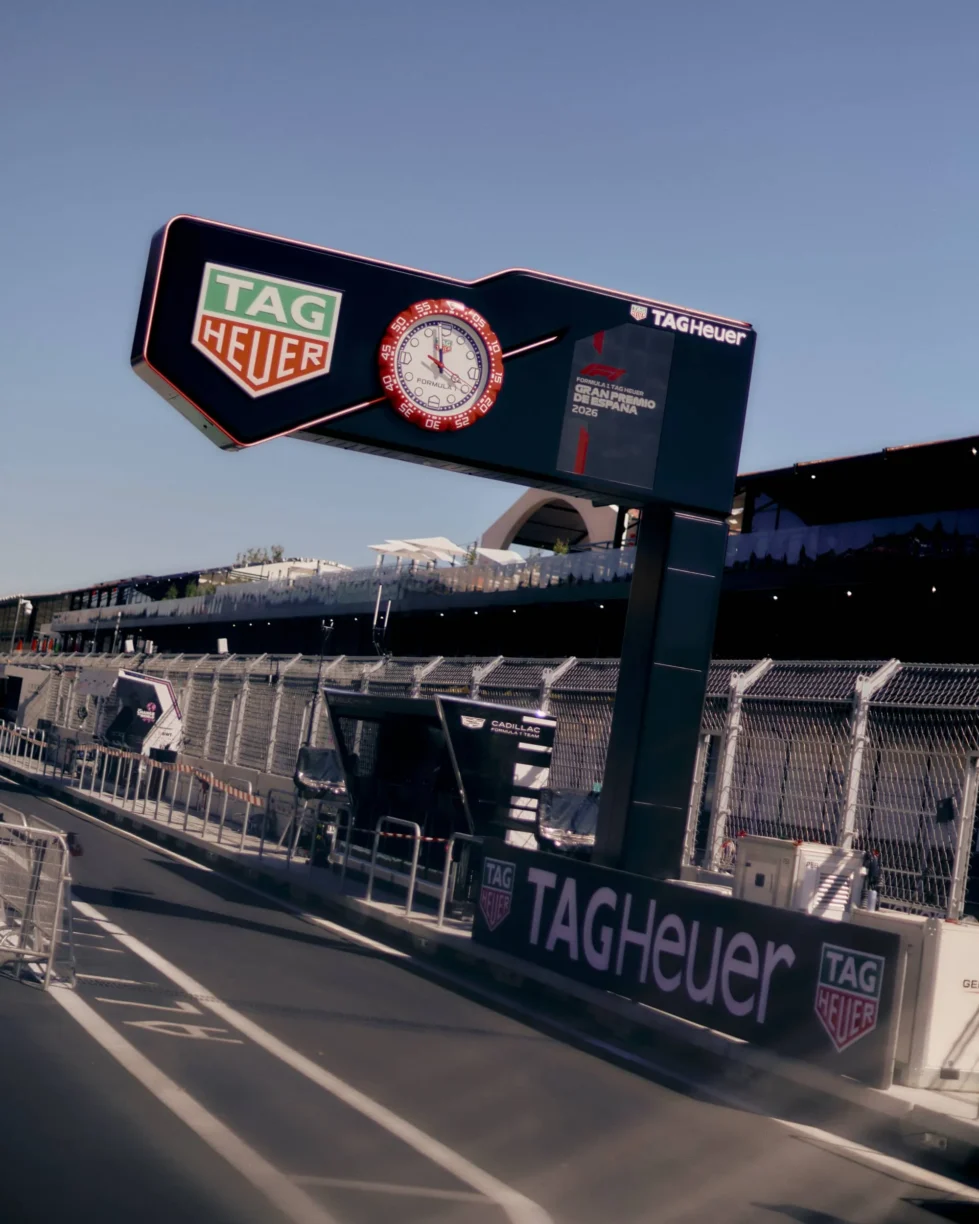
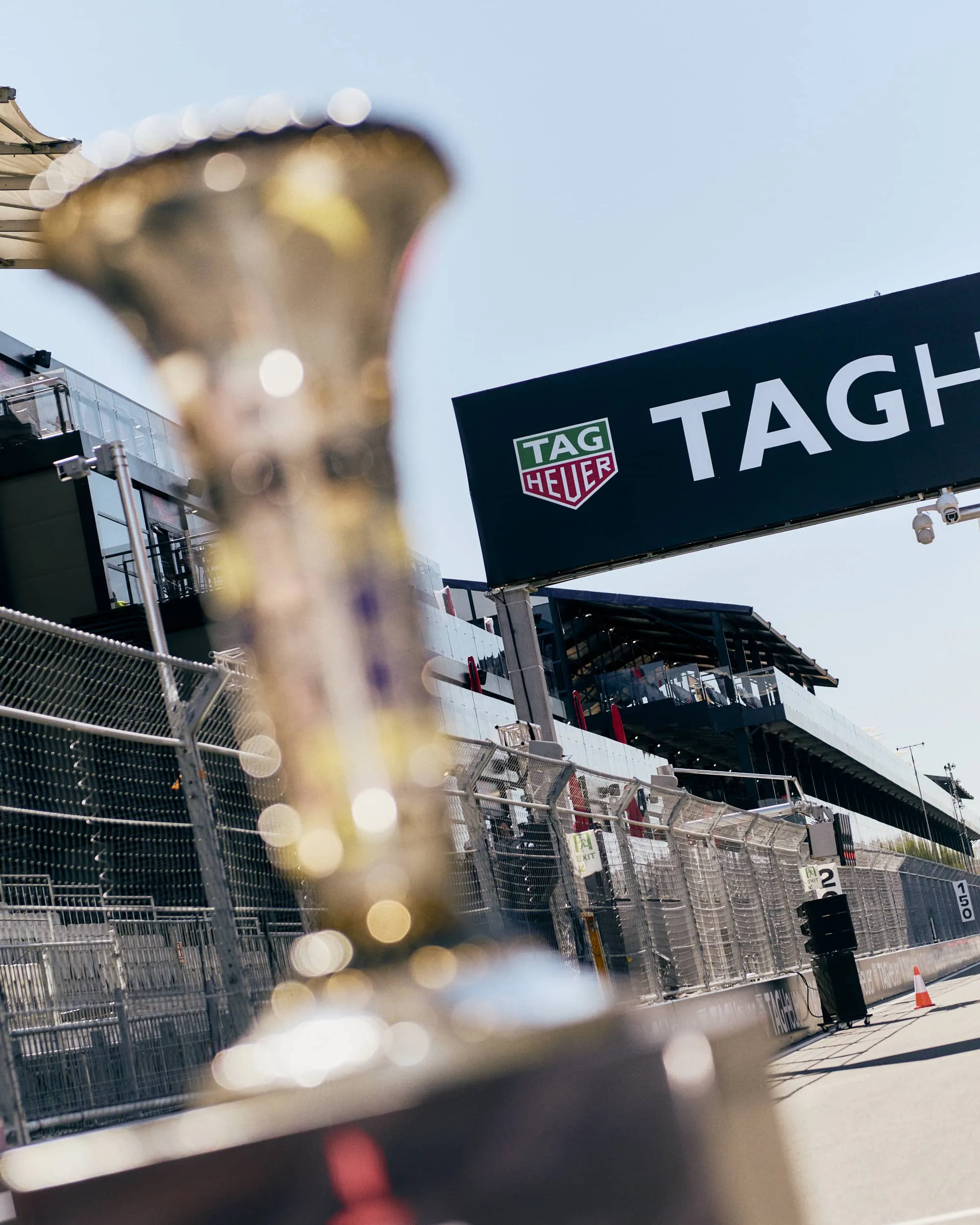
At the track, TAG Heuer’s presence was harder to miss. Branding ran across the main straight, bridges, trackside positions, broadcast graphics and the podium ceremony.
There is an obvious commercial calculation here. Title sponsorship only earns its keep if viewers can identify the title sponsor, and Formula 1 offers a rare combination of physical spectators, television exposure and social amplification. TAG Heuer did not leave much of that inventory unused.
Yet the more interesting element was consistency. Rather than treating the partnership as a logo placed repeatedly in convenient rectangles, the brand tried to make timing, racing history and watchmaking feel like parts of the same visual language.
That can become exhausting very quickly. In Madrid, the scale at least matched the occasion.
Inside the Paddock, watches met access
The F1 Paddock Club housed a 30-square-metre TAG Heuer pop-up combining retail, heritage displays and a Watchmaker Challenge. The product focus included the Monaco, Carrera and Formula 1 collections, with the recently launched Carrera Chronograph Sport given particular prominence.
A heritage area connected the current partnership with names and moments stretching from Jo Siffert in 1969 and Niki Lauda in 1976 to Ayrton Senna’s victorious 1989 Spanish Grand Prix. It was a useful counterweight to the newness of Madrid’s race: a reminder that the venue may be fresh, but TAG Heuer’s preferred story is very much about continuity.
The limited-edition Carrera Chronograph Sport created for Spain was available on site, with Spanish contemporary artist Manu Campa linked to its custom case design. Elsewhere, the LVMH Motorhome hosted watchmaking demonstrations and product presentations.
Luxury sports hospitality often promises “access” with heroic enthusiasm. Here, the access was at least tangible: garage visits, guided track tours, hot laps, grid access and behind-the-scenes experiences were part of the guest programme.
The weekend kept spilling into Madrid
Friday evening brought a dinner inside the Formula 1 garage, with a Gordon Ramsay signature dinner served overlooking the heart of the circuit. Saturday moved the operation to Club Metrópolis, where Oracle Red Bull Racing driver Isack Hadjar and team principal Laurent Mekies appeared before a performance by Spanish electronic duo MËSTIZA.
The city activations continued with a team show car, an exhibition built around the sport’s visual culture and a TAG Heuer pit-lane clock displayed in Las Rozas.
Taken together, the programme showed how modern sporting events increasingly compete beyond sport itself. A Grand Prix may be decided on the circuit, but its identity is now assembled through architecture, hospitality, fashion, music, retail and carefully rationed proximity to the people and machinery spectators normally see from a distance.
Madrid offered plenty of material for that treatment.
The Carrera became the souvenir with a stopwatch
TAG Heuer used the weekend to push the Carrera Chronograph Sport collection, including silver, black and blue dial versions on steel bracelets and the Spain limited edition.
The connection was hardly obscure. The Carrera name carries its own motorsport associations, and a chronograph is not exactly fighting for relevance at a race weekend. More importantly, the watches gave the sponsorship something physical to attach to the experience. Event branding disappears when the hoardings come down; a limited-edition watch is designed to remain.
That is the commercial logic in miniature: turn a weekend into memory, then give the memory a case, dial and bracelet.
Madrid’s first impression was deliberately oversized
The inaugural Madrid race did not arrive quietly, and TAG Heuer clearly had no interest in behaving like a discreet supporting partner. The city-centre projections, Paddock retail, hospitality and track branding all pointed in the same direction: make the first edition feel established before it has had time to become familiar.
There is risk in that. Too much branding can flatten a sporting event into a corporate backdrop. But the more coherent parts of the weekend — particularly the use of Puerta del Sol and the historic clock — gave Madrid something more useful than sheer volume. They gave the new race a visual identity rooted in the city itself.
For a Grand Prix with no history in its current form, that may be the most valuable head start available.