With a thinner face, adjustable weighting and the backing of PGA TOUR professional Jake Knapp, PXG believes its latest mini driver can offer greater control without giving away too much distance. Sustain Health Magazine will soon discover how that promise stands up on the course.
There are certain holes where taking the driver out of the bag feels like an act of optimism rather than sound course management. The fairway suddenly looks rather narrow, the rough rather uninviting, and that trusty three-wood begins making a persuasive case for itself.
PXG believes its new Secret Weapon Mini Driver could offer a more useful compromise.
With a compact 300cc clubhead, 13 degrees of loft and a standard length of 43.25 inches, the latest Secret Weapon has been designed to occupy the space between a conventional driver and a fairway wood. The attraction is straightforward: useful distance from the tee, potentially greater control and enough versatility to earn consideration elsewhere on the course.
Of course, that is the theory. And golf equipment has never suffered from a shortage of convincing theories.
What makes this particular club interesting is the engineering PXG has put behind its claims, together with the endorsement of PGA TOUR professional Jake Knapp, who has already embraced the updated model.
For everyday golfers, however, the important question is rather different. Can a smaller driver genuinely make the game a little more manageable?
That is what we’ll be exploring when Sustain Health Magazine puts the Secret Weapon through its forthcoming review.
The Appeal of Having Another Option Off the Tee

The argument for a mini driver is particularly compelling on holes where position matters more than maximum distance.
A conventional driver may offer the greatest potential length, but that advantage becomes less useful when an errant shot leaves the golfer facing a difficult recovery.
The Secret Weapon is intended to provide an alternative without demanding quite the same sacrifice in distance that golfers might associate with reaching for a shorter club.
Its 300cc head is notably more compact than a traditional driver, while its 43.25-inch playing length contributes to a different overall proposition.
Whether those characteristics make the club easier to control will depend on the golfer. Smaller equipment does not automatically produce straighter shots, and confidence at address is only valuable if the results justify it.
There is also the question of versatility.
PXG intends the Secret Weapon to perform from the fairway as well as the tee, although launching a 13-degree club cleanly from the turf may present a challenge for some recreational players.
That makes its performance away from the tee particularly interesting. A club capable of doing two jobs well would offer something different from one that simply provides another driving option.
Jake Knapp Has Already Made His Decision
PXG does have one particularly credible supporter in Jake Knapp.
The PGA TOUR professional was already a committed user of the original Secret Weapon, making his response to the updated model especially relevant.
“The original Secret Weapon was my favorite club in the bag, so I had high expectations for this one,” said PGA TOUR professional Jake Knapp. “I absolutely love it. It has everything I liked about the original, with more speed and forgiveness. Putting it in the bag was an easy decision.”
It is a strong endorsement from somebody familiar with the previous generation.
Knapp’s enthusiasm also suggests that PXG has retained the characteristics that made the original appealing while attempting to improve its performance.
But tour approval is not quite the same thing as everyday usability.
Professional golfers deliver the club to the ball with a level of consistency most amateurs can only admire. The more revealing assessment will be how forgiving the new design proves when impact wanders away from the middle of the face.
That, after all, is where a good deal of recreational golf takes place.
Why PXG Has Made the Secret Weapon’s Face Thinner
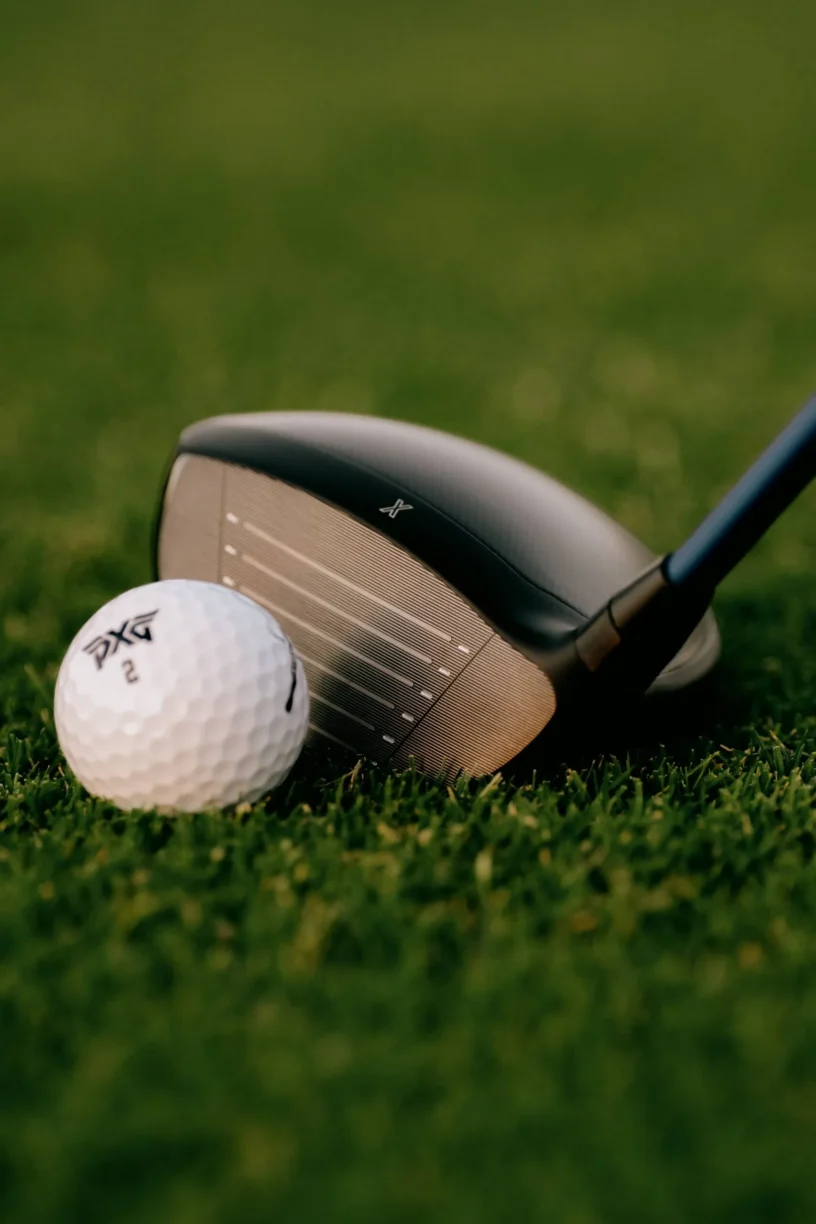
One of the biggest changes to the new Secret Weapon is not particularly obvious when looking down at the club.
PXG has redesigned the face, making it more than 4 per cent thinner than the previous generation.
The objective is to increase face flexibility at impact, helping maintain ball speed across a wider area of the striking surface.
That matters because even relatively small variations in contact can influence how far a shot travels and where it finishes.
Creating a thinner face without compromising the surrounding structure requires careful engineering.
PXG has used finite element analysis, a computer-based modelling process, to refine the internal sole structure and manage the forces generated during impact.
The revised construction allows material to be redistributed around the perimeter of the clubhead, with the intention of increasing its moment of inertia.
In practical terms, a higher moment of inertia makes a clubhead more resistant to twisting when the ball is struck away from the centre.
A lightweight carbon fibre crown also helps PXG position mass lower and deeper within the head.
Taken together, these developments are intended to improve forgiveness and stability while preserving useful ball speed.
The engineering argument is sound in principle. Establishing how much difference it makes to actual shots is another matter, and one we will be examining rather than taking for granted.
Four Adjustable Weights Give Golfers Room to Experiment
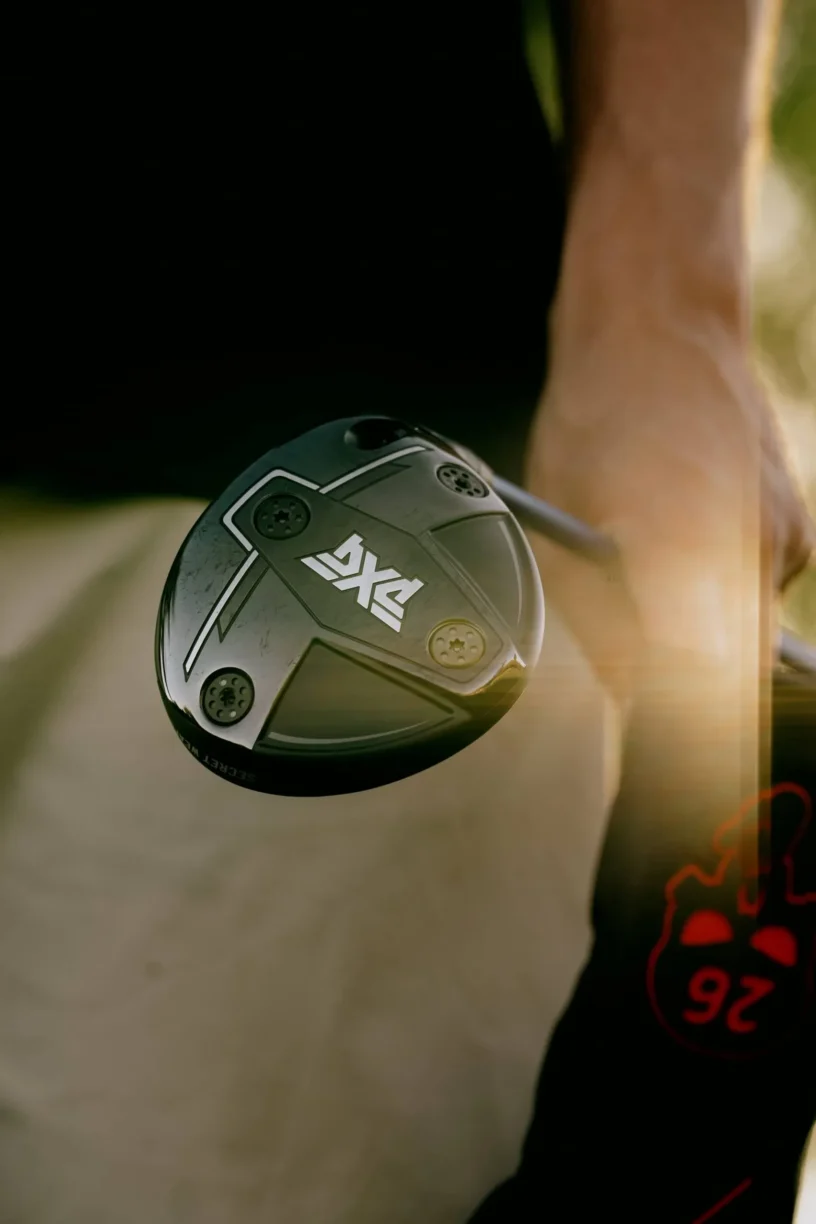
The new Secret Weapon also offers a considerable degree of adjustability for a club of its size.
PXG’s Precision Weighting Technology uses four sole weight positions, arranged at the heel, toe, front and back of the clubhead.
The standard arrangement comprises two 7.5g weights and two 2.5g weights.
By changing their positions, golfers can influence the club’s weighting characteristics, with PXG intending the system to provide options for shot shape, spin and swing weight.
An adjustable hosel adds further opportunities to fine-tune launch and trajectory.
<text weight=”medium”>The attraction here is that two golfers could approach the Secret Weapon with entirely different requirements.</text>
One might want a dependable alternative on tighter driving holes. Another might be looking for a particular flight or a club that can occasionally be used from the fairway.
The flexibility could be valuable, particularly when combined with a proper fitting.
There is, however, a difference between having numerous adjustment options and finding a combination that produces a measurable improvement.
We will be particularly interested in whether changing the weight configuration creates a noticeable difference in performance and how readily golfers can identify the setup that suits them.
What We Want to Discover in Our PXG Secret Weapon Review
There are several reasons to approach this new model with interest.
The specifications suggest a club designed around control and versatility, while the thinner face and redistributed weighting give PXG a plausible technical basis for its performance claims.
Knapp’s endorsement adds another layer of credibility.
Still, none of that establishes how the Secret Weapon will behave in the hands of an ordinary golfer.
Our forthcoming review will examine how comfortably it sits behind the ball, how easily it launches and whether its forgiveness provides a noticeable advantage when the strike is less than perfect.
We’ll also look at distance, consistency and shot patterns, alongside its performance from both the tee and fairway.
The adjustable weighting system deserves particular attention because its practical value will depend on how much meaningful control it actually gives the player.
Feel and confidence matter, too. A club may have impressive specifications, but golfers still need to enjoy standing over the ball with it.
Perhaps most importantly, we’ll be looking at the trade-off between distance and accuracy.
If the Secret Weapon can deliver sufficiently useful length while helping golfers keep more tee shots in play, it could make a persuasive case for a place in the bag.
If its advantages prove less noticeable, the question becomes whether another specialist club is really necessary.
For now, PXG has produced an intriguing proposition, backed by thoughtful engineering and a professional golfer who clearly believes in it.
The Secret Weapon doesn’t need to outperform a conventional driver at everything. It needs to give golfers a convincing reason to choose it.
That’s what our upcoming review intends to find out.