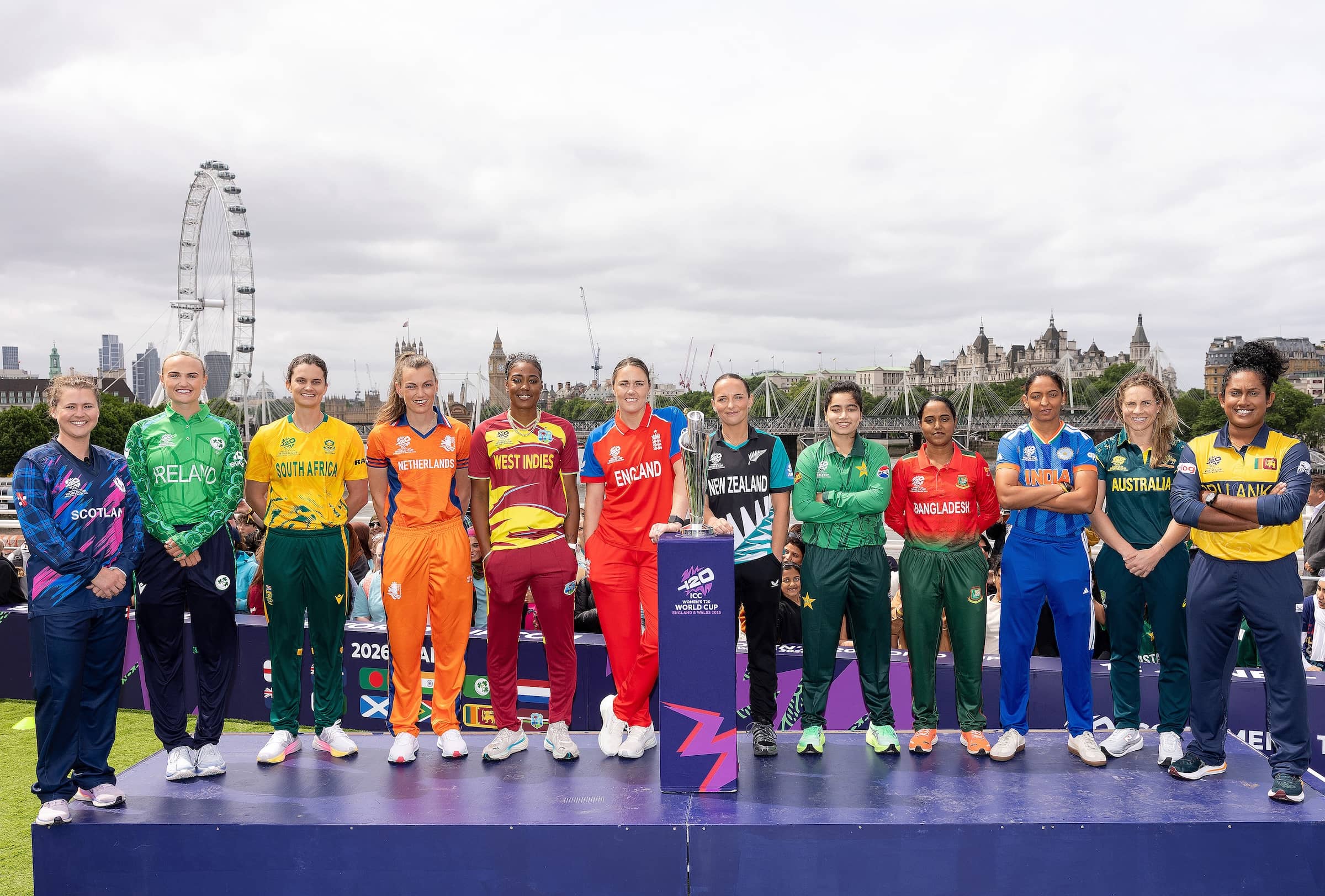
Waterloo Bridge becomes a cricket pitch as 12 captains launch the ICC Women’s T20 World Cup 2026 in London.
The ICC Women’s T20 World Cup made a rather magnificent entrance in London, turning Waterloo Bridge into a live cricket pitch for the first time and giving morning traffic something far better to grumble about than lane discipline.
Five days before the tournament opens on 12 June, all 12 team captains gathered above the Thames on a purpose-built pitch, with Big Ben, St Paul’s Cathedral and the London Eye watching on like a trio of grand old selectors pretending not to be impressed.
This was not your standard launch event with name badges, tepid coffee and someone saying “journey” too many times. This was cricket dropped into the middle of London with a red double-decker bus, gathered crowds, national colours, street cricket and the unmistakable sense that women’s cricket is not asking politely for space any more. It is taking the bridge.
Waterloo Bridge Gets A World Cup Makeover
Waterloo Bridge is no stranger to drama. Usually, it involves a cyclist, a van and a deeply philosophical dispute about right of way. But for one morning, the bridge swapped its usual commuter theatre for something rather more uplifting.
The captains of England, India, Australia, Bangladesh, Ireland, Netherlands, New Zealand, Pakistan, Scotland, South Africa, Sri Lanka and West Indies stepped into a scene built for the cameras but saved from feeling too polished by the simple joy of bat on ball in a place where bat on ball has absolutely no business being.
Fans from London and tournament host cities including Birmingham, Manchester, Leeds, Bristol and Southampton were invited to get involved through street cricket and interactive games. Around them, roaming performers brought the colour and noise of the competing nations, turning one of the capital’s most familiar crossings into a floating festival of short-format cricket.
Nat Sciver-Brunt Leads England Into A Home Summer
For England captain Nat Sciver-Brunt, the setting provided a sharp little jolt of novelty before the serious work begins. A home tournament carries its own peculiar electricity: part privilege, part pressure cooker, part family wedding where everyone expects you to behave and perform miracles.
England will open the tournament with the weight and warmth of home support behind them, and Sciver-Brunt sounded very much like a captain ready to get on with it.
England Women’s captain Nat Sciver-Brunt said: “Playing cricket on Waterloo Bridge isn’t something you get to do every day. It’s a special way to kick off a home tournament that’s for sure!
“The excitement has been building for such a long time now and the squad is ready. We’ve put in the hard work, the practice and the performances now over several months, and we just can’t wait to get out there in front of the crowds and give it everything we’ve got.”
That last line is doing a lot of honest work. Women’s cricket has spent years building momentum, visibility and proper competitive depth. Now comes the summer test: full grounds, loud crowds, fierce rivalries and the sort of knockout jeopardy that can make even the most experienced player feel as though their gloves have been filled with bees.
A Bigger Stage For Women’s Cricket
ICC Chairman Jay Shah placed the launch firmly in the wider growth story of the women’s game, with the ICC Women’s T20 World Cup positioned as both a sporting contest and a statement of ambition.
ICC Chairman, Jay Shah said: “This is a landmark moment for women’s cricket and a fitting way to launch what we believe will be the most exciting and ambitious ICC Women’s T20 World Cup ever staged. This will help elevate the buzz and excitement around the event, providing the final boost to the anticipation for the tournament before the first ball is bowled on June 12 in Birmingham. This event is another expression of the ICC’s commitment and belief linked to the agenda of building a more inclusive, global game.”
The scale matters. So does the symbolism. Putting 12 captains on Waterloo Bridge is not subtle, but sport rarely moves culture by whispering into a napkin. It needs stages, crowds, landmarks and moments that tell casual observers: look over here, something is happening.
And something is.
The tournament will begin at Edgbaston in Birmingham and move through some of the most recognisable cricket grounds in England and Wales, including Old Trafford in Manchester, Headingley in Leeds, the Hampshire Bowl in Southampton, Bristol County Ground, The Oval in London and finally Lord’s Cricket Ground for the final.
That route gives the competition both reach and resonance. It is not locked away in one city or one market. It stretches across established cricket communities, each with its own weather, accent, appetite and capacity for forming strong opinions by the third over.
Twelve Nations, One Prize And No Shortage Of Edge
The competing field has the right ingredients: established heavyweights, dangerous challengers and emerging nations with very little interest in behaving like guests.
England will carry the host-nation spotlight. Australia and India arrive with the gravitational pull that follows them almost everywhere in the modern game. New Zealand, South Africa, Sri Lanka, Pakistan and West Indies bring pedigree, volatility and match-winners. Bangladesh, Ireland, Netherlands and Scotland give the tournament further texture and global reach.
T20 cricket is wonderfully intolerant of slow starts and grand theories. One over can rearrange a match. One dropped catch can follow a player around like a small, malicious ghost. One innings can announce a new star to the wider world before the kettle has boiled.
That is precisely why this tournament has Discover-friendly potential beyond the usual cricket audience. It is fast, bright, emotional and occasionally completely unhinged, which is another way of saying it is ideal summer sport.
Ticket Demand Adds To The Sense Of Occasion
Beth Barrett-Wild, ICC Women’s T20 World Cup 2026 Tournament Director, described the Waterloo Bridge launch as a visible marker of the tournament’s ambition, with fans already buying tickets in strong numbers.
Beth Barrett-Wild, ICC Women’s T20 World Cup 2026 Tournament Director said: “Today felt pretty surreal – we turned Waterloo Bridge into a cricket pitch and assembled 12 of the best female players on the planet, alongside hundreds of fans, to play on it! It’s a brilliant reminder that the T20 World Cup is almost here and the sheer scale of our ambition. The excitement is building every day, and with fans already snapping up tickets in record numbers, the tournament is shaping up to be one of the unmissable events of the summer.”
That word “surreal” feels about right. Cricket has been played in parks, playgrounds, alleys, beaches, driveways and, if family history is to be believed, several kitchens shortly before a lamp met a tragic end. But Waterloo Bridge, with the Thames beneath and London’s skyline all around, gives the launch a clean visual punch. It says the ICC Women’s T20 World Cup 2026 is not tucked away in the sporting margins. It is front and centre, high above the river, waving cheerfully at the traffic.
From London Landmarks To Lord’s
The tournament now moves from spectacle to substance. Launches are lovely, but scoreboards are less sentimental. Once the first ball is bowled at Edgbaston, the bunting gives way to powerplays, death overs, selection calls and the magnificent cruelty of elite sport.
For England and Wales, this is a chance to host a tournament with genuine summer breadth. For the players, it is a world title. For supporters, it is the opportunity to watch the women’s game at its sharpest and loudest, across venues that already understand the theatre of cricket.
The bridge has done its job. It caught the eye, stopped the traffic metaphorically if not permanently, and gave the ICC Women’s T20 World Cup a London postcard with a bit of bite.
Now comes the cricket. And, mercifully, not a single cone in the middle lane.
Get ready to catch the spirit this summer and be a part of history. Secure your tickets for the ICC Women’s T20 World Cup 2026 here.