Simple England football team home workouts inspired by Kane, Bellingham, Saka, Rashford, Rice and more.
Ahead of the World Cup, plenty of people will be wondering how to train like the England football team without needing a private chef, a sports scientist, three physios and a gym that looks like NASA has gone into hamstrings.
The good news? Much of the useful stuff is simpler than it sounds.
New research by 101 Great Goals suggests that the same movement patterns used by England’s leading footballers can be adapted for everyday home fitness. We are not talking about trying to become Harry Kane by Thursday or Jude Bellingham before the school run. This is about borrowing the basics: balance, mobility, strength, coordination and recovery.
And the equipment list is gloriously unglamorous. A chair. A wall. A towel. Maybe a resistance band if you’re feeling dangerously organised.
Jon Fisher, football expert at 101 Great Goals, said: “People often assume professional football training is all about high-tech equipment and intense gym sessions, but a huge amount of it comes down to simple, repeatable movements done consistently.
“That’s why so many of these exercises translate so well to everyday fitness. They help with strength, balance, mobility and coordination, which are useful whether you’re playing 90 minutes or just trying to feel fitter and move better.”
The Real Secret Behind England-Inspired Fitness

Professional football fitness can look impossibly polished from the outside. There are GPS vests, ice baths, nutrition plans and men with clipboards who can spot a tight calf from 80 yards.
But beneath all that theatre, the body still obeys the same old rules.
You need stable ankles. Strong hips. A core that does not fold like a deckchair. Legs that can handle stairs, squats and sudden changes of direction. A recovery routine that keeps you moving rather than limping around the house like you’ve tackled a wardrobe.
That is why learning how to train like the England football team does not mean copying the full programme of a Premier League international. It means taking the movements that matter and making them fit your own life.
Harry Kane’s Ankle Work: Balance Before Bravado
Harry Kane’s career has featured its share of ankle problems, which means stability has become a serious part of his training life.
For the rest of us, that lesson is wonderfully practical.
The single-leg balance stand is the sort of exercise that looks almost too easy until you try it while your ankle starts negotiating with gravity. Stand on one foot for 30 seconds, keeping your posture tall and your eyes forward. It trains the small stabilising muscles around the ankle and improves balance.
For anyone less confident, do it beside a kitchen worktop with fingertips resting lightly for support.
Seated ankle circles are another simple option. Sit in a chair and draw circles, or even the alphabet, with your foot. It helps keep the ankle mobile and takes the joint through a fuller range of movement. A towel or scarf can be looped around the foot for gentle resisted flexion.
Fisher said: “These movements may not look dramatic, but they build the kind of stability and control that benefits everyone. They’re especially useful for improving balance and reducing the risk of everyday slips or stumbles.”
Jude Bellingham’s Power Starts With The Basics
Jude Bellingham plays like a man who has been built in a laboratory by someone with a very generous view of midfielders. But much of that power is rooted in lower-body strength, stability and mobility.
The sumo squat is an ideal home-friendly version.
Stand with your feet wider than shoulder-width, toes turned slightly out, then lower into a squat and drive back up through the heels. It works the glutes, thighs and inner legs — all crucial for power and control.
Beginners can scale it back with a simple sit-to-stand from a chair. That still trains the same fundamental pattern: lowering, standing, controlling and repeating without turning the knees into a committee meeting.
Another Bellingham-inspired move is the static lunge hold. Hold a lunge position for 20 to 30 seconds to build hip stability, leg strength and balance. Use the back of a chair for support if needed and keep the movement small.
Fisher said: “These are exactly the sort of functional movements that carry over into everyday life. They help with standing up, sitting down, climbing stairs and staying strong through the hips and legs.”
Bukayo Saka’s Sharpness Comes From The Hips
Bukayo Saka’s game is built on acceleration, agility and those little changes of direction that leave defenders looking like they’ve just been asked to assemble flat-pack furniture without instructions.
The foundation is hip and glute strength.
The clamshell is one of the best home exercises for that. Lie on your side with knees bent, keep your feet together and lift the top knee. It looks modest, but it targets the muscles around the hips that help with stability and knee protection.
A resistance band can make it harder, but it is not essential.
Monster walks are another useful drill. Place a band around the knees or ankles and take slow, controlled side or diagonal steps while keeping tension in the band. These light up the glutes and hip muscles used for acceleration and quick turns.
For a gentler version, hold onto a wall and take smaller sideways steps.
Fisher said: “Saka’s style relies on being quick and reactive, but before you get to the flashy stuff, you need strength in the hips and lower body. These drills are brilliant for that.”
Marcus Rashford Shows Fitness Does Not Need To Be Fancy
Marcus Rashford’s training often leans into practical, functional exercises. The sort of work that builds power without needing a machine with 14 settings and a warning sticker.
A medicine ball slam is a good example. At home, you can recreate the same pattern with a cushion, soft weighted bag or pillow. Lift it overhead, brace the core and drive it down with control.
For a gentler option, use a slow downward chopping motion instead.
The side lunge is another Rashford-style move worth stealing. Step out to one side, bend into the working leg and keep the other leg long. It trains the quads, glutes and hips while improving mobility.
Scale it down by taking a smaller step and holding onto a chair.
Fisher said: “Rashford’s training shows you don’t need complicated machines to work the whole body. Simple, explosive and side-to-side movements can do a lot of the heavy lifting.”
Phil Foden’s Coordination Drills Are Not Just For Footballers
Phil Foden’s touch is so soft it practically arrives with a handwritten thank-you note. But that control is built through repetition, not magic.
Wall passes are a simple way to copy the idea at home. Gently pass a ball against a wall and control the return. It improves coordination, timing and foot-eye control.
Use a softer ball if space is limited, stand closer, or slow everything down.
Tennis ball juggling is another Foden-inspired option. Confident movers can tap the ball up with their feet. Beginners, older adults or anyone less steady can simply bounce a tennis ball and catch it.
It still trains reaction speed and coordination.
Fisher said: “Repetition is what matters here. It’s not about doing something spectacular. It’s about doing small skills again and again until they become natural.”
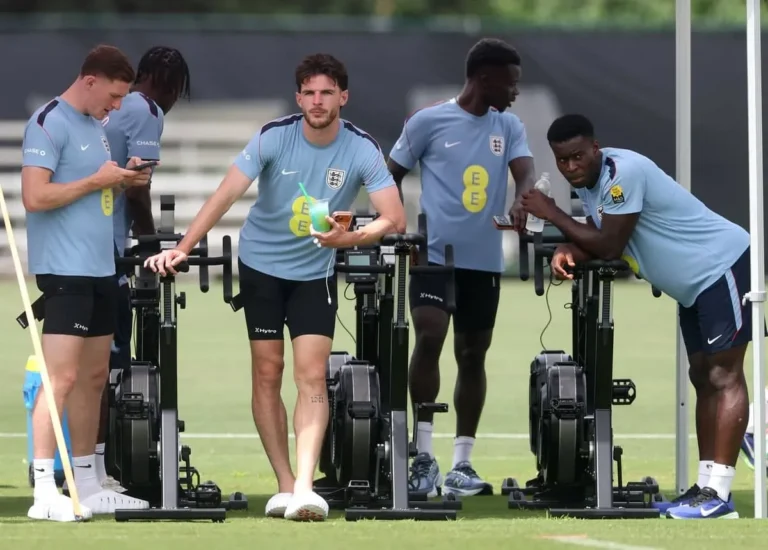
Declan Rice’s Recovery Routine May Be The Smartest Move
Declan Rice is not just about engine-room intensity. Recovery and mobility are major parts of staying ready, sharp and durable.
For most people, the simplest adaptation is a 20-minute gentle walk.
Rice uses low-impact cardio such as cycling to encourage blood flow and support recovery. A steady walk can do much the same for ordinary bodies that are not being asked to patrol Wembley for a living.
Hamstring and flexibility work also matter. Try a seated banded leg curl by pulling one foot back under the chair against light resistance, or build a simple stretching routine around the hamstrings, hips, calves and chest.
Fisher said: “Rice is a good reminder that fitness is not always about pushing harder. Sometimes it’s about moving consistently, recovering properly and keeping the body mobile.”
Cole Palmer Proves Football Fitness Is Not Just Legs
Cole Palmer’s movement depends on more than neat feet and a calm finish. Upper-body and core strength help with balance, turning, shielding and staying composed under pressure.
The under-table row is one home option. Lie under a sturdy table and pull your chest upward using your arms and back.
For a gentler variation, use a resistance band while standing, or perform a pulling movement from a secure door-handle setup.
The Pallof press is another strong choice. Anchor a resistance band to one side, hold it at chest height, then press it straight out while resisting rotation through the torso. It builds core stability without needing to fling yourself around like a man late for a train.
It can also be done seated with a light band.
Fisher said: “People tend to think footballers only train their legs, but upper-body and core strength are huge parts of balance, control and athletic movement.”
Jordan Pickford’s Reaction Drills Work At Any Age
Jordan Pickford’s world is built around reaction, handling and quick feet. For the rest of us, those qualities are useful far beyond a penalty shootout.
A tennis ball wall reaction drill is simple and effective. Throw a tennis ball against a wall and catch it on the rebound. It trains hand-eye coordination, focus and reaction speed.
A seated version, bouncing the ball off the floor and catching it, works well for older adults.
Then there is the footwork pattern drill. Place books, bottles or shoes on the floor and step in and out between them. Done quickly, it challenges timing and coordination. Done slowly, it becomes a safe movement drill for balance and control.
Fisher said: “Pickford’s sessions are all about repetition and reaction. Those qualities matter just as much in daily life as they do in goal.”
Kobbie Mainoo’s Strength Work Can Be Scaled Right Down
Kobbie Mainoo’s upper-body work includes demanding moves such as pull-ups and weighted push-ups. Happily, no one is asking you to hang from the door frame like a startled bat.
The same principles can be scaled.
For pulling strength, try resistance band rows or assisted negative pull-ups. For pushing strength, wall push-ups or knee push-ups are far more approachable than weighted versions.
The key is progression. Find the version you can do well, then build from there.
Fisher said: “The principle is the same whether you’re an elite player or a beginner. You find the version that suits your level, and you build from there.”
So, Can You Really Train Like The England Football Team?
Yes — but with one important caveat.
You are not trying to replicate England’s full training schedule. That way lies exhaustion, bad decisions and possibly a hamstring that writes its own resignation letter.
The smarter approach is to borrow the principles.
If you want to know how to train like the England football team, start with the foundations: ankle stability, lower-body strength, hip control, coordination, core strength and recovery. These are not just football qualities. They are life qualities.
They help with stairs. Balance. Posture. Confidence. Getting up from a chair. Moving without stiffness. Playing five-a-side. Chasing children around the garden. Staying active without needing to turn your home into St George’s Park.
Fisher concluded: “You don’t need to copy a professional footballer’s entire training plan. The real takeaway is that many of the habits behind elite performance are simple, accessible and easy to adapt.
“That’s why these exercises can work for almost anyone, whether your goal is to improve your game, get fitter, or just stay active at home.”
The Verdict: Elite Habits, Everyday Bodies
The best part of this England-inspired home workout is that it strips football fitness back to its useful bones.
There is no need for a punishing routine. No need for expensive equipment. No need to pretend you are warming up for a World Cup quarter-final when you are really just trying to feel a bit less creaky before breakfast.
The England stars may operate at a level most of us will only ever watch from the sofa. But the habits behind their movement — stability, strength, mobility, coordination and recovery — are available to everyone.
And that is the point. Training like a professional does not mean living like one. It means taking the smart bits, leaving the brutal bits, and giving your body a better chance of moving well.