Frank Lampard, Hayden Hackney and EFL’s finest took centre stage as the 2026 awards honoured promotion, loyalty and community.
The EFL does not really do dainty. It deals in long coach rides, wet weekends, strained hamstrings, fried nerves and promotion dreams that can make grown men look as though they have seen the face of God in a pair of muddy boots. So when the EFL Awards 2026 rolled into London, this was never going to be a night for empty glamour. It was a night for substance, for momentum, and for the sort of achievements that leave marks on clubs for years.
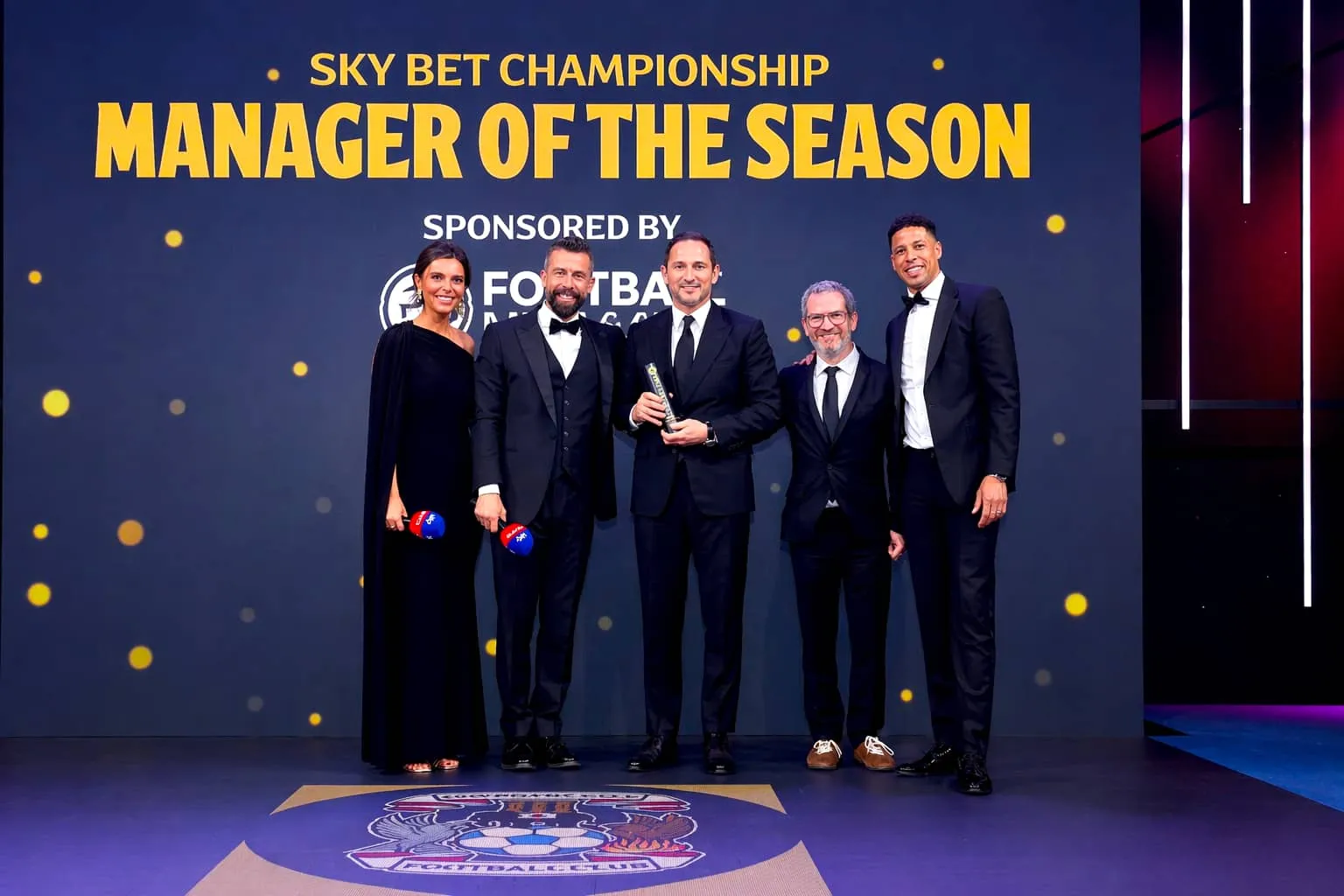
At the centre of it all stood Frank Lampard, newly crowned EFL Championship Manager of the Season, two days after guiding Coventry City back to the Premier League for the first time since 2000/01. Timing, in football, is everything. Lampard arrived at the podium with the look of a man who had been living on adrenaline and takeaway coffee.
Speaking after winning the award, Lampard said: “I’m very happy, while it’s an individual award it takes everything from the players and those at the Club. It’s been a special year and that’s testament to all involved. We’ve got a really good group, we didn’t make too many changes and we’ve really carried on from where we were last season – All credit to the players, I am really happy for them and the whole Club.”
That, in truth, was the thread running through the whole evening. The EFL awards may hand a trophy to one person, but the stories behind them are always bigger than that.
Lampard and Hackney give the Championship its headline act
Lampard’s award was the obvious headline, but not because of the name on the suit. Coventry’s promotion gave it real weight. This was not a sentimental nod to reputation or past glories. It was recognition of a side that found consistency when the stakes became suffocating.
The Championship has a way of chewing up certainty and spitting out drama. It is a division with all the serenity of a tumble dryer full of bricks. To come through it requires resilience, calm and a squad willing to keep its head while the table convulses around them. Coventry managed that, and Lampard got the reward.
If Lampard embodied leadership from the dugout, Hayden Hackney represented the Championship’s other enduring virtue: the local lad who makes good without losing his bearings. The Middlesbrough midfielder was named EFL Championship Player of the Season with his club still firmly in the promotion mix, and there was a proper sense of authenticity to the honour.
After picking up his award, Hackney said: “It’s an unbelievable feeling, a proud moment for me and my family. The Club means everything to me – that’s the dream when you first get your scholarship, you go to your pro, under 18s, under 21s and hopefully one day you may get a chance to make it with the first team, so to play for Middlesbrough every weekend and then to win this award is a dream.”
That is the sort of quote football people trust because it does not sound manufactured in a boardroom. It sounds like a young player who still understands what the badge means. In an age of polished messaging, that counts for plenty.
League One delivers old-fashioned upheaval
Below the Championship, the EFL story did not get any less compelling.
Lincoln City’s Michael Skubala was named EFL League One Manager of the Season after steering the Imps into the second tier for the first time in 65 years. That is not a tidy statistic; that is a generational shift. Football clubs can wait decades for a moment like that. Grandparents tell grandchildren about the last time it happened.
Meanwhile, Leyton Orient’s Dom Ballard was named EFL League One Player of the Season after finishing as the division’s top scorer with 22 goals. That alone would have been enough to earn the spotlight, but Ballard doubled down by also taking the League One Young Player of the Season award.
A scorer who bags goals is valuable. A scorer who drags a promotion push along by the collar is something else entirely. Ballard did not merely have a productive season. He had the kind of campaign that changes how a club imagines itself.
Leicester City’s Jordan James was named Championship Young Player of the Season, adding another note of promise to a night that balanced achievement with potential. The EFL has always been good at this: applauding what has happened while quietly introducing the names that may dominate tomorrow.
Bromley and Swindon rise as League Two rewards nerve
League Two is where ambition often arrives with mud on its boots, and this year’s winners captured that mood perfectly.
Andy Woodman was named EFL League Two Manager of the Season after leading Bromley to the third tier for the first time in the club’s history. There are promotions, and then there are promotions that alter the very shape of a football club. This was the latter.
Swindon Town striker Aaron Drinan claimed the EFL League Two Player of the Season award after scoring 22 goals during their promotion push, while Walsall’s Daniel Kanu picked up the League Two Young Player of the Season accolade.
There is a pleasing symmetry in numbers when it suits the narrative, and both Ballard and Drinan finishing on 22 goals gave this year’s awards a nice little flourish. More importantly, both men supplied the currency every promotion race demands in the end: goals when nerves are high and margins are thin.
Honour for service, and a reminder that football is bigger than the table
The EFL has always been at its best when it remembers that football is not just about league positions and transfer fees. It is also about service, place, and the sort of commitment that modern sport sometimes treats as an antique.
Former Milton Keynes Dons defender Dean Lewington was honoured with the Sir Tom Finney Award, presented live on Sky Sports. More than 900 appearances across a 22-year career is the kind of number that belongs in a different era, one built on duty, routine and remarkable durability. Whatever one thinks of the club, that level of longevity deserves respect.
Then came Brenda Spencer, presented with the Contribution to League Football Award. As the first female Chief Executive in the Football League, and after a 40-year association with Wigan Athletic that saw the club climb to the Premier League and win the FA Cup, Spencer’s recognition felt both overdue and entirely fitting. English football has often been too slow to celebrate the people who hold institutions together. On this occasion, the EFL got it right.
Community still matters, and the EFL knows it
One of the strongest parts of the evening came away from the usual flashpoints of promotion and silverware.
Oxford United’s Will Vaulks was named EFL Player in the Community for the fourth time, which is not just impressive but faintly ridiculous in the best possible way. Once might be admirable. Four times says something deeper about the man and his priorities.
Plymouth Argyle were named EFL Community Club of the Season, while Blackburn Rovers received the Community Project of the Season Award for ‘Dads FC’. In a football culture that can occasionally behave like a pub argument with floodlights, these awards matter. They remind everyone that clubs are still civic institutions, not just weekend entertainment or content farms for social media.
That is where the EFL remains different. Beneath the noise, beneath the churn of managers and the permanent anxiety over points, there is still an ecosystem of people trying to make football mean something in their towns and cities.
What this EFL night really told us
The awards ceremony in London was nominally about winners, but really it was about the architecture of the league itself. The EFL remains the proving ground for managers rebuilding reputations, players carrying hometown hopes, clubs punching through history, and communities finding identity through football.
Lampard’s resurgence with Coventry, Hackney’s rise at Middlesbrough, Lincoln’s long-awaited leap, Bromley’s historic climb and the community work recognised across the night all pointed to the same conclusion: the health of English football still depends on what happens outside the Premier League spotlight.
And that is why the EFL retains its grip on people. It is messier, louder, stranger and often more believable. One minute it gives you a promotion miracle, the next it honours a lifetime of service or a community project that changes lives away from the cameras.
For all the polish of the stage in London, the message was plain enough. The EFL still belongs to the builders, the believers and the people prepared to keep going when the road gets steep. On this evidence, that is exactly how it should be.