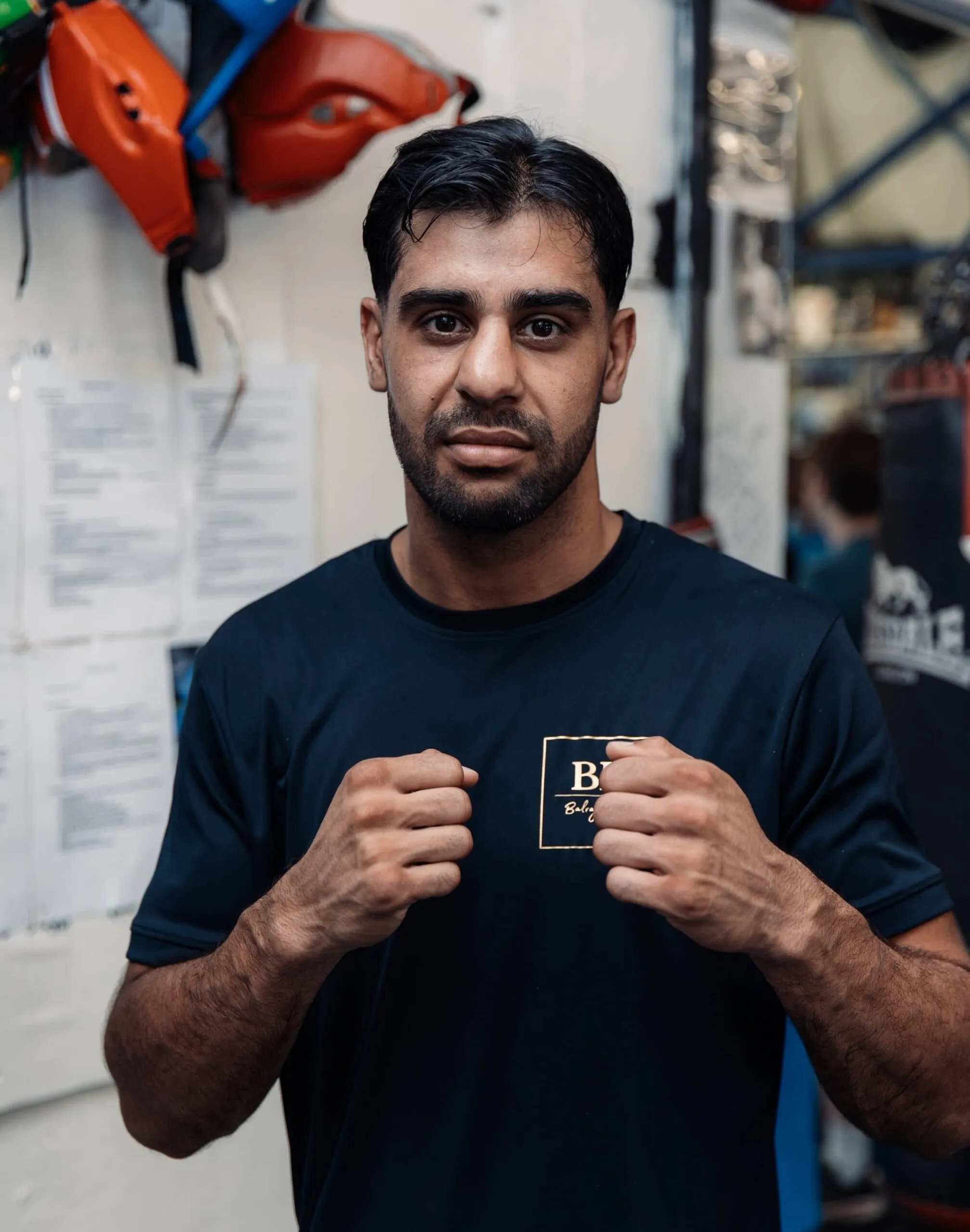
Boxer Balraj Khara explains why hearing loss sharpens his focus, as the British Sikh super-middleweight builds his career in professional boxing.
British boxer Balraj Khara has built his professional career around an apparent contradiction: hearing less, he believes, has taught him to concentrate more.
The super-middleweight, who was born with a hearing impairment, does not regard partial hearing loss as something boxing has forced him to overcome. He considers it part of the reason he can do the job at all.
There is something pleasingly inconvenient about that idea.
Sport has long had a weakness for neat stories about adversity. Present athlete with obstacle. Athlete conquers obstacle. Everyone applauds at the appropriate moment.
Khara’s version is less obliging. His hearing impairment has not disappeared, nor does he appear particularly interested in pretending it has. Instead, he has incorporated it into the way he works.
For a boxer, that makes the subject rather more interesting than the usual motivational poster.
A boxer who refuses the usual disability script
Khara was born in Chichester and raised in Feltham, West London. A third-generation British Sikh, he now competes professionally at super-middleweight after turning professional in 2022.
The temptation is to place the hearing impairment at the centre of every sentence about him. Khara’s own interpretation is subtler.
It is not simply something he has learned to tolerate. He argues that living with partial hearing loss has helped develop concentration, composure and awareness — precisely the sort of qualities that become rather useful when another man is attempting to punch you.
His description of it is unequivocal.
“Most people look at hearing loss and see a disadvantage. I see it differently. It has helped me develop an incredible level of focus. In boxing, distractions can cost you everything. I’ve learned how to shut out the noise and focus entirely on the task in front of me. That’s why I call it my superpower.”
That final word could sound suspiciously polished in somebody else’s hands. With Khara, the interesting part is the reasoning behind it.
Boxing demands selective attention. Instructions, movement, distance, fatigue, an opponent’s habits and the small matter of incoming punches all compete for processing space.
Khara’s argument is that he has spent much of his life becoming unusually good at filtering what matters from what does not.
From Feltham to the professional ranks
Before entering the paid game, Khara built his foundation through amateur boxing and years devoted to combat sport.
His professional debut arrived on 27 March 2022 at York Hall, where he defeated Frane Radnic.
He now trains at Ivybridge Boxing Club in Isleworth, with John Holland as his trainer and Abdul managing his career.
The record supplied for Khara stands at nine wins, two losses and two draws.
Those numbers matter, naturally. Boxing is not particularly sentimental about the arithmetic. But they tell only part of the story of a fighter still building his professional career.
The more revealing question is what separates one boxer from the endless queue of ambitious professionals attempting exactly the same climb.
For Khara, identity is part of that answer, although not the whole of it.
British Sikh representation without the slogan
As a third-generation British Sikh boxer, Balraj Khara occupies territory in British sport where representation remains significant.
South Asian athletes have contributed across British sport for decades, but visibility at elite level still carries weight for younger competitors looking for evidence that people from similar backgrounds can belong there.
Khara therefore represents more than one thing at once: a professional fighter, a British Sikh athlete and a sportsman living with hearing impairment.
It would be easy to turn all three into branding language. The more persuasive version is simply to allow them to coexist.
His ambition, after all, is not to become permanently labelled as the boxer with hearing loss. That would replace one limitation with another.
The boxing has to stand on its own.
That distinction matters. Representation is most effective when the athlete is allowed to be competitive, flawed, ambitious and judged by the demands of the sport rather than continually presented as a symbol.
Khara wants recognition as an athlete whose hearing impairment is part of his story, not the entire plot.
Why focus matters inside the ring
The sporting case behind Khara’s “superpower” description is straightforward enough.
Professional boxing punishes lapses.
A moment’s hesitation, a missed cue or a loss of concentration can alter a contest very quickly. Khara believes years of adapting to reduced hearing have strengthened his ability to remain mentally fixed on immediate information.
There is no need to turn that into pseudo-science or claim a physiological advantage that has not been demonstrated.
The important point is Khara’s own experience: he has taken a physical characteristic commonly discussed as a deficit and built a working method around it.
That is a far more useful way of understanding his story than simply declaring him inspirational and moving briskly on.
He is not claiming the impairment magically makes boxing easier. He is saying the adaptation required by it has influenced how he approaches pressure.
There is a considerable difference.
The work outside boxing
Khara’s ambitions also extend beyond collecting rounds and results.
He mentors younger fighters and supports Rise and Thrive, a charity campaigning against child exploitation. His involvement fits naturally with his broader emphasis on how young people respond to barriers placed in front of them.
The local gym matters here as well.
Boxing clubs have always performed functions considerably broader than producing professional fighters. Mentorship, routine, discipline and community sit alongside the pads and punchbags, often without much ceremony.
Khara’s contribution to younger boxers places him within that tradition.
His commercial backing currently includes ClipperandCloth, Grey Fox Group, Broomsfield Coffee Company and MSL Cabling.
For a developing professional, sponsorship can form part of the less glamorous machinery required to sustain a fighting career. The public sees the contest. Careers, inconveniently, must also function between contests.
A career still being written
There are further professional bouts planned for Khara in the coming months, providing the obvious next test of how far his career can travel.
That is where the story should ultimately be judged.
Not through sympathy. Not through the novelty of a boxer with partial hearing loss. And certainly not because his background fits conveniently into an uplifting headline.
By boxing.
Khara’s wider story gives people reasons to pay attention: disability, British Sikh representation, community work and an unusual approach to concentration. But attention and sporting achievement are different currencies.
He appears perfectly comfortable with that distinction.
The interesting thing about Balraj Khara is not that he has found a way to ignore hearing loss. It is that he has stopped treating it as something that requires an apology.
He is not trying to make silence sentimental. He is making it useful.