Behind every smoother appointment is a hidden healthcare system finally making chronic care less exhausting for patients.
Most of the changes that matter most in healthcare are the ones patients never directly see. The electronic record system means your specialist already has your bloods when you walk in. The pharmacy infrastructure that delivers a complex prescription to your front door instead of asking you to take half a day off to collect it.
The scheduling tool that catches a clash between two appointments before it becomes a confused phone call on a Friday. None of this gets headlines. But the cumulative effect on what it feels like to be a patient has been larger than most of the things that do.
There is a name for this category of work that nobody outside the industry uses, which is business-to-business healthcare. The phrase sounds dull, and a lot of it is dull on the surface. These people are not promising miracle cures. They are usually solving a workflow problem the average patient has only ever experienced as a moment of mild irritation in a waiting room. When those problems get solved at scale, the experience of being unwell starts to look different.
The Old Pattern of Friction

The traditional patient experience for anyone with a chronic or complex condition has been defined by repetition. You explain your history to one clinician, then again to another, then again to the receptionist who needs your details for the third time that month. You wait for letters that take a week to arrive. You sit through appointments where the person across the desk is reading your notes for the first time because the previous specialist’s letter has not made its way over yet.
None of this is anyone’s deliberate decision. It is the accumulation of years of systems that were never designed to talk to each other, and together they ask the patient to be both the courier of their own information and, more often than they should be, the project manager of their own care.
For short-term illness this is annoying but tolerable. For people managing chronic or complex conditions, it can become the single largest source of stress in the whole experience of being unwell, which is a strange place for stress to be coming from.
What Has Actually Been Changing
The most useful thing that has happened in healthcare infrastructure over the past decade is not any single technology. It is the gradual untangling of the systems that used to live in their own corners. Patient records that travel with the patient. Pharmacy logistics that handle delivery in the background. Diagnostic results that show up in the right inbox without anyone having to chase them.
A lot of this has been driven by companies in the B2B layer of healthcare. Their customers are clinics, hospitals and care providers, not patients directly. But their work shows up in the patient experience as things that simply do not go wrong any more.
What This Looks Like in Specialty Care
One of the cleanest examples is speciality pharmacy networks, particularly for patients on long-term prescribed infusion treatments. Conditions like primary immunodeficiency, certain autoimmune diseases and other chronic conditions where the immune system itself needs medical support are managed with medicines delivered intravenously, often for hours at a time, often every few weeks, sometimes for years.
The historical version of this involved the patient travelling to a hospital outpatient unit for every dose. Take time off work. Arrange childcare. Sit in a waiting room. Then the actual treatment. Then the journey home. Repeated indefinitely.
The version that exists now involves speciality pharmacy networks like Acelpa Health, which in the US coordinate home-based and clinic-based infusion care for patients managing chronic and complex conditions. A nurse comes to the home. The medication arrives ahead of time. The visit fits inside the rhythm of the patient’s week instead of demanding the patient reshape the week around it. The clinical content is the same. The patient experience is unrecognisable.
For the people living through it, the change in what the week looks like is one of the biggest improvements in their care in years.
The Software Layer Nobody Talks About
A second example is electronic medical records, particularly for speciality practices. The first generation of these systems was famously awful for both clinicians and patients. They created more friction than they removed and asked clinicians to spend more time on the keyboard than with the person in front of them.
The newer generation has started to fix this, especially for speciality practices that have moved to platforms designed for their workflows rather than retrofitted from primary care tools. The clinician spends less time fighting the software. The patient gets more attention in the room and less of the experience of being looked at across the top of a laptop screen.
This is unglamorous work. It is also probably the biggest single change in what an appointment actually feels like for the patient.
At-Home Diagnostics and the Quiet Shift in How Data Moves
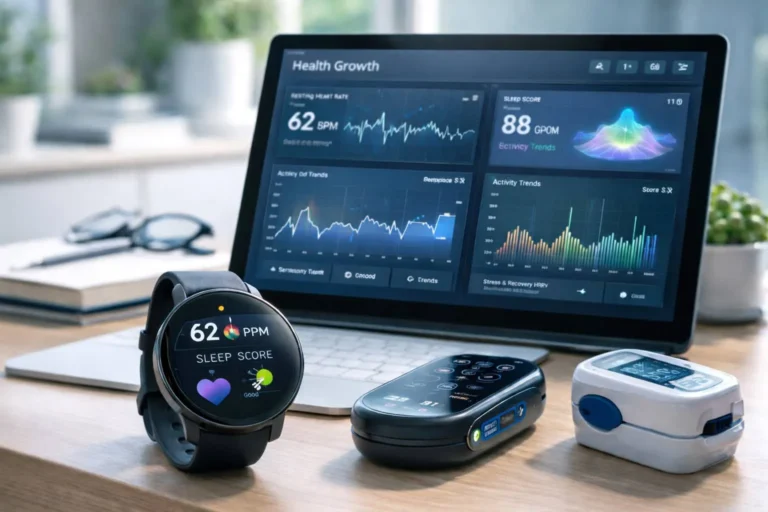
A third example, quieter than the other two but starting to matter, is the rise of at-home diagnostic and monitoring services. Microbiome testing. Hormone panels. Remote biomarker tracking. Continuous monitoring devices that send data straight to the patient’s care team.
The old model required a clinic visit for almost every meaningful piece of data. The new model lets the patient generate data at home and share it with the clinical team, so the appointment can be about what the data shows rather than waiting for it to come back.
Why This All Matters for Patients
The point of pulling these examples together is not that any one of them is a transformation on its own. It is the cumulative effect that changes what it means to be a patient with a chronic or complex condition.
You spend less time as the courier of your own information. You spend less time travelling to receive care that could come to you. You spend less time waiting for one system to talk to another. You spend less time as the project manager of an experience that should have been organised on your behalf.
None of this replaces the importance of good clinicians, good medicine and the daily habits patients still need to look after. The work the patient has to do remains the work the patient has to do. But the surrounding infrastructure, the parts that used to absorb so much patient energy in friction, is finally starting to do its job.
A Quiet Sort of Progress
The healthcare industry tends to celebrate the loud changes. The new drug. The breakthrough therapy that lands in the press cycle for a week. Those matter. But the quiet changes in the B2B layer, the ones nobody outside the industry would recognise as healthcare, are the ones that have changed the patient experience most in the last ten years.
For anyone living with a chronic condition, or supporting someone who is, the practical takeaway is simple. The infrastructure exists in ways it did not before. The lifestyle side, including what ends up on the plate each day, still has its place. But the surrounding architecture is no longer the bottleneck it used to be.