
adidas Adizero Adios Pro Evo 3 brings sub-100g ambition, new foam and carbon tech to adidas’ boldest marathon shoe yet.
The adidas Adizero Adios Pro Evo 3 has arrived looking like something smuggled out of a wind tunnel and finished by a watchmaker with a caffeine problem. adidas says it is the lightest and fastest racing shoe the brand has ever created, and in an age where every major shoe launch arrives draped in science, swagger and claims of free speed, this one at least has the decency to sound properly audacious.
This is not a gentle update or a lick of paint on an old favourite. The Adizero Adios Pro Evo 3 is pitched as a moonshot: adidas’ attempt to create its first-ever sub-100-gram race shoe while still improving performance. That is an outrageous brief. Most brands would settle for shaving a few grams and sending out a tidy marketing deck. adidas appears to have taken a hacksaw to convention instead.
“Our goal was two digits on the scale, with better performance than we’ve ever had” – Stephan Scholten, VP Product, adidas.
First impressions: barely there, all business
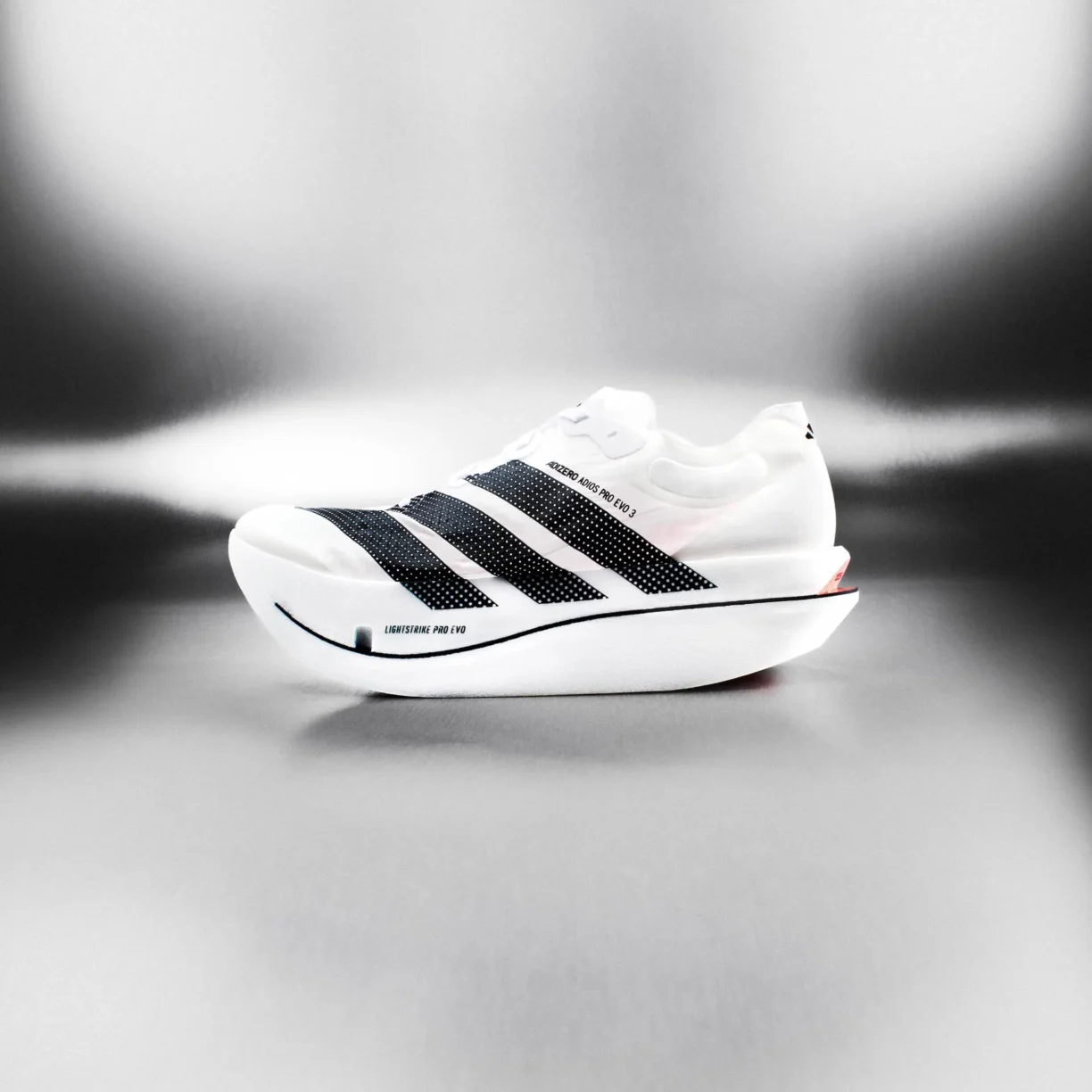
At first glance, the Adizero Adios Pro Evo 3 looks like the sort of shoe a marathon runner might hide from their training partners until race morning. It is stripped-back, severe and purposeful, with a minimal white finish, black three stripes and an exposed heel outsole detail that shows off the new Energy Rim construction.
There is no visual clutter here. No unnecessary theatre. Just a racing silhouette that seems to have been put on a strict diet and told to mind its manners. The impression is simple enough: this shoe has not been built for jogging round the park admiring blossom. It has been built for speed, and speed tends to be a fairly humourless business.
What makes the Evo 3 different?
The headline figure is the weight. adidas says the Adizero Adios Pro Evo 3 was engineered to break the sub-100g barrier, which puts it in truly rare air even in today’s supershoe arms race.
But the real story is not just that it is lighter. It is how adidas is trying to keep that low weight from turning the shoe into a flimsy, unstable pancake.
The big change is the next-generation Lightstrike Pro Evo foam, described as the lightest and most responsive foam adidas has made to date, at nearly 50% less weight than earlier versions. With a 39mm stack, the idea is clear enough: keep maximum cushioning and propulsion underfoot without hauling around unnecessary bulk.
Then comes ENERGYRIM technology, the new carbon-integrated system at the heart of the shoe. In plain English, this is the architectural trick that allows adidas to pack in more of that light foam while still controlling stiffness and stability. That balance matters. Too soft and a race shoe feels sloppy. Too rigid and it can feel like running in a carbon ironing board. The promise here is a more efficient blend of rebound, structure and forward motion.
The upper has also been pared down with inspiration from kitesurfing sail technology, which tells you all you need to know about the design brief. Everything has been trimmed to the bone, from laces to stitching, in the pursuit of marginal gains.
Finally, the outsole uses strategically placed Continental™ rubber in the forefoot for traction at speed, without adding unnecessary heft. Again, same theme: keep what matters, throw overboard what does not.
How that tech should translate on the road
For serious marathoners and half-marathon runners, the appeal of the Adizero Adios Pro Evo 3 is obvious. Less weight means less energy wasted over time. More responsive foam means better rebound and fresher legs deeper into a race. A tuned carbon system should help maintain rhythm and efficiency when form starts to fray in the later miles.
That is the theory, anyway, and it is sensible enough. The best supershoes do not merely feel fast for 5K. They help runners stay organised when the body begins negotiating with itself at mile 22. adidas is clearly aiming for that sweet spot of cushioning, propulsion and economy.
The racing kit arriving alongside it follows the same thinking. adidas says its Techfit+ endurance suit has improved running economy by up to 1% in testing, while athletes such as Sebastian Sawe and Tigist Assefa are expected to opt for the shorts and singlet, and Yomif Kejelcha and Amos Kipruto will race in the endurance suit. The message is plain: this is not just a shoe launch, but a full race-day systems play.
Who is it actually for?
Not everyone, and that is rather the point.
The Adizero Adios Pro Evo 3 is for ambitious runners chasing times, places and possibly a small existential crisis somewhere after 30 kilometres. It is built for athletes who care about running economy, efficiency and race-day execution. That could mean elites, sub-elite marathoners and serious club runners who know exactly why they want a supershoe and what they expect it to do.
It is not likely to be the best option for beginners, casual runners or those who want one shoe to do everything from easy miles to supermarket errands. A $500/€500 racer with a highly limited first release is not pretending to be democratic.
How it stacks up against the competition
The Adizero Adios Pro Evo 3 enters the most obsessive corner of the running market, where brands are fighting over grams, foam chemistry and fractions of efficiency as though national pride depends on it.
Its competitive edge appears to be the combination of ultra-low weight and high-stack cushioning, backed by a new carbon-integrated structure rather than a simple update to an existing platform. That gives it a distinct identity in a field crowded with premium marathon shoes chasing similar promises.
Where some rivals lean heavily into maximal cushioning or aggressive rocker geometry, adidas seems to be framing the Evo 3 as a more radical lightweight engineering exercise. It is less about comfort-first softness and more about mechanical efficiency with as little excess baggage as possible.
The making of a moonshot
Patrick Nava, GM Running at adidas says: “Creating the Adizero Adios Pro Evo 3 pushed us to think differently from the very start. We weren’t just trying to improve on what we’d done before, we wanted to see how far we could go. We went through more than a dozen iterations, working closely with our athletes and testing everywhere from our labs in Herzogenaurach to high-altitude camps in Kenya and Ethiopia.
At that level, every detail really matters – we were measuring things down to the nearest nanogram. It was a long process, but it’s led to something we believe genuinely changes what a race-day shoe can feel like.”
That quote does at least suggest the right level of obsession. When brands start discussing nanograms, you are no longer in the land of normal product development. You are in the territory of people trying to squeeze speed out of air molecules.
Verdict: bold and seriously interesting
The Adizero Adios Pro Evo 3 does not look like a modest shoe, sound like a modest shoe or behave like a modest shoe. It is expensive, limited and engineered with the sort of single-minded intensity that makes perfect sense at the sharp end of marathon racing and none at all anywhere else.
That is also why it matters.
In a market full of “faster than ever” claims, adidas has produced something that at least appears to have earned the drama. The Adizero Adios Pro Evo 3 is not for everybody, but it was never meant to be. It is for runners who treat race day like a final exam and want every legal advantage they can lace up.
Whether it becomes the defining supershoe of this cycle will be settled where these things always are: not in launch copy, not in laboratory talk, but on the road, under pressure, when the clock is cruel and the legs are bargaining. That is where reputations are made. And that is where this one will be judged.
The shoe launches on adidas.com for $500 in a limited release April 23.