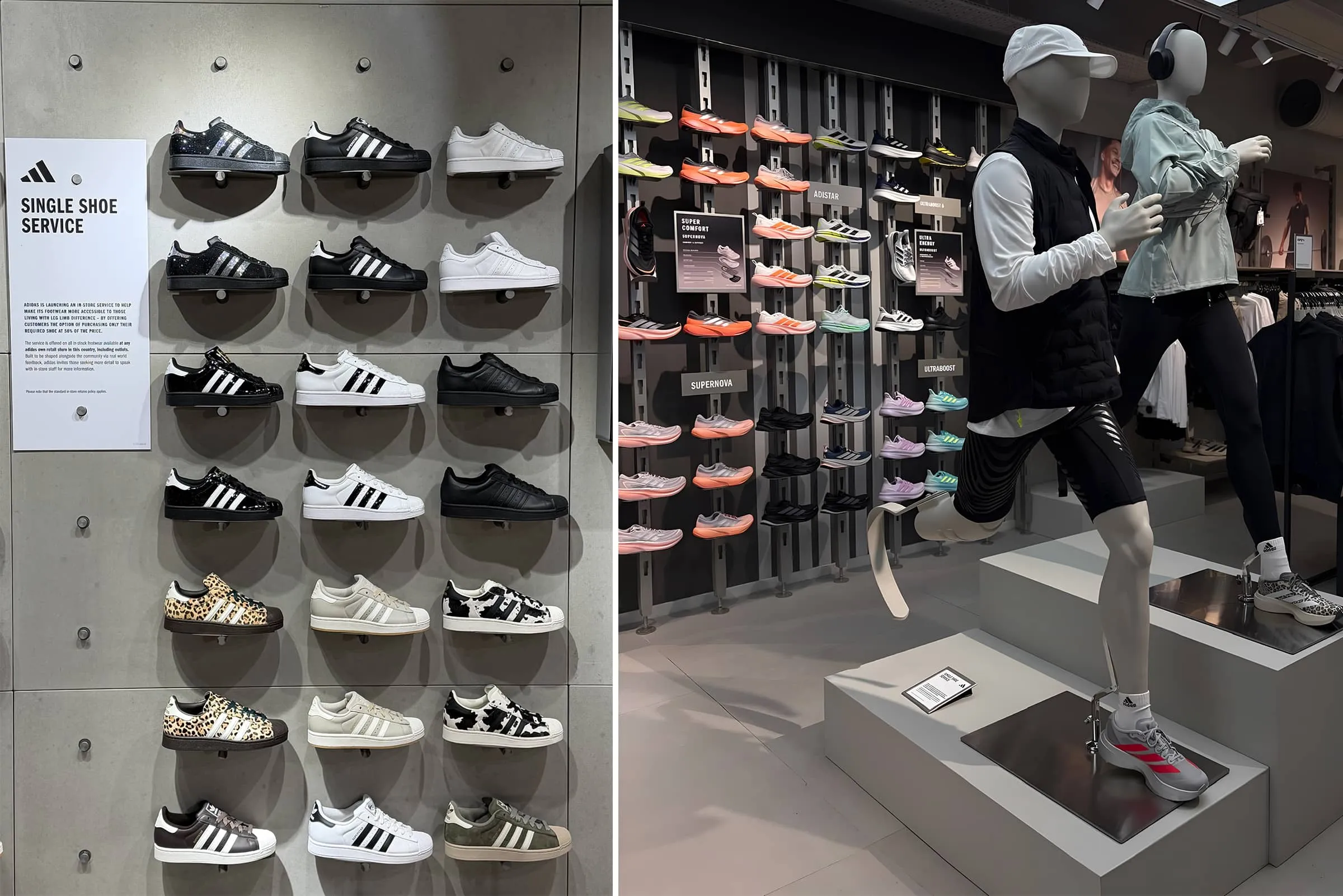
adidas launches a single shoe service, making footwear more accessible for people living with limb difference.
There are grand gestures in sport, and then there are practical ones. adidas has gone for the latter, which is usually where the real progress lives. The sportswear giant has launched a new in-store service designed to make its footwear more accessible for people living with leg limb difference, allowing customers to buy only the shoe they actually need at 50% of the full pair price.
It is the sort of idea that feels so obvious you wonder why it took this long to appear in plain sight. Yet retail, like golf, has a habit of missing the straightforward shot while admiring the complicated one. In this case, adidas has chosen usefulness over fanfare, and the result is a service with genuine weight behind it.
A retail change rooted in real life
The new adidas Single Shoe service has been live since 19 January and is now available across 22 countries in Europe. It applies to all in-stock footwear sold in adidas-owned stores, including outlets, giving customers the option to purchase one required shoe rather than being forced into buying a full pair.
That matters because accessibility is often discussed in sweeping corporate language, then abandoned somewhere between the boardroom and the shop floor. Here, adidas has put forward something concrete. No sermon. No chest-beating. Just a practical solution to an obvious problem.
Better still, the service was developed in consultation with the community itself, including ParalympicsGB and partners such as Harder Than You Think, the producers of Rising Phoenix, the documentary on the history of the Paralympic Movement.
That consultation is significant. It suggests this was not dreamed up in a sterile meeting room by people congratulating themselves over herbal tea, but shaped by people who understand the daily reality of living with limb difference.
Inclusion that goes beyond slogans
Brands talk endlessly about inclusion, often with the glazed certainty of someone reading from a laminated values card. adidas, to its credit, is attempting to do something more grounded. The single shoe service sits within a broader push to remove barriers for athletes with disabilities and bring adaptive design into the mainstream.
That wider work includes adaptive basketball uniforms created specifically for wheelchair and seated athletes. It also includes design decisions that meant 86% of the apparel worn at the Paris 2024 Olympic and Paralympic Games was created using principles intended to work for athletes with and without a disability. An adaptive running shoe, developed for and alongside people with Down syndrome, is also on the way.
Taken together, that paints a clearer picture of what adidas is trying to do. This is not simply about launching one thoughtful retail option and polishing the halo. It is about rethinking how performance wear, sports culture and consumer access intersect.
Why the adidas single shoe service matters
The importance of the adidas single shoe service is not merely economic, though paying for one shoe instead of two is plainly fairer. Its real value lies in recognising people as customers with actual needs rather than awkward exceptions to a standard system.
Retail has long relied on the convenience of uniformity. One box. One pair. One process. That system works well until it does not. For customers with leg limb difference, the old model was not just inefficient; it was indifferent. By adjusting the model, adidas is acknowledging that accessibility is not a side project. It is part of good design, good service and basic respect.
There is also something quietly powerful in making this available across standard in-store inventory. It avoids turning inclusive footwear access into a niche corner of the business. This is not a special line hidden at the back of a catalogue. It is part of the regular shopping experience, which is exactly where it belongs.
A smarter view of accessible sportswear
The lesson here is that innovation does not always need to arrive dressed like a spaceship. Sometimes it is a simple retail fix that removes an unnecessary burden from people’s lives. For all the noise around sportswear technology, performance fabrics and futuristic silhouettes, adidas has stumbled upon something rarer: a sensible idea with human value.
And that may be the most impressive part of it. The service does not ask for applause. It just solves a problem.
In an industry fond of telling us it is changing the world one foam compound at a time, adidas has made a quieter point. Accessibility is not about spectacle. It is about whether people can walk into a shop, ask for what they need, and be treated as though that need was worth anticipating in the first place.
That is not revolutionary in theory. But in practice, it is a meaningful step. And sometimes the smartest move any brand can make is simply to stop selling people what they do not need, and start listening to what they do.