World Baseball Classic 2026 preview as Great Britain targets credibility, momentum and a statement on baseball’s biggest international stage.
The World Baseball Classic has always felt like baseball after somebody has kicked the doors open and turned the amplifier well past sensible. It is not merely a tournament, nor just a polite gathering of flags and famous arms. It is an international sporting event with noise in its lungs, national pride in its chest and enough elite talent to make even the calmest manager chew through his own dugout railing. In 2026, it returns larger, sharper and carrying the distinct sense that old assumptions are being shoved aside. Great Britain, for one, are no longer here to make up the numbers.
Why the World Baseball Classic now carries real weight
There was a time when international baseball could be treated as a curiosity by those who only glanced at the club game. That time has gone. The World Baseball Classic is sanctioned by the World Baseball Softball Confederation as the sport’s official National Team World Championship, and the scale is no longer debatable.
Across its editions in 2006, 2009, 2013, 2017 and 2023, the tournament has attracted more than 4.7 million fans. The 2023 event alone drew 455 million viewers across 152 countries and territories, welcomed 1.3 million supporters through the gates and generated a reported economic impact of $336.6 million for host communities.
Those are not decorative figures dressed up for a boardroom slideshow. They are the numbers of a global sports event with commercial force, cultural relevance and a growing ability to command attention beyond traditional baseball strongholds.
That matters because the World Baseball Classic succeeds where many international tournaments merely posture. It combines the polish of top-level professional baseball with the unpredictability of national-team sport. The result is tighter, fiercer and often more emotionally charged than the everyday club calendar.
Japan arrive as reigning champions after beating Team USA in the 2023 final and claiming a third title. Before that came the Dominican Republic in 2013 and the United States in 2017. It is a list that tells a useful truth: this is not one nation’s stage with everyone else hired as extras. The championship has become properly global.
World Baseball Classic 2026 format and schedule explained
The shape of the 2026 World Baseball Classic is familiar, but familiar in the way a thunderstorm is familiar. You know what is coming, but that does not make it any less lively.
The first-round pools will be staged in San Juan, Houston, Tokyo and Miami before the tournament moves into the knockout rounds of quarter-finals, semi-finals and the championship game. It is an efficient format because it forces urgency from the first pitch. There is no comfortable drift, no leisurely warming of the engine. Survive the pool, manage the pressure, then step into the louder and less forgiving air of the final rounds.
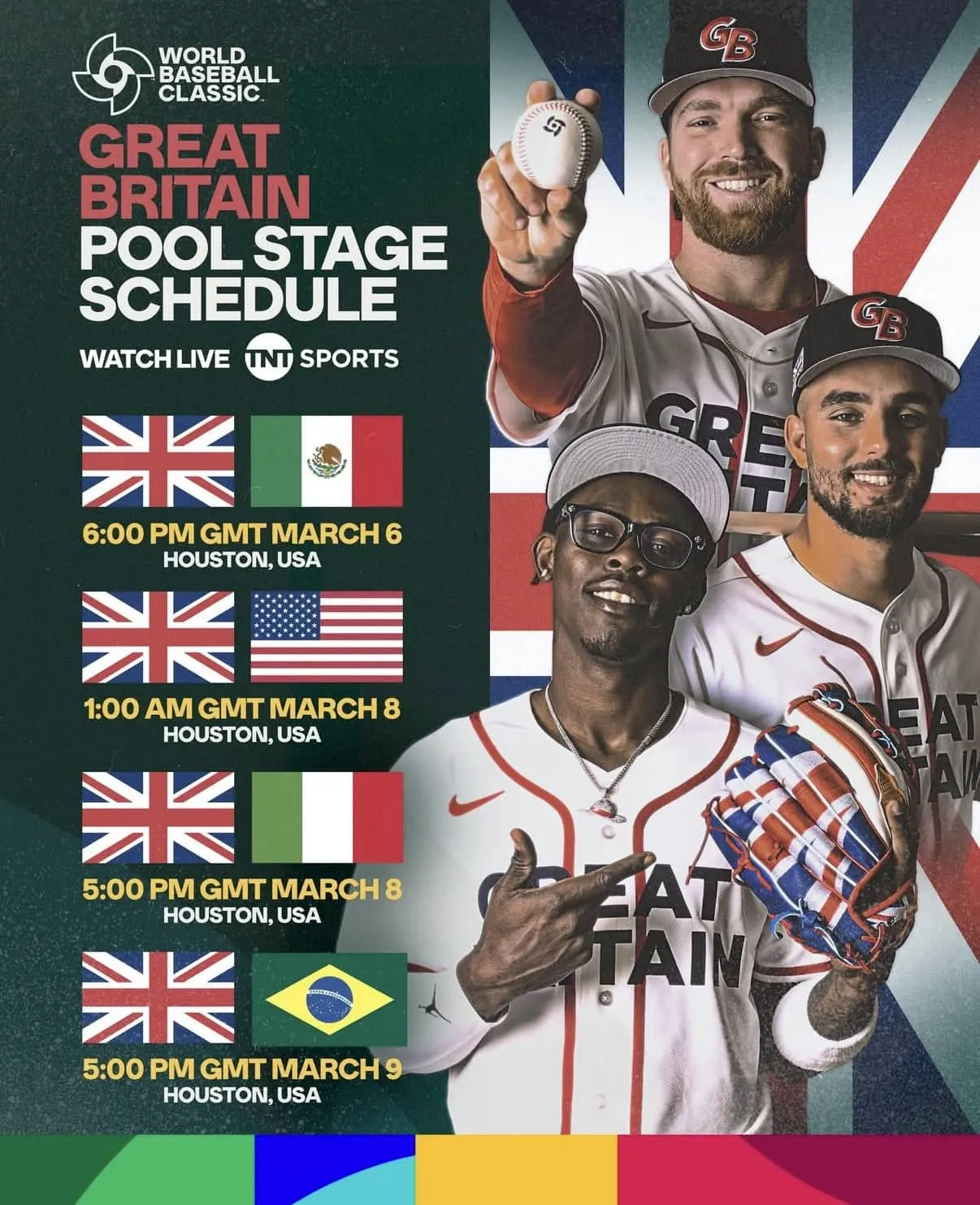
Great Britain has landed in Pool B in Houston from 6-11 March 2026 alongside the United States, Mexico, Italy and Brazil. That is not a gentle pool. It is more of a bar fight in formalwear.
The Americans carry depth and swagger by the truckload. Mexico have developed into a serious international force. Italy are disciplined and technically polished. Brazil will not turn up to admire the lighting. For Britain, this is a group that demands nerve, not novelty.
Elsewhere, Pool A in San Juan includes Puerto Rico, Cuba, Canada, Panama and Colombia. Pool C in Tokyo brings together Japan, Australia, Korea, Czechia and Chinese Taipei. Pool D in Miami features Venezuela, the Dominican Republic, the Netherlands, Israel and Nicaragua.
There are no soft passages here. No gentle lane. No one gets to stroll.
Great Britain’s baseball rise is no longer a novelty act
For years, baseball in Britain existed somewhere behind the national wallpaper while football, rugby and cricket made all the noise and took all the oxygen. It survived, it organised, it persisted, and often it did so without much fuss. But survival and momentum are very different things, and Britain now appear to be moving from one to the other.
The sport’s roots in Great Britain run deeper than many assume. According to the media overview, the first recorded game in Britain took place in Walton-on-Thames in Surrey in 1749, with Frederick, Prince of Wales, taking part. That little historical detail gives the game a deliciously awkward truth: baseball in Britain is not some imported fad in a shiny tracksuit. It has history here.
By the end of the 2025 season, there were 105 adult baseball teams nationally and more than 3,000 players across all levels. The British Baseball Federation, founded in 1987, now oversees a programme with more structure, more substance and more intent.
The National Baseball League remains the leading adult tier, with the London Mets winning the title for nine consecutive years. British clubs are also beginning to leave footprints in Europe. In 2025, the London Mets and Essex Arrows both won their respective European tournaments. That tends to happen when a sport stops politely existing and starts building with purpose.
A national programme beginning to look serious
The most encouraging part of Britain’s World Baseball Classic story is that it is not built on one roster and a handful of temporary headlines. The wider programme is beginning to show shape, and shape matters.
The U23 side won Great Britain’s European Championship in 2025, securing the country’s first baseball gold medal since 1938 with victory over Czechia. Soon after, the Women’s Senior National Team claimed the second-ever Women’s European Baseball Championship.
These are not trinkets. They suggest pathway depth, system growth and, perhaps most importantly, a more mature belief that British baseball can compete rather than simply appear.
Since first qualifying for the World Baseball Classic in 2022, Britain has re-qualified by defeating Colombia in 2023, won silver at the Senior European Championship, taken silver at the U23 European Championship, competed at the 2024 U23 Baseball World Cup and then added those European titles at U23 and women’s senior level in 2025.
The Emerging Players Programme, launched by the British Baseball Federation and BaseballSoftballUK only strengthens the sense that this is being approached as a long-term sporting project rather than a charming one-off.
That does not make Britain a finished article. Far from it. But it does make them credible, and credibility is the currency that matters before a ball is thrown.
Harry Ford and Jazz Chisholm Jr could shape Britain’s campaign
Every World Baseball Classic campaign needs players capable of changing not only the scoreboard but the emotional temperature of a game. Britain appear to have at least two who fit that description.
Harry Ford offers an intriguing modern catcher profile. He is athletic, offensively useful and still developing, which is both encouraging and slightly unnerving for future opponents. His résumé already includes starring in the 2022 World Baseball Classic qualifiers, contributing in previous international appearances and progressing through the professional ranks with the kind of trajectory that makes scouts reach for notebooks and sunglasses.
A catcher who can steady the game behind the plate and still threaten in the batter’s box alters the balance of a team. Ford has the potential to do exactly that.
Then there is Jazz Chisholm Jr, who does not so much join a contest as detonate into it. The Bahamian-born infielder with British eligibility brings major league quality, charisma and a style that can tilt a game sideways in a hurry. Talent matters in tournament baseball, but so does theatre of the useful kind. The ability to jolt a dugout, ignite a crowd or turn a flat moment into a live one is not a luxury. It is a weapon.
Britain will need both talent and composure if they are to take meaningful strides in Houston.
Where UK fans can watch the World Baseball Classic
For supporters in Britain, visibility matters almost as much as victory. The World Baseball Classic will be available on TNT Sports in the UK, with highlights and condensed games also accessible through the tournament’s official channels.
That may sound like a practical footnote, but it matters. International sports events do not grow in the dark. They grow when audiences can find them, follow them and begin to care in real time. Accessibility is not everything, but it is how relevance gains a foothold.
What success would actually look like for Great Britain
Britain are not entering the World Baseball Classic as favourites, and pretending otherwise would be like taking a teaspoon to a demolition job. But international tournaments are not always judged by medals and champagne.
Sometimes success is sterner and more interesting than that. It lies in credibility, in sharp execution, in the ability to drag heavyweight opponents deep into uncomfortable innings and force them to earn every last out.
A serious push in Pool B would matter. A composed, aggressive showing against elite opposition would matter. One proper win under pressure could matter enormously.
The World Baseball Classic has a habit of accelerating national programmes when they seize a moment. A single standout performance can alter how a country sees its own place in the sport. That is the opportunity in front of Britain.
Their presence is compelling not because it is surprising anymore, but because it now feels earned.
The bigger picture for baseball’s global championship
The 2023 figures were enormous: 455 million viewers, 620 million social impressions, 1.3 million attendees and a 20 per cent increase on the previous attendance record. Those numbers tell broadcasters, sponsors and governing bodies that this tournament has commercial gravity. But the deeper value of the World Baseball Classic lies elsewhere.
It gives baseball passports, edge and consequence. It wraps the game in rivalry and urgency. It strips away the long-haul comfort of the season and replaces it with short-form jeopardy, where timing, nerve and one badly located pitch can change everything.
In 2026, that matters just as much for emerging nations as it does for the old powers. Japan will defend. The United States will loom. The Dominican Republic will swagger. Venezuela will threaten. And Great Britain will arrive with a history older than many realise and a programme healthier than many assume.
That is enough to make this championship worth your attention before the first anthem is even sung. After that, as ever in international sport, the margins will become small, violent and terribly interesting.