Suzanne Edwards joins Wings for Life World Run after pioneering brain–spine interface surgery to fund spinal cord injury research.
The Wings for Life World Run has never been short of extraordinary stories, but Suzanne Edwards brings the kind that makes you put the kettle down and pay attention. Not because it is wrapped in miracle language, but because it is grounded in something far more interesting: science, graft, bruising rehab, and a woman refusing to let paralysis have the final word.
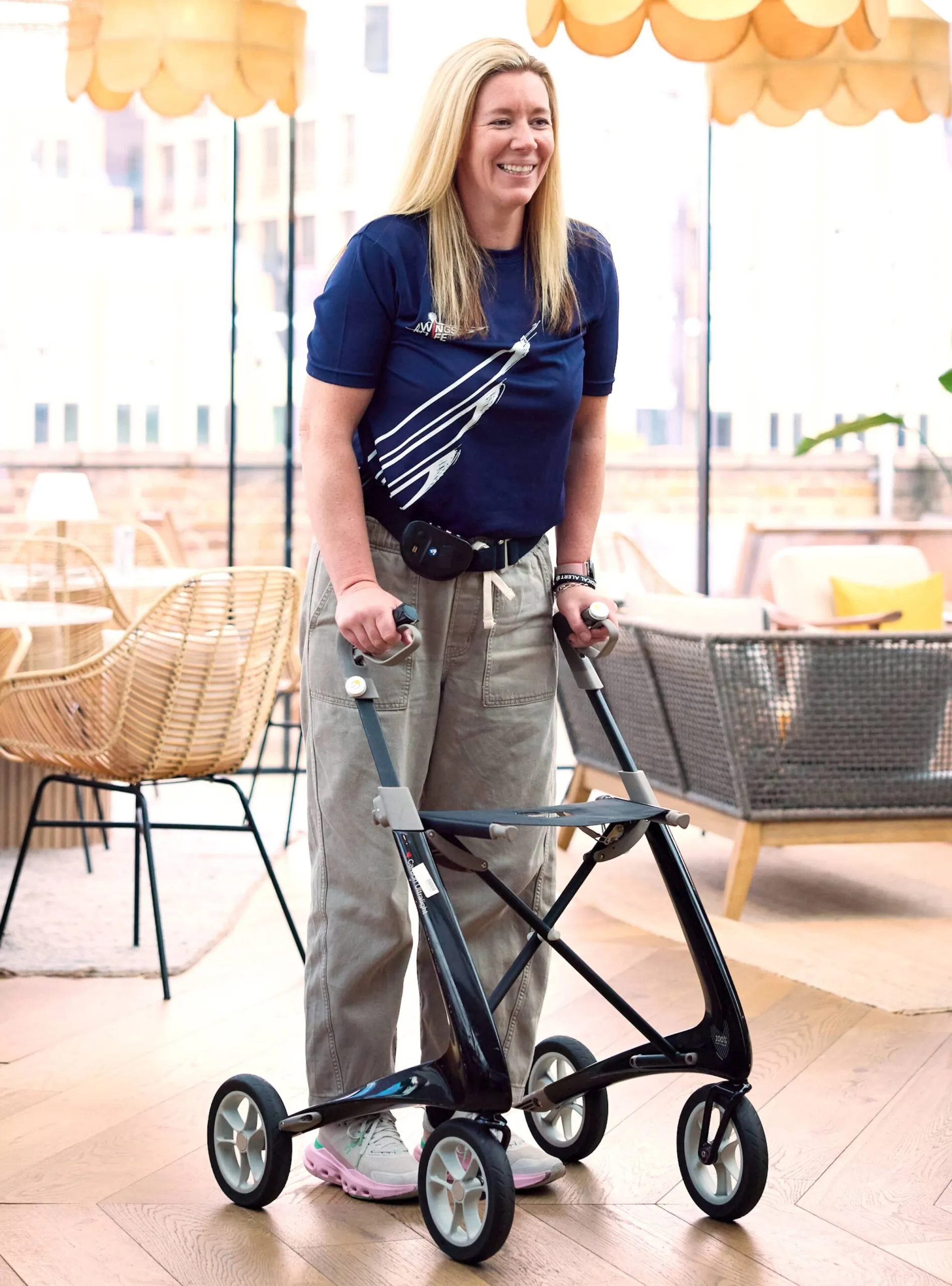
Edwards, Accessibility Standards Lead at Airbnb, is one of only three people globally to have taken part in a pioneering clinical trial using a brain–spine interface to restore movement after spinal cord injury.
In 2011, aged 22, she fell 20 feet when a balcony railing collapsed while she was on holiday in Morocco. The accident left her paralysed. Before it, she had been a keen surfer. After it, she remained stubbornly active, competing in wheelchair tennis and later joining the English adaptive surf team.
Now, after surgery and months of rehabilitation in Switzerland, she will take part in the Wings for Life World Run in Lausanne alongside the very research team helping push spinal cord injury science into territory that once sounded like the work of fiction writers with lab coats.
A Trial Built On Signals, Surgery And Serious Resolve
Last year, Edwards underwent surgery at NeuroRestore in Lausanne as part of a clinical trial led by neuroscientists Grégoire Courtine and Jocelyne Bloch.
The work builds on research supported by Wings for Life from its earliest stages. The foundation’s mission is clear and ambitious: to help find a cure for spinal cord injury within a lifetime.
The system uses electrodes to transmit signals from the brain to the spinal cord, bypassing the site of injury and enabling movement in the legs. It sounds like something from a particularly confident episode of Tomorrow’s World, but the reality is far more painstaking.
“It’s not a cure,” she says. “I’m still paralysed, but it shows what technology and research can do in terms of restoring function.”
That distinction matters. This is not a magic wand. It is a bridge. And bridges, as anyone who has ever tried to build one over uncertainty will tell you, take time, money, skill and an awful lot of nerve.
Six Months Of Rehab, One Step At A Time
Following surgery, Edwards completed six months of rehabilitation in Lausanne. The programme began with a “mapping” phase, identifying how to stimulate specific muscles before progressing to daily sessions lasting up to three hours, focused on standing and walking.
“I used to train for wheelchair tennis, so I saw it as that, like going to the gym every day,” she says. “It was tiring, especially alongside work, but seeing progress was a big motivation.”
That is the line in the sand, really. Progress. Not the grand Hollywood version with violins swelling and everyone weeping into their sleeves. Actual progress. The sort measured in effort, balance, aching wrists and the quiet fury of doing it again tomorrow.
As her legs strengthened, the strain moved elsewhere.
“My arms and wrists became the limiting factor because I was putting so much weight through the walking frame,” she says. “We had to ease off so I didn’t damage my shoulders.”
For anyone imagining recovery as a straight road, there is the correction. It is more like a bad cart path after heavy rain: uneven, awkward, full of hazards, but still leading somewhere if you keep your head.
Life Back In North Devon
After six months in Lausanne, Edwards returned to North Devon, resumed work and travel, and adapted to training outside the structure of daily rehabilitation.
Now, she trains three to four times a week. Walking is not yet part of day-to-day mobility. It is practice. A deliberate session. A commitment.
“I’ll set aside time to do walking practice, then go back to my wheelchair,” she says.
Recently, she has begun walking independently without someone nearby to assist. It has not all been graceful. But then, very little worth doing is.
“I tried too early on, walking from my wheelchair to the sofa, lost my balance and ended up on the floor,” she says. “In the last month, I’ve got better at manoeuvring and sitting down safely. It’s not always elegant, but it means I don’t need to call someone to help.”
That last sentence is where the story lands hardest. Independence does not always arrive with trumpets. Sometimes it looks like getting from one chair to another without needing to shout for backup.
Restored Movement Is Not The Same As Recovery
Edwards is careful not to oversell the science or her own progress. That restraint gives the story its power.
“I don’t want to give the impression that I’m going to wake up one day and be able to move normally,” she says. “That’s not where this is. But it is progress.”
She initially chose not to share details of the trial publicly, partly because she did not yet know how things would unfold.
“I didn’t want the pressure of updating people when I didn’t know how it would go, or how I’d feel about it,” she says.
That feels entirely human. Research can be public. Recovery is personal. And when you are the one living inside the experiment, you get to decide when the world is invited in.
Returning To Lausanne For A Major Checkpoint
Edwards is due to return to Lausanne for her one-year evaluation. That will include a 10-metre walking test and a six-minute endurance test.
“I’m a bit nervous,” she says. “I haven’t been training three hours a day like I was there, but hopefully I’ll show improvement.”
The timing of that return is expected to coincide with this year’s Wings for Life World Run, where she plans to take part for the first time alongside the research team.
It is a neat full circle, although neat is probably the wrong word for a journey involving spinal cord injury, surgery, rehabilitation and the relentless business of learning new limits while nudging them wider.
Why The Wings For Life World Run Matters
The Wings for Life World Run raises money for spinal cord injury research and clinical trials around the world. The format allows participants to take part globally via the app, all starting at the same time, wherever they are.
For Edwards, joining the event in Lausanne marks a shift from following spinal cord research to being directly part of it — first in the lab, now in a global sporting event funding the next stage.
The current trial involves three participants, with researchers seeking further funding to expand it to a larger group. Wings for Life has supported this wider body of work over several years, helping accelerate progress toward treatments that may one day transform what spinal cord injury means.
Crucially, 100% of money raised through the run goes directly to spinal cord injury research.
A Global Run With A Very Personal Finish Line
There is something quietly brilliant about the Wings for Life World Run. It gathers runners, wheelchair users and app participants from around the world, then points all that collective effort toward one urgent question: how quickly can research move when enough people decide to push?
For Edwards, the answer is already visible in small, hard-earned ways. In standing. In walking practice. In returning to Lausanne. In joining an event that funds the very science reshaping her own possibilities.
“It’s important to look after your body, even if part of it is paralysed,” she says. “There’s a lot of research happening, and it’s moving quickly.”
And that, really, is the heartbeat of the piece. Not a miracle. Not a slogan. Just movement — scientific, physical, personal — edging forward one difficult step at a time.