TCL keeps Milan in view as the Paralympic Winter Games carry Milano Cortina 2026 into its final stretch.
The Olympic fortnight has come and gone, the medals have been handed out, and Milan has had a moment to catch its breath. But TCL is still all over the city as the spotlight shifts to the Milano Cortina 2026 Paralympic Winter Games, which are running now from 6 to 15 March 2026, after the Olympic Winter Games ended on 22 February 2026.
That change matters because it gives TCL’s citywide campaign a more interesting shape. What first looked like a large sponsorship splash around the Olympic spectacle now reads as something longer-ranging and better judged: a campaign built to stretch across both phases of the Games, staying visible as the attention turns from the grand theatre of the Olympics to the grit, skill and emotional pull of the Paralympics. The selected placements are still set to continue until the end of March, which means TCL is not merely passing through the party but hanging around for the full conversation.
TCL keeps its grip on Milan
There are brands that sponsor events and brands that occupy them. TCL has plainly chosen the second option.
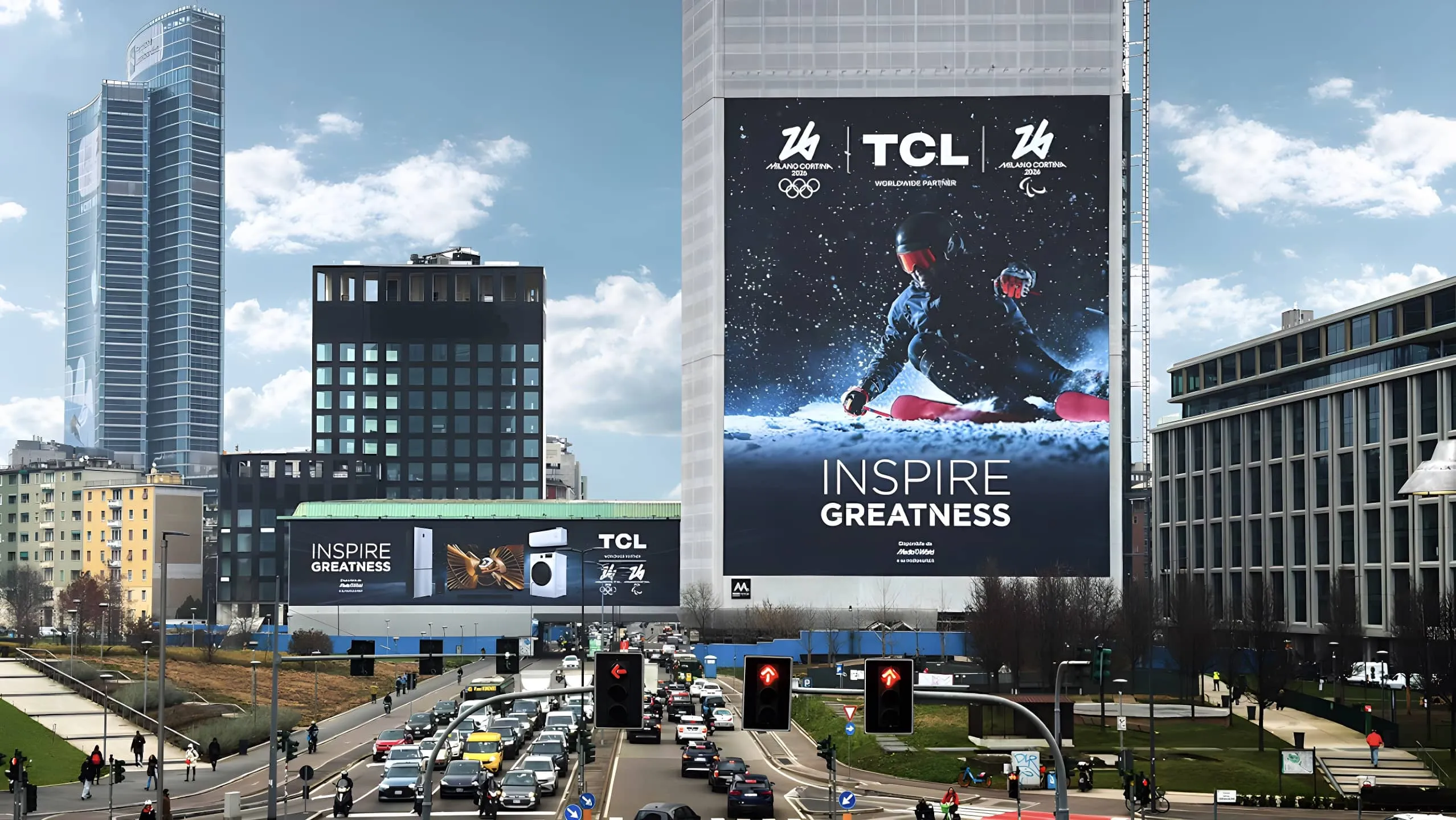
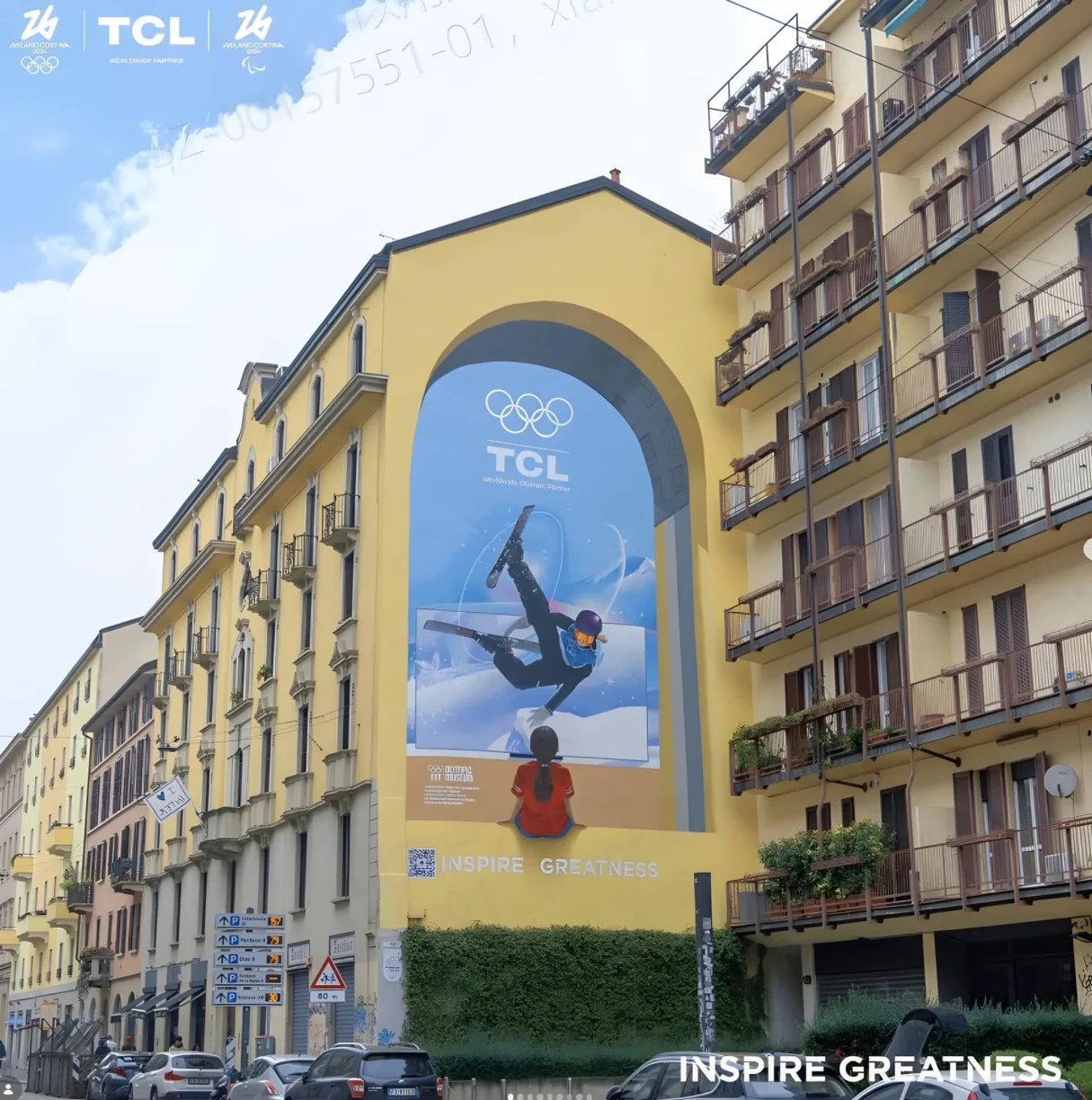
Its out-of-home campaign spans more than 30 high-traffic locations and hundreds of placements across Milan and its travel arteries, reaching commuters, tourists and sports fans as they move through one of Europe’s busiest host cities. The visuals appear on major roads, sightseeing buses, metro stations, central rail hubs, and at key entry points including Malpensa and Linate airports, with the campaign stretching beyond Milan into Venice and Verona as well.
The boldest flourish remains the giant billboard mounted on the 90-metre Tower of Municipal Technical Services in central Milan, which is not exactly subtle. Then again, subtlety is not much use when the whole point is to be seen by people arriving with ski jackets, accreditation lanyards and the thousand-yard stare of those trying to understand a rail timetable in a foreign language.
“The theme of our OOH campaign and experiences is all around Inspiring Greatness – and this isn’t just for the athletes competing in the Olympic Winter Games, but for all of us who dare to push the boundaries,” said Stefan Streit, CMO, TCL Europe. “Our presence across Milan is designed to bring the spirit of this huge sporting moment into our everyday lives.”
That quote lands differently now. A few weeks ago, it would have sounded like standard sponsor optimism with its tie straightened. In the current Paralympic context, it carries more weight. The campaign is no longer attached solely to the fanfare of opening nights and medal races already gone; it is now sitting alongside a phase of the Games that often reveals the sharper human edge of sport.
A campaign built for movement, not just visibility
Milan during a major Games is a city in motion. Stations swell, roads pulse, airport halls feel like they are operating on three separate time zones at once. So TCL has sensibly placed itself where movement happens.
Rather than relying on one glossy installation and a hopeful shrug, the brand built a campaign around repetition and proximity. You saw it on the way in, on the commute across town, in the station, near the airports, around the shopping centres, and in the sort of public spaces where a sporting event stops feeling like television and starts feeling like weather.
That is the clever bit. The campaign’s “Inspire Greatness” message may have been broad enough to fit on a billboard, but the execution was rooted in ordinary urban behaviour. People do not need to seek TCL out. TCL has arranged things so they trip over it.
TCL Edelweiss Land offers a public stage
The most tangible public expression of the campaign was TCL Edelweiss Land at Milan Central Station, in Piazza Duca d’Aosta. Opened daily from 10 am to 10 pm until 22 February, the installation covered more than 500 square metres and offered a hands-on showcase for TCL technology, including the TCL SQD-Mini LED TV X11L.
The timing of that central station showcase tied it directly to the Olympic phase, but it still matters in the wider story because it showed the shape of TCL’s approach. This was not simply logo wallpaper. It was experiential, public-facing and designed to turn passers-by into participants.
The company says the installation was built around environmentally conscious principles, which fits neatly with the modern sponsor’s need to be seen doing something other than printing giant pictures of itself and hoping for applause. In practical terms, it also gave TCL a place where consumers could interact with the products rather than merely absorb the branding from the side of a bus.
The roadshow rolls on into March
Where the station showcase had a fixed Olympic window, TCL’s wider activation continues through March.
The TCL Road to Milano Cortina 2026 Tour, which began in Rome in November 2025 and has already staged stops in Rome, Turin and Venice, has now arrived in Milan. It continues at MILAN IL CENTRO ARESE through 15 March, with TCL branding placed on the balaustre of the ice-skating area next to the booth. The brand’s Olympic Winter Games-themed booth is also open at the Milano Certosa offline store.
That matters because it prevents the campaign from feeling like it has missed the train. With the Paralympic Winter Games underway now, TCL still has consumer-facing points of contact in play. The Olympics may have packed up on 22 February, but the brand has not folded the tent and gone home.
Beyond billboards: how TCL supports the Games
This is where the campaign becomes more substantial than a handsome media buy.
TCL helped support the Games operationally by providing TVs, digital signage and technical assistance to Olympic Broadcasting Services, allowing media at the International Broadcasting Centre to deliver Milano Cortina 2026 to audiences around the world. The company also showcased its broader “screen universe” and technologies such as AI-enabled air conditioners in a TCL space at the Milano Olympic Village, demonstrating how sport is now experienced across a small army of screens rather than one family television in the corner of the room.
TCL branding and devices are also present in several NOC Houses, the official homes of National Olympic Committees where athletes, delegations and fans gather. These spaces are often overlooked in the public telling of a Games, but they matter. They are where protocol loosens, national pride softens into celebration, and sponsors get the rare chance to be present in a setting that feels lived-in rather than staged.
What the public didn’t actually see was how the brand also helped athletes more directly. TCL says its smart washing machines and dryers supported competitors in the Anterselva and Livigno Olympic Villages, while TCL TVs provided a way to unwind. It also backed the Athlete Moment, supplying the display technology that connects athletes with loved ones immediately after competition.
That last detail is the strongest of the lot. Sport is full of polished sponsorship surfaces; very few of them sit close to the emotional heartbeat. The moment after an event, when elation and exhaustion come tumbling out together, is where the Games feel most human. Getting near that without trivialising it is no small feat.
TCL’s UK engagement figures suggest the strategy is working
The risk with any giant partnership is that visibility can be mistaken for connection. One is bought. The other has to be earned.
TCL will be pleased, then, that its UK division recorded the highest online engagement across the Olympic Winter Games, according to findings compiled by Quantcast. The adtech firm tracked interaction across the UK open internet, including news sites and blogs, and found that TCL posted the largest increase in online engagement among sponsors, at 30 per cent.
These results reflect the strength of TCL’s approach to the Olympic Winter Games. Rather than simply appearing as a sponsor, we executed a series of activations designed to create genuine audience connection, most notably the local UK ‘In My Zone’ campaign, which featured short-form social content created directly with athletes. The campaign showcased how TCL’s TVs, soundbars and home technology support athletes in their day-to-day lives, from analysing track footage and self-coaching sessions, to gaming for mental reset, family movie nights and recovery routines.
That feels like the right lesson. Audiences are not daft. They know the difference between a sponsor standing near sport and a sponsor trying to understand how sport fits into daily life. TCL’s stronger work appears to have come not from waving a badge around, but from finding credible ways to show how its technology intersects with routine, preparation, rest and family.
What the Paralympic phase now says about TCL
The Olympics bring scale, ceremony and the familiar thunder of global attention. The Paralympics bring something else: perspective, intensity and stories that cut through the upholstery.
That is why the timing now helps TCL rather than hurts it. With the Olympic Winter Games finished and the Paralympic Winter Games running through 15 March, the campaign no longer looks like a simple sprint for visibility. It looks more like an attempt to stay present through the full emotional range of Milano Cortina 2026.
And that is a better story.
TCL has used Milan as a stage, certainly, but also as a test. Can a consumer technology brand be both highly visible and genuinely useful during one of the world’s largest sporting events? Can it support broadcasters, athletes, fan spaces and public activations without feeling like an overexcited salesman at a wedding?
So far, the answer appears to be yes.
The Olympic blaze may have passed, but the Games are not over yet. As the Paralympics carry Milano Cortina 2026 into its final chapter, TCL remains where it most wanted to be all along: not just in the city, but in the picture.