In a shock Olympics twist, Biles has pulled out of women’s gymnastics team finals halfway through the competition.
The Tokyo team final was supposed to be a victory lap with fireworks—until Simone Biles made the kind of decision that stops sport mid-sentence. One moment you’re watching the most decorated gymnast in history thunder down a runway; the next, the arena feels like someone’s turned down the oxygen.
The rhythmic gymnastics team final at Tokyo 2020 has been dramatic viewing, to say the least.
US athlete Simone Biles, the most decorated gymnast in history, has pulled out of the competition mid-way through proceedings.
After struggling with her landing in the first vault event and scoring lower than all the Russian and American gymnasts in the discipline, organisers announced Biles had pulled out of competing in the next piece of apparatus – the uneven bars.
It was later announced she would no longer be competing in the remaining team events. In an official statement posted to Twitter by US Gymnastics, it was revealed that Biles pulled out of the team all-around final due to a medical issue.
Six years on, that Tokyo pivot still lands with the same force—because it wasn’t merely a sporting plot twist. It was a reminder that even the greatest are not machines, and that gravity doesn’t negotiate with reputation.
The Tokyo Moment That Became Bigger Than Tokyo
At the time, the shock wasn’t just that Biles stepped away—it was that she did so in a sport built on the illusion of control. Gymnastics is choreography performed in the language of risk: half-turns, blind landings, split-second timing. When something feels “off,” it’s not a bad day at the office. It can be dangerous.
The immediate context mattered. The vault landing looked uncharacteristically uncertain. The decision not to continue on uneven bars changed the entire tenor of the final, for Team USA and for everyone watching at home trying to make sense of it in real time.
And looming over it all was a statistic that felt almost fictional: Biles hadn’t lost an all-around competition since 2013. Not in a sport where careers can flicker and vanish between Olympic cycles—where the line between dominance and disaster can be as thin as a missed hand placement.
Records That Don’t Fit Neatly on a Medal Table
Tokyo didn’t erase what came before it. If anything, it underlined it. Simone Biles’ legacy is built on a body of work so dense with difficulty and hardware that it starts to sound like a typing error.
She has 25 world titles to her name
Biles proved she’s in a class of her own when she became the most decorated female gymnast at elite level at the World Championships in Stuttgart in 2019, beating all previous records.
Her accomplishments include being a four-time Olympic gold medallist and five-time all-round World Champion.
That list matters because it establishes the baseline: this isn’t an athlete protected by hype. This is an athlete who repeatedly turned the world’s biggest stages into her personal workshop.
Difficulty, Named and Claimed
Gymnastics has always had moves, but only the rarest athletes get a move that becomes a signature—one that doesn’t just win points, but redraws what’s considered possible.
Her signature move is one of the most difficult
At just 16, Biles began competing with a mesmerising double flip and ‘half twist midair’ on the floor. The incredibly difficult move, which since became known as ‘The Biles’, is one of her signatures.
Biles is still the only woman who has performed The Biles on a vault at a competitive level.
There’s a particular kind of intimidation in watching someone do a skill that others won’t even attempt. It’s not arrogance; it’s physics, mastered. The sport has a scoring code for a reason—because not all bravery is created equal.
She’s the first female athlete to cleanly land a triple-double
Simone Biles became the first-ever female gymnast to cleanly land a ‘triple double’ – when a gymnast completes two backflips while twisting three times in the air – at the US Gymnastics Championships in August 2019.
The move has since been dubbed the ‘Biles II’, and it is the highest-rated skill across all apparatuses in women’s artistic gymnastics.
When your innovations become vocabulary—“The Biles,” “Biles II”—you’re no longer just competing in the sport. You’re editing it.
Rio 2016: The Gold Standard of Dominance
If Tokyo was the pause, Rio was the full-throated symphony. The 2016 Olympics presented Biles at maximum voltage: power, precision, swagger, and the unnerving calm of someone who seemed to know the ending before the music started.
She dominated the 2016 Olympics
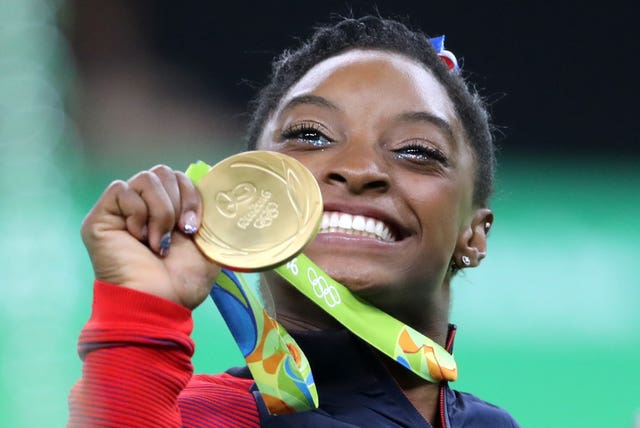
At the 2016 Olympics in Rio, Biles won individual gold medals in all-around, vault and floor, bronze in balance beam, and gold as part of the United States team.
Her floor routine went down in history as one of the most accomplished ever performed at an Olympic final.
That’s the thing about peak Biles: she didn’t just win—she made winning look like the least interesting part of the performance.
The Pressure Nobody Can Stick a Landing On
Elite sport sells certainty because certainty is easier to market than complexity. But Tokyo pulled the curtain back on the reality that greatness is not just muscle memory and medals. It’s expectation—public, internal, relentless.
She’s carried the pressure of being the team leader
In a post on social media, Biles talked about the pressure of being dubbed ‘The GOAT’, meaning the ‘greatest of all time’.
After the US gymnastics team posted uncharacteristically low scores during the Olympic qualifiers, she opened up to fans about her mental health on social media.
“[I]t wasn’t an easy day or my best but I got through it. I truly do feel like I have the weight of the world on my shoulders at times,” Biles said on Instagram.
“I know I brush it off and make it seem like pressure doesn’t affect me but damn sometimes it’s hard hahaha! The Olympics is no joke!” she added.
Those lines endure because they’re plainspoken and human. No slogans. No corporate polish. Just the truth, typed out by someone who had been asked—implicitly and constantly—to be unbreakable.
What That Day Changed, Six Years Later
It’s tempting to treat the Tokyo episode as a single dramatic chapter. But the longer view is more interesting: Simone Biles helped force sport to talk about athlete wellbeing, mental health, and performance safety without whispering.
She also reminded everyone—fans, federations, broadcasters, the lot—that “toughness” isn’t always staying on the floor. Sometimes it’s knowing when the risk is no longer worth the applause.
Win or lose, Biles is clearly an undisputed star of the Olympics and has already re-written the gymnastics history books.
What happens next remains to be seen – but we’re sure she’ll come back stronger, faster and more determined than ever.
That final sentiment captures why her story keeps pulling readers back: because it isn’t only about what she won. It’s about what she revealed—about the cost of excellence, the courage of restraint, and the rare athlete whose influence reaches beyond the scoreboard.