Preply reviewed: a practical, human look at language learning, brain health, flexibility, and whether online tutoring is worth it.
Learning a language later in life is often framed as a charming little ambition, somewhere between taking up olive oil tasting and finally sorting the shed. In reality, it can be far more significant than that. For many older adults, the appeal is not just the fantasy of ordering a coffee in Lisbon with a flourish, but the deeper hope that the brain still has some life in it yet — that it can stretch, adapt, surprise and refuse to quietly rust in the corner.
That hope is not daft. Learning a new language forces the mind to work in several directions at once: memory, listening, concentration, self-control, recall, pattern recognition and social interaction all get dragged onto the same stage and told to perform. It is not passive entertainment. It is mental effort with a passport.
That was the spirit of this experiment: to find out whether learning a language later in life still felt genuinely possible, and whether the process offered something richer than a few polite travel phrases and the occasional triumph over a menu.
Why learning a language later in life matters
The attraction is obvious enough. Learning a language later in life is often linked to improved memory, better concentration, increased confidence and sharper multitasking. It has also become part of a wider conversation around cognitive reserve — the brain’s ability to cope better with age-related changes by building up resilience over time.
Cognitive reserve is not magic, and anyone selling it as immortality for the mind should be made to sit quietly in the corner. But the principle is sensible. The brain responds well to challenge, especially the sort that combines mental complexity with real human interaction.
That is what makes language learning so compelling. You are not merely storing facts. You are hearing unfamiliar sounds, sorting grammar, recalling vocabulary, responding in real time and trying not to make a complete fool of yourself, often simultaneously. It is effortful, mildly uncomfortable and, in many ways, exactly the point.
A midlife leap into Portuguese
With that in mind, and with a memory that no longer felt entirely factory fresh, I decided to try learning Portuguese in my 50s.
On recommendation, I turned to Preply and booked a 50-minute trial lesson. The platform’s setup was straightforward: choose a tutor, discuss goals, test the chemistry, and see whether this felt like a realistic path into language learning rather than just another polished piece of digital optimism.
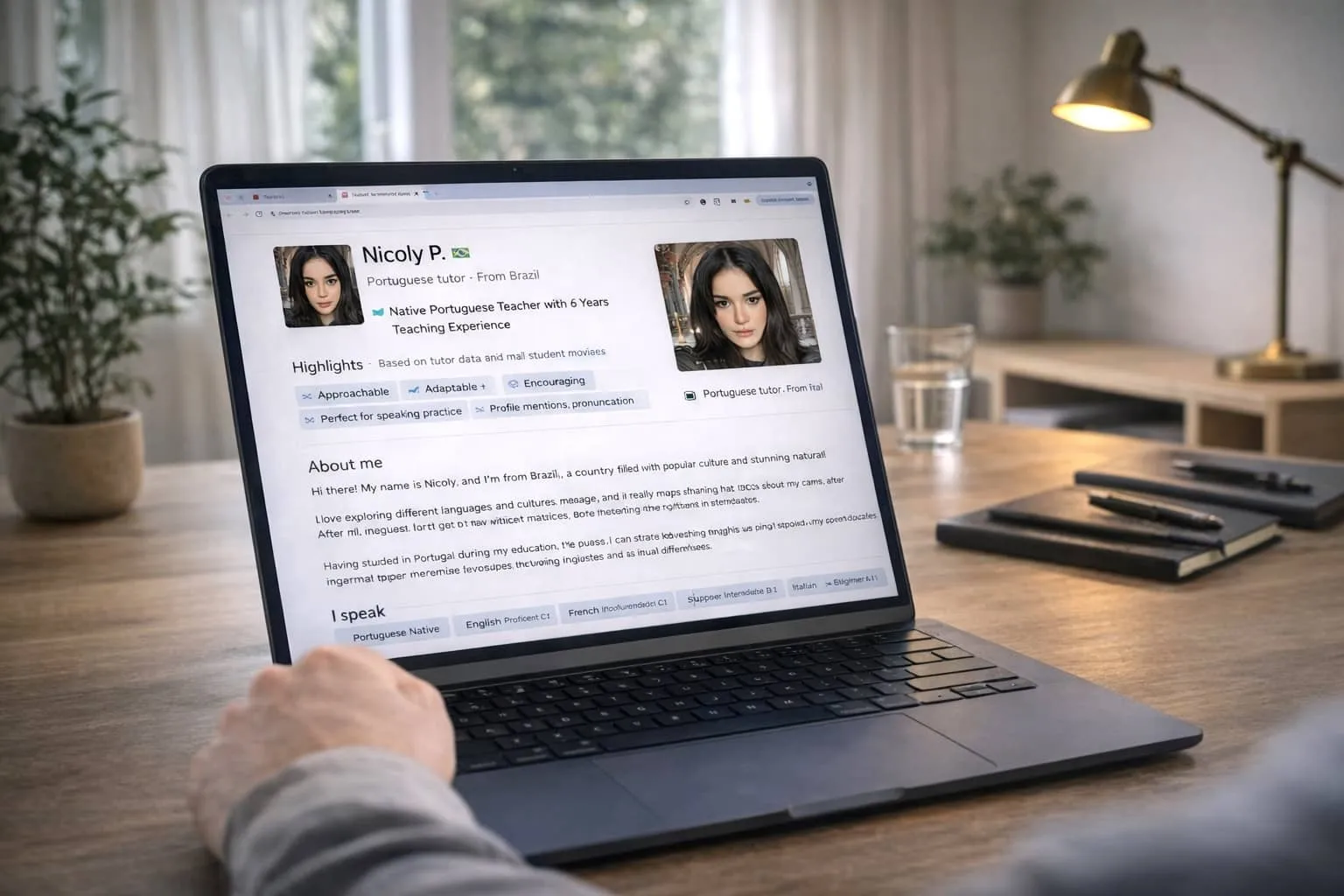
Enter Nicoly.
The nerves arrived on schedule. It had been roughly 25 years since I had last stepped into anything resembling a classroom, unless one counts life’s occasional bureaucratic humiliations as continuing education. So yes, there was apprehension. A fair bit of it.
But the surprise was how quickly that old classroom dread began to dissolve. The lesson did not feel institutional or stiff. It felt human. There was room to ask silly questions, make mistakes, go back over things and generally behave like a learner rather than a contestant in some grim academic obstacle course.
Which was fortunate, because Portuguese does not exactly greet the beginner with a warm handshake and a biscuit. Masculine, feminine and gender-neutral structures, unfamiliar sounds, new vocabulary — it can all feel like trying to assemble flat-pack furniture while wearing oven gloves. Nicoly, mercifully, remained patient throughout.
Meet Nicoly: a tutor who believes mistakes are part of the job
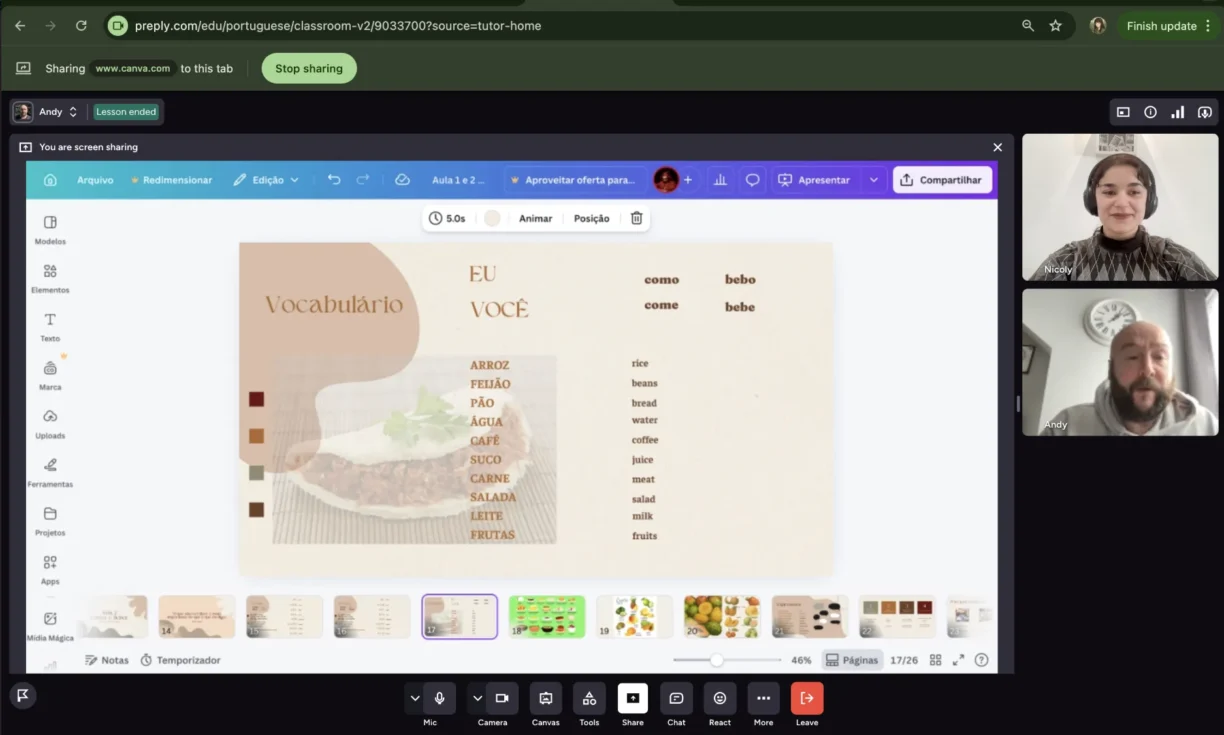
What became clear quite quickly is that Nicoly is not simply teaching a language. She is genuinely passionate about languages themselves, and that comes through in the way she works. More than that, she seems to get a real sense of accomplishment from seeing her students truly learn their target language rather than just survive a lesson and stagger out with two new nouns and a headache.
Her academic path reflects that same depth of interest. Nicoly is currently completing a master’s degree in Linguistics, which she sees as another step toward an academic and research career. Her hope is to continue studying languages and the ways they shape human interaction and our understanding of the world.
That broader perspective matters. It means she teaches language not as a checklist of grammar points, but as something alive — something tied to confidence, identity, curiosity and connection. Yes, being able to order a coffee in Lisbon or some hidromel in Tomar is definitely a plus, haha, but there is more going on here than tourism with better pronunciation.
She is also refreshingly realistic about the challenge. At the beginning, different sounds and structures can feel awkward and unnatural, but with time the brain adjusts. In fact, it begins to seek the reward that comes from expanding knowledge beyond what is already familiar.
Perhaps most importantly, Nicoly rejects the old rigid model of teaching in which students are expected to be perfect almost immediately. That kind of pressure, she believes, does not always motivate people to do their best. Quite often it becomes an obstacle. Her view is that people learn better in an environment where they feel safe to make mistakes — as many as necessary — and where self-correction becomes a practical tool for developing the language effectively.
For adult learners, that is not some fluffy bonus. It is central to the whole thing. Later in life, the real barrier is often not ability. It is embarrassment.
How Preply works for adult learners
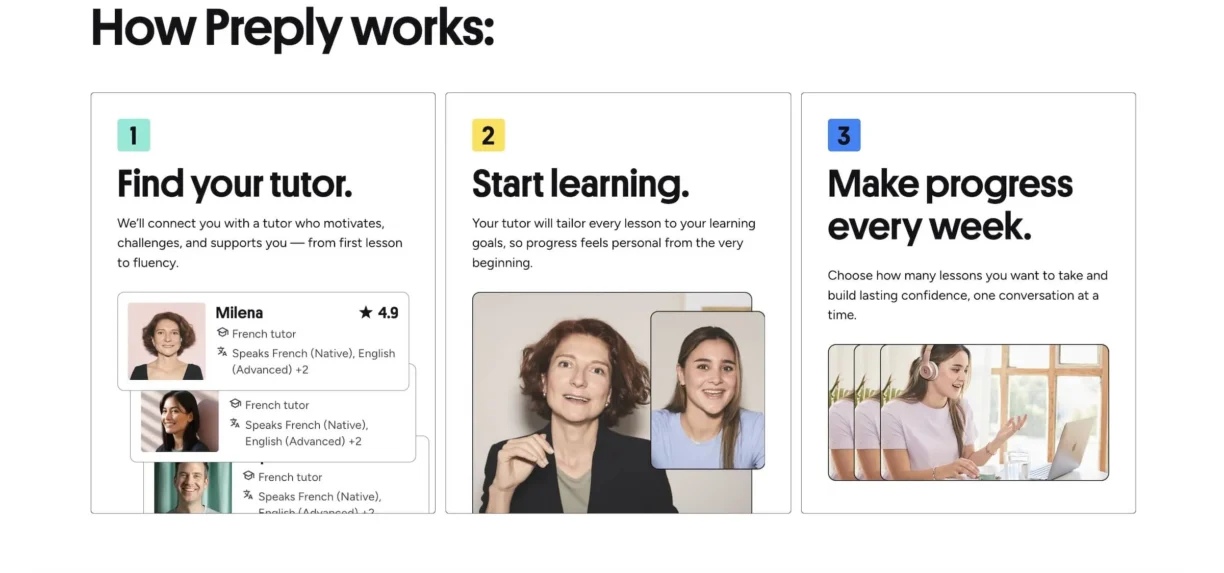
At its core, Preply is built around live tutoring rather than self-study alone.
The process is simple. You browse tutors based on your goals, schedule and preferred learning style, watch their introduction videos, read reviews and book a trial lesson. If the match feels right, you then move onto a subscription plan based on how many lessons you want each week.
That model gives Preply a few clear advantages, especially for adults.
The first is tutor fit. Preply offers access to a large pool of tutors from varied backgrounds and nationalities, which matters because teaching chemistry is not a luxury — it is half the battle. A tutor can be knowledgeable, organised and technically excellent, but if their style does not suit you, the learning soon feels like a chore.
The second is personalisation. That word gets mangled by marketers so often it now arrives limping, but here it does have substance. Lessons can be shaped around your actual aims, whether that means conversational confidence, travel, pronunciation, grammar or simply giving your brain something more ambitious to do than panic about passwords.
The third is flexibility. Lessons can be arranged around ordinary life, which is helpful because most adults are not floating through the week with vast pockets of spare time and a burning desire to master verb conjugations before lunch.
Why live tutoring makes a difference
The strongest thing Preply offers is also the most obvious: you are learning with a real person.
That matters more than it sounds. Plenty of language apps are sleek and efficient, but emotionally they can feel like interacting with an expensive parking machine. Preply gives you live conversation, real-time correction and the small but vital encouragement that comes from another human being helping you move forward.
That is especially valuable when learning a language later in life. The challenge is not just remembering vocabulary. It is dealing with rust, self-consciousness and the quiet suspicion that your best learning years have already trotted off without you.
A patient tutor helps dismantle that nonsense. Real conversation makes learning more relevant, more memorable and less abstract. You are not simply memorising words. You are using them, misusing them, correcting them and gradually making them your own.
In Nicoly’s case, that process felt notably calmer and more forgiving than traditional classroom learning. Mistakes were not treated as evidence of failure, but as part of the machinery of progress. That makes a considerable difference when you are returning to education after a long gap.
Preply also includes lesson insights and personalised activities outside the sessions, which can help keep momentum alive between lessons. That matters because adults usually succeed or fail not on enthusiasm, but on consistency. Anyone can be motivated for a week. The trick is keeping the habit alive once life begins throwing chairs again.
The subscription model: useful, but worth understanding
Preply runs on a recurring payment every 28 days after the trial lesson, based on your chosen lesson frequency. Users can select between one and five hours per week, and the system is designed to secure regular slots and encourage steady progress.
There are clear benefits to that. Routine helps. Fixed lessons create accountability. They stop language learning from becoming one more noble intention that sits in the diary for a fortnight before being flattened by work, family and general adult chaos.
Still, it is worth being realistic. A subscription works best if you genuinely plan to use it. The option to adjust lesson frequency is helpful, but anyone with a wildly unpredictable schedule should still be honest about what they can commit to.
Preply can provide structure, access and support. It cannot learn Portuguese on your behalf while you sit there eating crisps and hoping for osmosis.
The strengths of learning with Preply
Preply’s biggest strength is the human element. One-to-one lessons provide accountability, immediate feedback and a pace that can be adapted to the learner rather than imposed from above.
It is also well-suited to adult life. The platform is flexible, simple to use and built for people who need learning to fit around jobs, families and the general circus of being alive.
The personalised tutor match is another major advantage. Learning a language later in life is rarely about brute-force discipline alone. It is about finding the right teacher, the right rhythm and a process that feels sustainable enough to keep going.
Where it may not suit everyone
The main weakness is that the experience depends heavily on tutor fit. That is not unique to Preply, but it is real. A strong platform cannot rescue a weak match. The upside is that switching tutors is possible, and probably wise if the chemistry is not there.
The subscription model may also feel like too much structure for people who prefer to dip in and out casually. Those who want a completely freeform app experience with no recurring commitment may find it a little too organised for comfort.
Who should consider learning a language later in life with Preply?
Preply is particularly well-suited to:
- adults returning to learning after a long gap
- beginners who need patience and structure
- busy professionals who need flexible scheduling
- learners who do better with conversation than solo app work
- anyone looking to build confidence as well as language skills
For those people, it offers something more grounded than many self-study tools: real contact, real correction and a sense that progress does not have to be perfect to be genuine.
Is Preply worth it?
It’s a most definite yes from me.
Preply does not rely on gimmicks or shiny nonsense. what it offers is a way into language learning that feels manageable, human and realistic to keep up. That is especially meaningful for older learners, who may not simply be chasing fluency but also trying to keep the mind alert, rebuild confidence and prove that the capacity to learn has not vanished with youth.
And that, really, is the most interesting part of learning a language later in life.
Because the real triumph is not just mastering Portuguese, Spanish or Italian. It is discovering that the mind still has some spring in it. That it can be challenged. That it can improve. That it has not, in fact, retired to the shed with a tartan blanket and a crossword.
Preply works because it understands that language learning is not purely educational. It is personal. For many adults, it becomes an act of defiance against drift, routine and the dreary little myth that reinvention belongs only to the young.
In that sense, the platform offers more than lessons. It offers momentum.
And for anyone standing in midlife wondering whether they have left it too late to begin something new, that is a very good place to start.