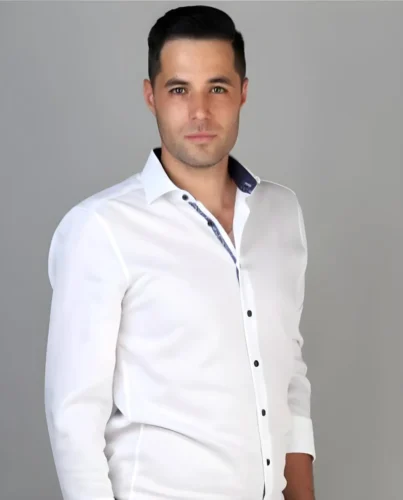
Enrico Weber goes backstage at OKTAGON 83—filming, learning, and plotting his own cage-walk moment.
In my January 27 2026, report for Sustain Health, I covered AllStar Contenders 5 and Enrico’s sensational MMA debut. Just days later, Enrico found himself on an even bigger stage at OKTAGON 83 in Stuttgart, right next to Lazar Todev on fight night.
Todev delivered a convincing heavyweight win against former Ultimate Fighting Championship fighter Josh Parisian, and Enrico was there for every second of it. Not as a spectator, not as a fighter, but as part of the team.
After the event, Enrico walked me through how it all came together and what it felt like to experience the night from behind the curtain.
Q: How did you get the chance to be part of the corner team that night?

Enrico: I work with videography on the side, and I film and edit the YouTube videos for my coach Serdar Karaca. So this time I came along as the third man in the corner, basically as the videographer. For me it was huge, because I was not just watching, I was part of the process.
He describes it like stepping into a different role without stepping away from the same mission. The camera was the reason he was cageside, but the mindset was still a fighter’s mindset. Pay attention, stay calm, capture the moment, and learn everything.
Q: How did the day feel before the fight actually started?
Enrico: Honestly, it was very relaxed. Everyone had a good mood, the atmosphere was calm. It felt similar to my own fight days. You know you have a job to do, but if the team energy is right, it does not feel stressful. It feels focused.
That calm is something many fans do not see. The crowd experiences the roar, the intensity, the violence. Backstage, the best teams often look almost normal. There is laughter, quiet talk, checking gloves, checking corners, small routines that keep the nerves under control.
Q: What was the moment where it really hit you that this is the big stage?
Enrico: The walk-in. It was spectacular. So many people, the lights show, the atmosphere was brutal. You feel the energy in your chest. For me, that moment was special because I could really visualise where my own journey is going.
That is the part that separates a major event from a regular show. The walk-in is not just a walk. It is a statement. It is noise, light, pressure, and attention all at once. For Enrico, standing close enough to film it, close enough to feel the bass and the crowd reaction, it became more than content for a video.
It became a mirror. This is the place you want to earn. This is the stage you want to return to, but next time with gloves on.
Q: When the fight started, what did you notice first?
Enrico: From the first seconds I could see Lazar was dominating his opponent. I had the feeling he would probably finish early.
That kind of confidence is not just fan optimism. It is the corner read. The small details like who wins the first exchange, who controls distance, who looks comfortable under fire. Enrico saw it immediately and as a cameraman in the corner, you do not get to be emotional for long. You still have to work.
Q: What did it feel like to capture a fight like that from the corner?
Enrico: It is intense because you are fully locked in. You are trying to capture the moment, but you are also emotionally invested. You feel the shots, you feel the crowd, you hear the corner instructions, and everything happens fast. You do not want to miss anything.
For MMA fans, this is a perspective that rarely gets described well. The corner is not silent. It is information. It is timing. It is urgency. Even if you are filming, you are absorbing the language of high-level preparation. What matters. What gets repeated. What the team sees that the audience might not.
Q: After the win, what happened next?
Enrico: After the fight we went back to the locker room, and shortly after that we went to the press conference.
It is a quick shift. One minute you are in chaos, lights and noise and adrenaline. The next minute, you are packing up, breathing, cooling down, and then stepping into the formal side of the sport where fighters answer questions and teams reset their focus.
Q: You mentioned you met a lot of people there. Who did you run into?
Enrico: I met people like Jungwirth, Ringlife, Max Holzer, Eckerlin, and Tamerlan Dulatov. They all gave a very respectful impression.
That is another hidden part of big events. The sport is competitive, but the community is real. You see athletes, media, and familiar faces moving through the same hallways. For someone like Enrico, it is not about celebrity spotting. It is about understanding the ecosystem. This is where connections happen and where the next steps start to feel possible.
Q: What did being backstage do to your mindset as a fighter?
Enrico: Because I was there live and I was behind the scenes, I could visualise my goal. It felt real. It felt reachable. Give me a bit more time and I will be standing there myself as a fighter. I owe a lot of that to my coach Serdar Karaca.
That line says everything about why experiences like this matter. Not every motivation comes from a speech or a highlight reel. Sometimes motivation comes from proximity. From seeing the lights up close, hearing the crowd with your own ears, and realising that this world is not a fantasy. It is a destination with a real door, and you can work your way through it.
Final thought
Enrico’s story at OKTAGON 83 was not about him winning a fight, at least not yet. It was about perspective. He arrived with a camera, stood in a real corner, felt the full scale of a major arena show, watched a teammate deliver, and walked away with a stronger picture of what comes next.
For MMA fans, that is the part worth watching. The sport is not only built on fight nights. It is built on the steps between them. The days where a fighter learns, grows, and quietly moves closer to the moment when the walk in is not something he films, but something he owns.