
Education’s Financial Literacy Forum brought 180 east London students to London Stadium for hands-on money and business learning.
There are days when a stadium roars and days when it teaches. On Tuesday, Education’s Financial Literacy Forum turned London Stadium into something far more useful than a theatre of noise, bringing 180 students and teachers from six east London schools together for a crash course in money, business and the sort of real-world decision-making that tends to arrive long before anyone feels properly dressed for it.
The event, staged by Intuit for Education in collaboration with the West Ham United Foundation, marked the UK launch of a programme with a hefty ambition: to help 50 million students become financially literate, capable and confident by 2030. Lofty target, yes. But then so is asking young people to navigate adult life without understanding how money works, which is what happens all too often.
A lesson far bigger than the classroom
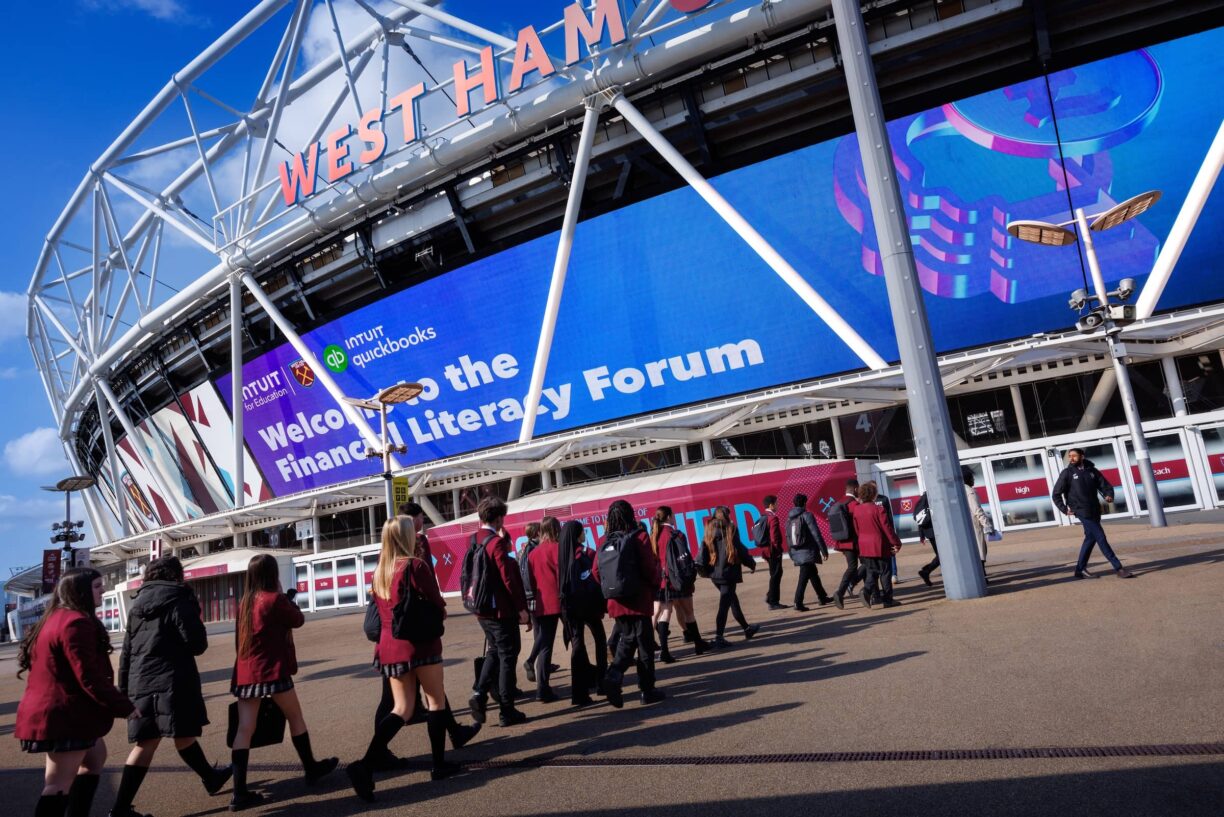
This was not a day of dusty worksheets and polite nodding. Education’s Financial Literacy Forum was built around interaction, movement and problem-solving, the kind of thing that keeps minds switched on and phones, briefly, forgotten.
Held at West Ham United’s home ground on 21 April, the forum aimed squarely at one of the UK’s more stubborn problems: the financial literacy gap. It is not merely an educational blind spot. It is a social one. It narrows opportunity, widens inequality and leaves too many young people learning about money the hard way, which is usually the most expensive method available.
The numbers are not exactly comforting. Only 26 per cent of young adults in the UK say they received any financial education in school. At the same time, appetite for entrepreneurship is clearly there, with 58 per cent of UK adults aged 18 to 34 either interested in starting a business or already running one. Yet only around a third of young adults in England say their secondary school offered guidance on how to start one.
That is quite the contradiction: ambition in abundance, instruction in short supply.
From QuickBooks to campaign strategy
If the point of Education’s Financial Literacy Forum was to make financial education feel tangible, it did not come up short.
Students moved through interactive breakout sessions designed to turn abstract concepts into practical experience. In “The Building Blocks of Business”, they used QuickBooks to run a business simulation, wrestling with the mechanics of making sensible decisions rather than simply hearing about them.
Then came “The Marketing Campaign Showdown”, where pupils stepped into the shoes of business marketers and built social media campaigns to understand what makes content work and how platforms such as Mailchimp help businesses win customers. It was commerce made visible, and that matters. Young people tend to engage faster when they can see where the road leads.
Dave Zasada, global vice president of education and corporate responsibility at Intuit, said: “Financial literacy is a critical life skill and is the key to unlocking opportunities and making decisions that secure a better future.
We are helping students build real-world money skills early on and giving them the confidence to do everything from navigate daily financial decisions to building a business of their own.”
That gets to the point neatly. Financial education is not about turning teenagers into accountants before lunch. It is about giving them enough confidence and competence to avoid obvious traps and recognise genuine opportunities.
Why London Stadium mattered
There was also something smart about the setting. London Stadium is a place usually associated with spectacle, but spectacle can be useful when you are trying to make education memorable.
By bringing Education’s Financial Literacy Forum into an iconic sporting venue, Intuit for Education and the West Ham United Foundation gave the day a sense of scale and occasion. Young people notice when adults make something feel important.
A forum like this, staged in a stadium rather than a classroom, tells them that money management and business skills deserve the same serious billing as sport.
Joseph Lyons, Chief Executive Officer at West Ham United Foundation, said: “At West Ham United Foundation, we are committed to creating opportunities for young people across our communities. Collaborating with Intuit for Education on this event helps us to give students a unique experience while offering access to practical financial skills that will support them both in school and beyond. Days like this help build confidence, broaden horizons and prepare young people with vital skills for the future.”
That phrase, “broaden horizons”, can sound like brochure copy when handled badly. Here, it fits. Because for many students, the biggest barrier is not a lack of talent. It is a lack of access to the sort of information that helps talent breathe.
Anton Ferdinand and Bobby Seagull bring it home
The event also had voices who could speak from experience rather than theory. Renowned educator, author and media personality Bobby Seagull joined the day, as did former West Ham United defender and club ambassador Anton Ferdinand. Both discussed financial education and entrepreneurship, and both brought something more valuable than celebrity sparkle: perspective.
Ferdinand’s contribution, in particular, landed with the force of lived truth.
Anton Ferdinand praised the programme and said: “I wish this was available when I was younger and when I signed my first professional football contract at 17 years old. I didn’t have that financial literacy growing up, I was left to my own devices and at times it was difficult manage at a young age.
“I felt privileged to be part of this forum, as it gave me an opportunity to share with young people what I now know about financial management and share any lessons I have gone through.”
That is the thing about financial literacy. People only call it boring until they do not have it. Then it becomes rather urgent.
Bobby Seagull, meanwhile, picked up on the atmosphere among the students themselves.
Bobby Seagull shared how positive the day was for him: “Speaking to the young people today, I heard how much they were thinking about their future and building those skills to have that financial literacy mindset.
“When I was younger, we didn’t get these opportunities. But pupils today got the chance to speak to experts, to learn from a financial literacy programme and be enthused about personal finance, which is fantastic. I feel optimistic about what is available to young people through Intuit for Education’s brand-new programme.”
Optimism is sometimes thrown around too cheaply. In this case, it seems earned.
A UK launch with serious intent
The arrival of Education’s Financial Literacy Forum in the UK is more than a one-off date on the calendar. It signals Intuit for Education’s broader international expansion and a clear belief that financial capability should not be treated as an optional extra.
Leigh Thomas, Vice President, EMEA at Intuit, added: “Expanding Intuit for Education into the UK is an important milestone for us. With the support of West Ham United, we can reach students in a meaningful way, combining education with real-world application to help them build skills that will be invaluable throughout their lives and help them thrive.”
And there it is: real-world application. Two words that should probably feature more often in education policy and less often in corporate presentations.
Teaching confidence, not just numbers
What made Education’s Financial Literacy Forum work was not simply that it taught pupils about budgets, business tools and marketing. It treated them like future adults rather than present children. That is a subtle difference, but an important one.
Money has a habit of shaping every corner of life, from the obvious decisions to the ones that arrive in disguise. The earlier young people understand that, the better prepared they are to build stability, spot opportunity and avoid being taken for a ride by the fine print.
At London Stadium, the crowd was smaller than on a matchday and the stakes, in some ways, were higher. No trophies were handed out. No one lifted silverware. But 180 students walked into an arena better known for sport and left with something far more durable than a result: a clearer sense of how the world works, and how they might one day shape it themselves.