Domaine Madrona offers a soulful southern France retreat shaped by history, organic farming, quiet luxury and deep connection to land.
Domaine Madrona sits on the slopes below the eastern Pyrenees with the sort of calm assurance that makes most luxury retreats look a bit needy. Near the medieval village of Castelnou, this restored 13th-century farmhouse has emerged from ruin not as some glossy stage set, but as a deeply rooted place to breathe, eat, wander and remember that life need not always be lived at motorway speed.
That is the trick here. Domaine Madrona does not shout. It does not hustle for attention. It simply opens its doors in one of southern France’s most quietly seductive corners and lets the landscape do the talking.
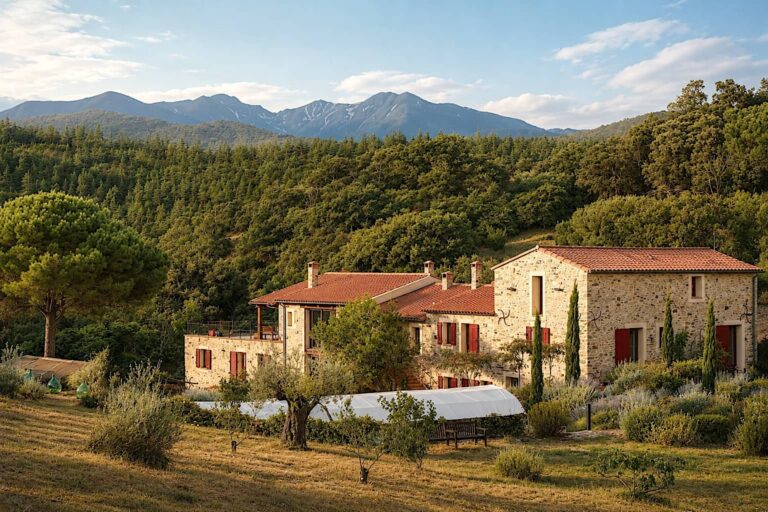
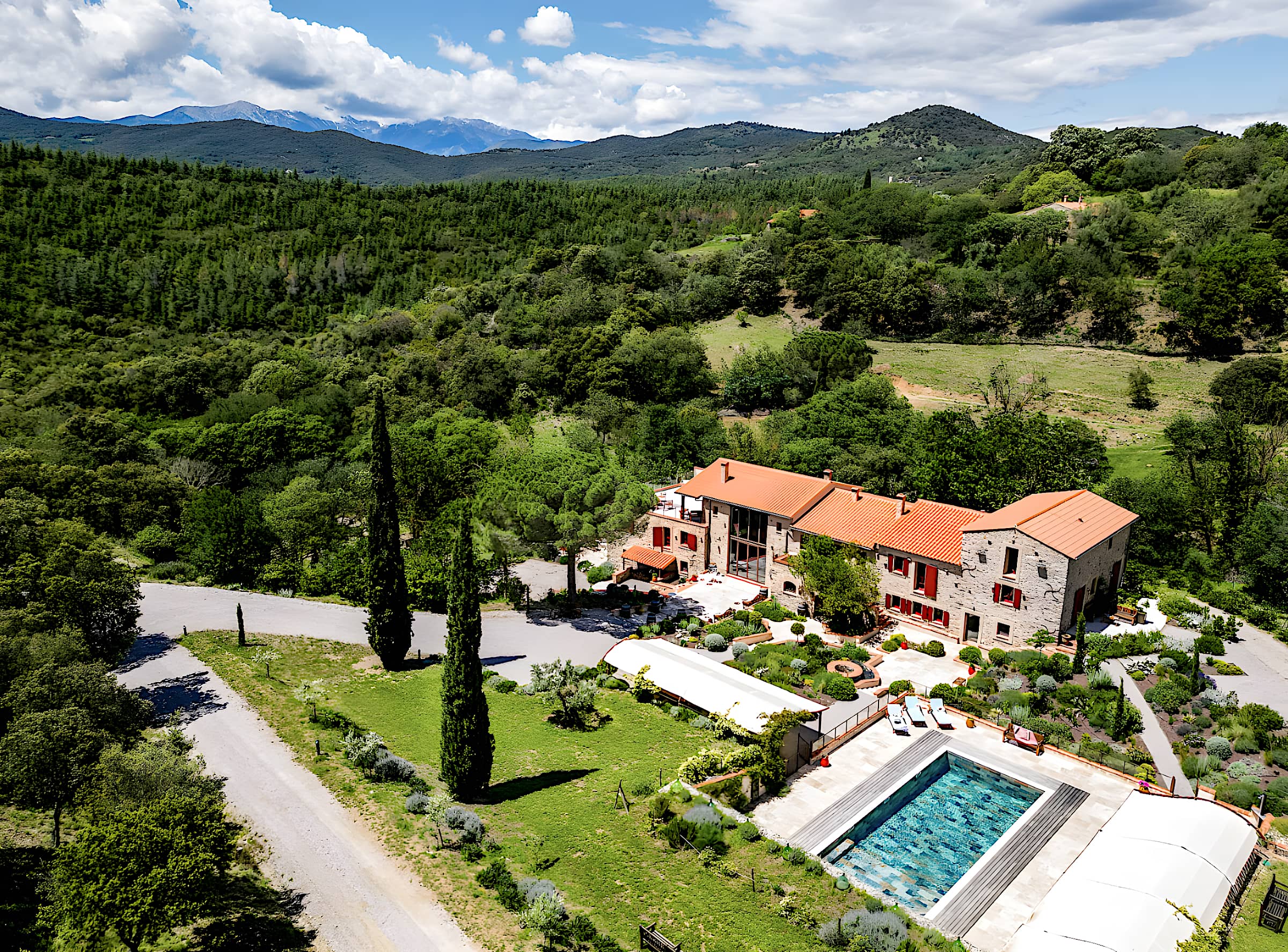
Set within 235 acres of Mediterranean forest, the retreat sleeps up to 22 guests across 10 bedrooms. The rooms are colourful without being precious, comfortable without falling into bland luxury shorthand, and the whole property carries the kind of ease that usually takes years to fake. Here, it comes naturally.
This is not merely a handsome house in the hills. Domaine Madrona forms part of the wider Domaine de Querubi organic olive estate, and that changes the whole rhythm of the stay. Guests are not sealed off from the land. They are drawn into it.
A farmhouse restored with brains, hands and patience
The restoration began in 2017, when Querubi founder Willem Voorvaart and estate manager Holly Hinchcliffe Cooper set about reviving the old farmhouse with the estate’s long-standing team and local craftspeople. It was a four-year labour of care rather than vanity.
Wood and stone from the land were used to restore the original walls, timber beams and traditional Catalan architecture. The result feels neither museum-stiff nor over-designed. It feels lived in, sensible and beautiful in the old-fashioned sense of the word.
There are antiques from local markets, colourful locally made tableware in the cupboards, and a large wooden dining table in the kitchen that all but demands long lunches and longer dinners. Outside, terraces look across rolling hills and forest, while shaded corners, gardens and a panoramic swimming pool provide the sort of backdrop that makes you put your phone down and leave it there.
The place has been designed for togetherness, but cleverly leaves room for silence too. That matters. Not every escape understands that the best luxury is often the freedom to hear yourself think.
And then there is that lovely Catalan notion of pertinença — a sense of belonging, of being exactly where you are meant to be. At Domaine Madrona, it arrives quietly and stays put.
Why this corner of southern France feels different
The region around Domaine Madrona has long been shaped by movement, refuge and cultural overlap. Catalan, French and Spanish influences all run through it, and the land still carries the residue of centuries of pilgrimage and sanctuary.
Nearby, Château de Quéribus stood as one of the last Cathar strongholds in the medieval period, while the domaine itself served as shelter for Cathar pilgrims travelling the hard route from Spain. Today, that legacy survives in a softer form. This is still a place of refuge, only now the travellers arrive with weekend bags rather than worn cloaks and a desperate need for cover.
What makes it especially compelling is that it remains relatively unspoilt. Provence, for all its charms, can now feel like it knows exactly how photogenic it is. The Côte d’Azur, meanwhile, rarely misses a chance to admire itself. This part of the Pyrenees-Orientales has no such vanity. It is wilder, quieter and more grounded.
That is precisely its strength.
The hilltop villages, vineyards and Mediterranean landscapes still feel intact rather than arranged. Farming traditions remain visible. The pace of life has not been ironed flat by tourism. Even the beauty feels less polished and more earned.
Just minutes away lies Castelnou, its name derived from the Catalan Castell Nou – “new castle”, a reference to the medieval fortress still perched above the village. Inside the fortified walls, the streets twist through stone houses and craft shops before opening into a mulberry-shaded square where producers gather during summer to sell food and handmade goods. It sounds idyllic because it is, though thankfully not in a staged or sugary way.
The experience is in the details, not the brochure
Domaine Madrona works because it understands that travel is not only about where you sleep, but how the place enters your bloodstream.
Guests can head out with local guides for walking tours to Cathar strongholds, abbeys such as Saint-Michel de Cuxa and Saint-Martin du Canigou, and medieval villages including Villefranche de Conflent. For those with a bit more appetite for velocity, there are mountain bike trails threading along ancient paths.
Then there is the coast, just 35 minutes away. St-Cyprien Plage offers a long sandy sweep, Plage de Paulilles brings a more dramatic natural bay, and Plage de la Marenda is known for its soft sand and restorative idleness. A little farther on, Collioure delivers one of the loveliest harbour scenes in France, its pastel facades and medieval lanes having once lured artists including Matisse, Picasso and Chagall.
You can still eat the town’s anchovies prepared by hand using centuries-old methods, ideally harbourside and with enough time to forget what day it is.
Back at the house, the tone shifts again. A yoga session. A swim. A cold glass of something local. A dinner built around the produce of the land. No fireworks. No over-programming. Just the increasingly rare pleasure of being somewhere that does not mistake noise for substance.
The soul of Domaine Madrona lies in the soil
Before Domaine Madrona became a retreat, Domaine de Querubi had already spent years proving that patient farming can be both principled and productive.
The project began in 2006 with the planting of 10,000 young olive trees and a clear belief that healthy soil shapes everything above it. Over two decades, that philosophy has guided a regenerative approach to farming without synthetic fertilisers or agricultural chemicals.
The team follows a minimal-intervention model inspired by Masanobu Fukuoka’s ‘do-nothing’ philosophy — no tillage, no fertiliser, no pesticides, no weeding — a philosophy articulated in his 1975 book The One-Straw Revolution.
That respect for natural systems runs through the estate. Vermiculture is used to turn organic matter into nutrient-rich compost, feeding the soil and supporting the long-term health of the trees. Today, Querubi produces small quantities of single-estate extra virgin olive oil from local varieties including Arbequina, Picholine, Verdal and Olivière.
The olives are harvested early, preserving flavour and nutritional value, and the oil is vibrant, herbaceous and chemical-free. Guests at Domaine Madrona are not merely told about this approach. They can walk the groves, watch the farmers at work, feel the living soil in their hands and understand that this is not a decorative sustainability story built for marketing decks. It is daily life.
That matters, particularly now, when so many high-end retreats borrow the language of nature while keeping it safely at arm’s length.
More than a place to stay
There is also a broader significance to Domaine Madrona. The retreat supports the local economy in the Pyrenees-Orientales, one of the least wealthy regions in France, helping keep tourism revenue within the community and nudging travellers beyond the usual polished circuits.
That gives the place a weight many luxury destinations lack. It does not simply extract beauty from the region and sell it back to visitors. It participates in the life of the area.
And that may be what sets Domaine Madrona apart from more famous names across the Mediterranean. Tuscany has its theatre. Provence has its perfume. Mallorca has its easy cachet. But Domaine Madrona offers something less performative and, in the end, more memorable: authenticity without fuss, beauty without strain, and hospitality with real roots in the land beneath it.
By the time the day ends with a meal in the farmhouse kitchen, made with the estate’s own olive oil and shared around that generous wooden table, the place has a way of settling into you.
Not as spectacle. As feeling.
That is rarer than infinity pools and linen napkins. And far more valuable.n